7 Melted Nvidia GPUs in 48 Hours and a 12A Buzzer Alarm: Inside Super Flower's 12+4-Pin OCP Protection Dongle
Pushing 600W through a single compact plug continues to exact a heavy toll on flagship PC builds. Just as prominent Chinese board-level repair technician Zhang the Computer Repairman (known as ?????? on Bilibili and YouTube) documented receiving seven Nvidia graphics cards with melted 12+4-pin power connectors in just 48 hours, Taiwanese power supply manufacturer Super Flower has unveiled an external hardware safeguard: the VGA 12+4Pin OCP Dongle. Installed inline between the power cable and the GPU socket, the module monitors per-pin +12V current in real time to warn users before plastic housings fuse to the graphics card.
Seven Melted RTX 5090 and RTX 4090 Cards in Two Days: Inside the Repair Bench Surge
The latest repair batch filmed on Zhang's workbench underscores that 16-pin connector failures are far from isolated user installation blunders. Across a single two-day window, seven high-end Nvidia GPUs arrived at the shop suffering from identical thermal breakdowns at the 12+4-pin power interface. The lineup consists mostly of GeForce RTX 5090 cards, including an official Nvidia Founders Edition model and a Gainward custom card, alongside GeForce RTX 4090 units from ASUS and MSI.
On several boards, extreme localized heat charred the connector housing and blackened the surrounding PCB. On others, the power cable plug melted completely into the GPU receptacle, forcing owners to snip their PSU wires with cutters just to box up the graphics card for repair. According to the technician, these failures are not coming from budget builds running underpowered PSUs; several units came straight out of heavily loaded laboratory workstations at a time when enthusiasts and board partners are pushing GeForce RTX 50 power envelopes to extreme levels.
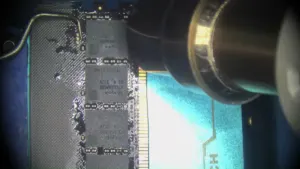
To bring all seven flagships back to life, Zhang desoldered the ruined headers, cleaned the damaged pads, and soldered fresh 12+4-pin sockets onto each PCB before verifying stability in 3DMark stress tests. For owners looking to catch a failing connection before it requires micro-soldering, he recommends two practical checks under load: lightly touching the power cable with the back of a finger roughly one inch (2.5 cm) above the GPU header (it should feel warm, never scorching hot) and monitoring the 12+4-pin voltage rail in GPU-Z. If voltage sags well below 12V under heavy draw, dropping to around 11.3V or 11.4V, contact resistance has already spiked to dangerous levels.
Why 600W Across Six +12V Pins Turns Current Imbalance Into a Meltdown
The underlying vulnerability stems from the electrical layout of the 16-pin standard (both the initial 12VHPWR plug and the updated 12V-2x6 revision defined by PCI-SIG). Aside from four tiny sense pins and six ground lines, the entire 600W power budget travels across just six active +12V pins.
Under an ideal 600W load at 12V (50A total), each of those six +12V pins carries roughly 8.33A. However, because current high-end GPUs lack independent per-pin load balancing on the board itself, minor variations in contact resistance, cable bend tension, or terminal wear cause current to shift unevenly. When one or two pins are forced to carry far more than their rated share of amperage, thermal runaway quickly follows.
Super Flower VGA 12+4Pin OCP Dongle: Per-Pin Monitoring, Buzzer Alerts, and a 195-Second Cutoff
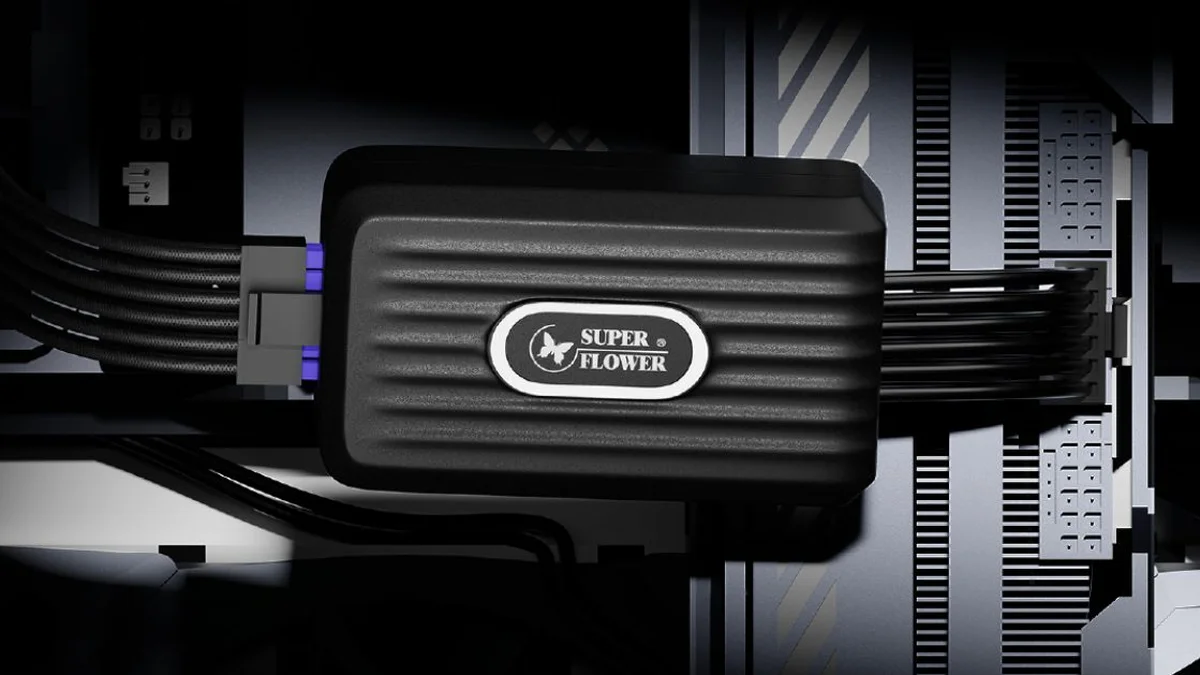
To catch those dangerous current spikes before the connector melts, Super Flower engineered the VGA 12+4Pin OCP Dongle, first spotted in Taiwan by hardware leaker Uniko's Hardware. Measuring 321 x 55 x 32 mm in a solid black enclosure with clearly marked PSU input and VGA output ports, the adapter pairs ARGB lighting with an integrated audible buzzer to track current across every +12V line.
Super Flower's Over Current Alert System evaluates current feedback over a sustained 10-second window across four distinct operating states:
- Normal Operation (< 9.5A per pin): When current stays below 9.5A for 10 seconds, the LED indicator cycles smoothly through its standard ARGB colors with the buzzer silent.
- Moderate Overcurrent Warning (9.5A to 12A): If any pin draws between 9.5A and 12A for 10 seconds, the LED turns orange and the buzzer emits rapid short beeps until the load drops back to normal levels.
- Inter-Pin Load Imbalance (> 6A delta): If the current difference between any two +12V lines exceeds 6A for 10 seconds, the dongle likewise triggers an orange LED and rapid short beeps to warn of uneven current distribution.
- Critical Overcurrent (> 12A) and VGA Black Screen Protection: If any pin exceeds 12A for 10 seconds, the LED flashes red and the buzzer sounds a continuous tone for 180 seconds (3 minutes). After 180 seconds, the LED turns solid red for an additional 15 seconds (195 seconds total) before triggering VGA Black Screen Protection to give you time to shut down the system. Even if current drops back down during that sequence, the warning state and black screen lock remain active until the PC is powered off and the cables are inspected.
For now, the Super Flower VGA 12+4Pin OCP Dongle is offered in Taiwan bundled with select Super Flower power supplies. It joins a growing wave of third-party and PSU-side safety solutions, including Cooler Master's GPU Shield Adapter Cable and MSI's GPU Safeguard+ power supplies.
Check Availability of ATX 3.1 (12V-2x6) Power Supplies on Amazon→
My Test Bench: An Audible Band-Aid Over a Board-Level Engineering Flaw
From an electrical engineering standpoint, I appreciate that Super Flower is monitoring not just absolute 12A spikes on a single pin, but also a 6A delta between any two +12V lines. Catching pin-to-pin current drift is the exact mechanism needed to stop a connector from cooking itself. Still, as someone who builds and stress-tests high-wattage rigs, the fact that this market of external alarm boxes even needs to exist is frustrating.
When PC builders spend $2,000 or more on a flagship graphics card, they should not have to hang a bulky ARGB buzzer brick off their power connector just to sleep soundly. Shunt resistors and active per-pin load balancing belong directly on the GPU PCB itself, rather than shifting the burden onto PSU makers and users at a time when Nvidia's upcoming GPU roadmap is already raising tough questions for PC gamers.

PC hardware enthusiast and competitive gamer, Arthur 'Heimdall' splits his time between France and the UK working in enterprise B2B software solutions. A business school graduate passionate about component benchmarking, he has been building, modding, and tuning PCs since childhood, optimizing every thermal degree and millisecond of display latency. An avid gamer across Assassin's Creed and sandbox titles, he forged his alliance with Grimtag and Chaya during late-night World of Warcraft raids before joining Pro-Gamer.