$175 Instead of $1,000: How a Modder Turned Laptop DDR5 SODIMMs Into a 7,800 MT/s Desktop RAM Kit
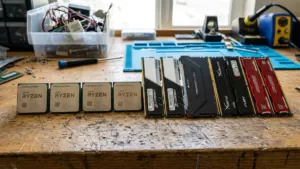
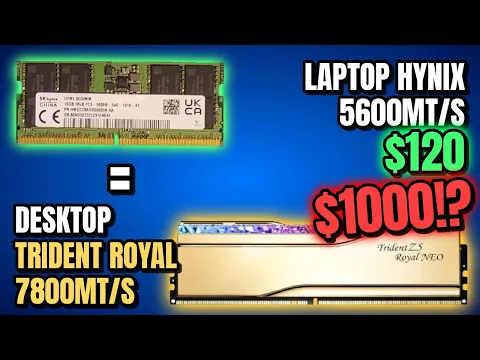
As the ongoing 2026 DDR5 RAM shortage pushes standard 32GB DDR5-6000 kits toward $450 and drives flagship high-frequency memory close to the $1,000 mark, hardware modders are firing up their hot air stations to fight back. BGA micro-soldering specialist Blighted Agent just pulled off a remarkable transplant: converting a used $120 laptop DDR5 SODIMM kit into a full-sized 32GB DDR5-7800 desktop memory kit.
A $120 Marketplace Score Packing High-Bin SK hynix A-Die Chips
The project started with a rare bargain on Facebook Marketplace: two used 16GB SK hynix DDR5-5600 SODIMM laptop sticks (exact part number HMCG78AGBSA095N AA, single-rank 1Rx8 PC5-5600B-SA0-1010-XT) picked up for just $120, at a time when comparable used 32GB laptop kits routinely list for $320 or more on eBay in the United States.
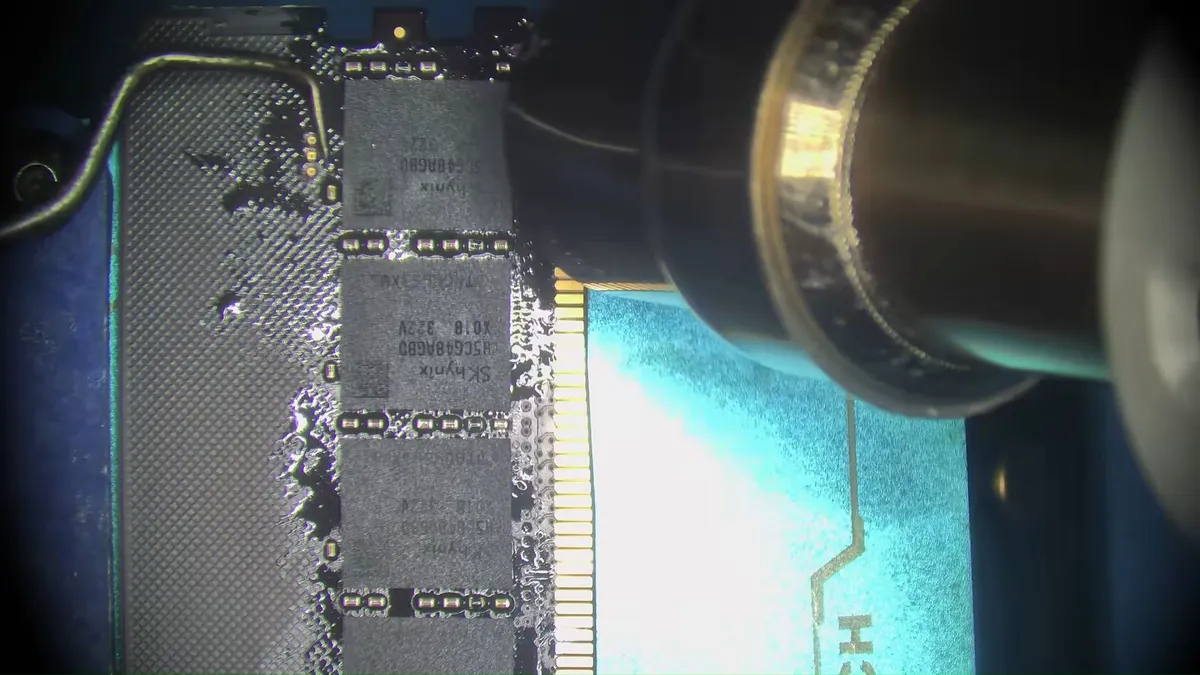
The real prize hidden inside those compact laptop modules becomes clear under a microscope: they are populated with sixteen SK hynix A-die memory ICs carrying the H5CG48AGBD X018 marking. Those are the exact same enthusiast-grade chips found inside ultra-expensive flagship desktop memory kits such as the G.Skill Trident Z5 Royal Neo series.
To bring those chips to a desktop motherboard, the modder ordered two blank desktop DDR5 UDIMM PCBs from AliExpress for roughly $16 each, along with a pair of gold-and-silver metallic heatspreaders with crystalline light bars for $18. Factoring in solder balls, flux, and small donor components, the entire bill of materials came out to $175.
Check Availability DDR5 SODIMM Laptop RAM Availability on Amazon→
0.45mm BGA Reballing and Transplanting the SPD Hub Under the Microscope
Needless to say, this is far beyond weekend PC building. Blighted Agent, who has previously doubled the VRAM capacity on several graphics cards through BGA rework, began by lifting all sixteen memory ICs off the donor SODIMM sticks using a hot air station.
Each H5CG48AGBD chip was then wicked clean and mounted into a reballing jig with a dedicated DDR5 stencil to apply fresh 0.45mm leaded solder balls across the entire BGA grid.
After prepping the pads on the blank desktop PCBs over a bottom preheater, the memory chips were aligned in flux and reflowed with hot air. Watching through the microscope, the modder gently nudged each IC with a dental pick until surface tension snapped the molten solder balls cleanly into alignment.
Finally, the SPD Hub chip and BIOS EEPROM from the donor laptop sticks were transplanted onto the new desktop PCBs so the motherboard could read the module profiles, before fresh thermal pads and the metallic heatspreaders were clamped on.
DDR5-7800 CL38 at 1.41V: Stress-Tested on the ASUS ROG Maximus Z790 Apex Encore
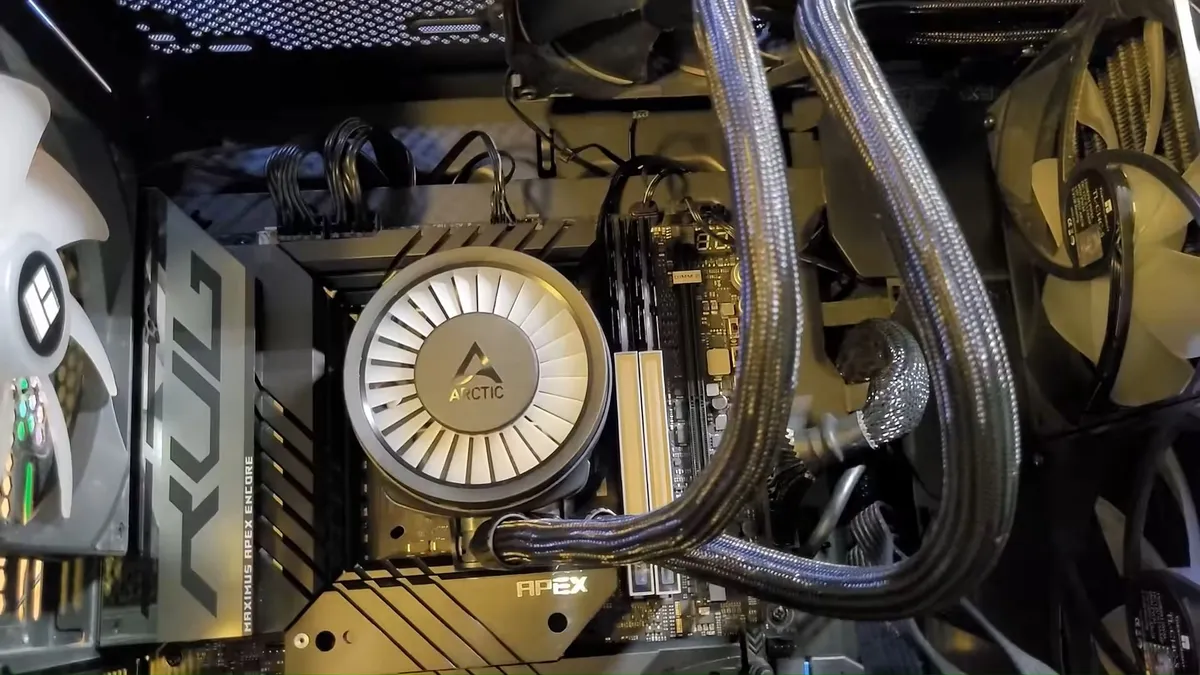
Installed into an overclocking-focused ASUS ROG Maximus Z790 Apex Encore motherboard cooled by an Arctic AIO liquid cooler, both custom DIMMs posted on the very first attempt, registering cleanly in the BIOS as two SK Hynix 16384 MB 5600 MHz modules.
While board partners are pushing four-slot density records such as the Colorful iGame X870E ULTRA-S running 192GB of DDR5-6600 CL28, the goal here was pure two-slot frequency headroom. With manual tuning, the 32GB (2x 16GB) kit locked in rock-solid operation at DDR5-7800 MT/s (reported as 3,900 MHz DRAM frequency in CPU-Z with the memory controller running at 1,950 MHz).
Telemetry captured across CPU-Z, HWiNFO64, and TestMem5 highlights just how well the transplanted SK hynix A-die chips perform:
- Frequency and Primary Timings: DDR5-7800 (3,900 MHz DRAM) at CL38-50-50-120 (
tRC 170,Command Rate 2T). - Operating Voltages: Set to 1.40V in BIOS (reading 1.410V under load on both VDD and VDDQ, with 1.815V on VPP).
- Thermal Performance: SPD Hub temperatures averaged 49.4°C and 51.9°C under sustained load, peaking at just 51.0°C and 53.5°C inside the aftermarket heatspreaders.
- Stability Validation: Completed 1 hour and 31 minutes (31 full cycles across 26,112 MB tested) of TestMem5 v0.13.1 using the demanding
anta777profile with zero errors.
Check Availability 32GB DDR5 Desktop RAM Kit Availability on Amazon→
My Test Bench Take: Why Direct BGA Transplanting Crushes Passive Adapters Yet Remains a High-Stakes Gamble
When chasing tighter 1% low frametimes in memory-bound competitive shooters, builders sometimes look at cheap $10 mechanical SODIMM-to-UDIMM adapter cards. In my experience on the test bench, those passive risers add extra trace length and signal reflection that severely cripple high-frequency DDR5 training, often struggling to stay stable even at baseline JEDEC speeds.
By soldering the SK hynix A-die packages directly onto a dedicated multi-layer desktop PCB, Blighted Agent (much like Russian modder VIK-on demonstrated earlier this year when flashing custom 6,400 MT/s XMP firmware onto rebuilt sticks) preserves full signal integrity. Holding 7,800 MT/s CL38 at 1.41V while keeping the SPD Hub under 54°C across 31 passes of TestMem5 anta777 delivers the exact electrical behavior of a flagship retail kit costing four to five times as much.
Still, the margin for error is brutal. Unlike GPU VRAM mods where diagnostic software pinpoints the exact failing memory channel on screen, desktop RAM gives you zero per-chip telemetry if a stick fails to POST. Without factory memory testers, a single bridged or cold 0.45mm BGA ball across sixteen chips turns a $175 triumph into hours of blind desoldering.

PC hardware enthusiast and competitive gamer, Arthur 'Heimdall' splits his time between France and the UK working in enterprise B2B software solutions. A business school graduate passionate about component benchmarking, he has been building, modding, and tuning PCs since childhood, optimizing every thermal degree and millisecond of display latency. An avid gamer across Assassin's Creed and sandbox titles, he forged his alliance with Grimtag and Chaya during late-night World of Warcraft raids before joining Pro-Gamer.