After Standing Unbroken for 12 Years: A 6.3 GHz Intel Core i5-4670K Under Liquid Nitrogen Just Toppled a Cinebench World Record
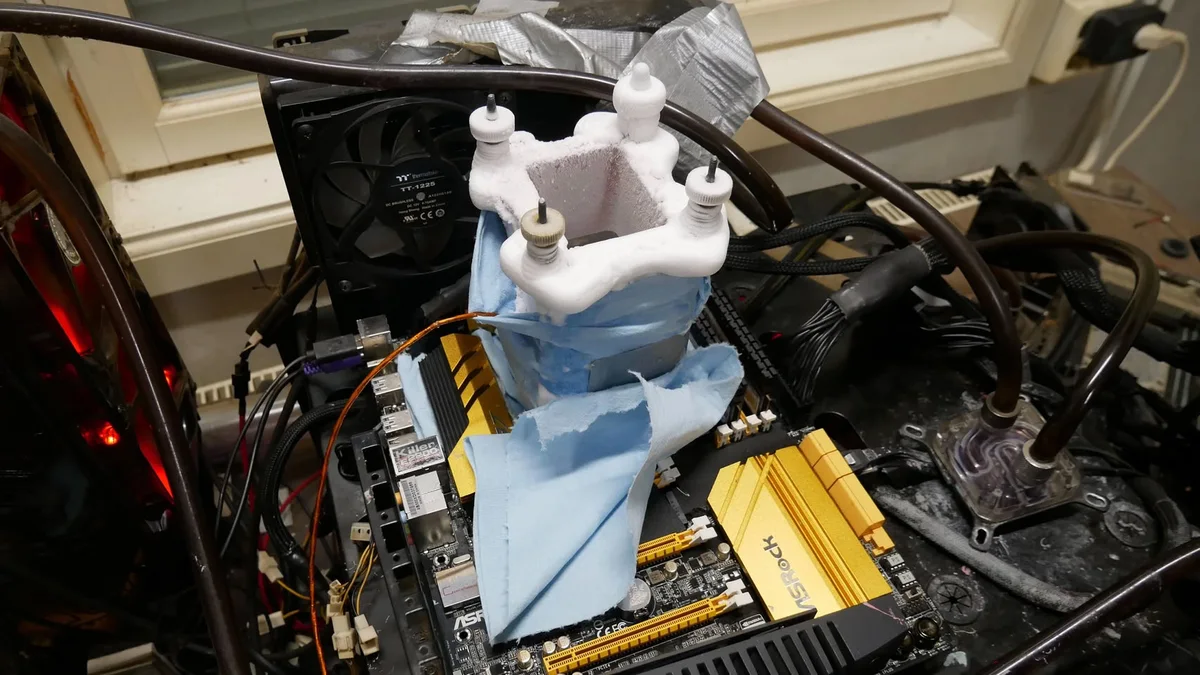
After standing untouched at the top of the extreme overclocking leaderboards for twelve straight years, the four-core Cinebench R11.5 world record for Intel's Core i5-4670K has finally been shattered. Armed with a liquid nitrogen pot and an ASRock Z97 OC Formula motherboard, renowned Finnish overclocker Luumi pushed the 2013 Haswell processor to 6,301.18 MHz to claim a verified 10.80-point score on HWBot.
6,301.18 MHz at 1.711V Under Liquid Nitrogen: How Luumi Toppled an October 2014 Milestone
Released by Intel in June 2013, the Core i5-4670K was the go-to gaming processor for an entire generation of PC builders: fabricated on a 22nm Haswell process for the LGA 1150 socket, the chip packs 4 physical cores and 4 threads (without Hyper-Threading), 6MB of L3 cache, and an 84W TDP, shipping with a 3.4 GHz base clock and a 3.8 GHz Turbo boost. Since October 2014, the global top spot for this specific CPU in Maxon's multi-threaded Cinebench R11.5 benchmark had belonged to overclocker Strat, whose 10.76-point run at roughly 6,249 MHz withstood every challenger for more than a decade.
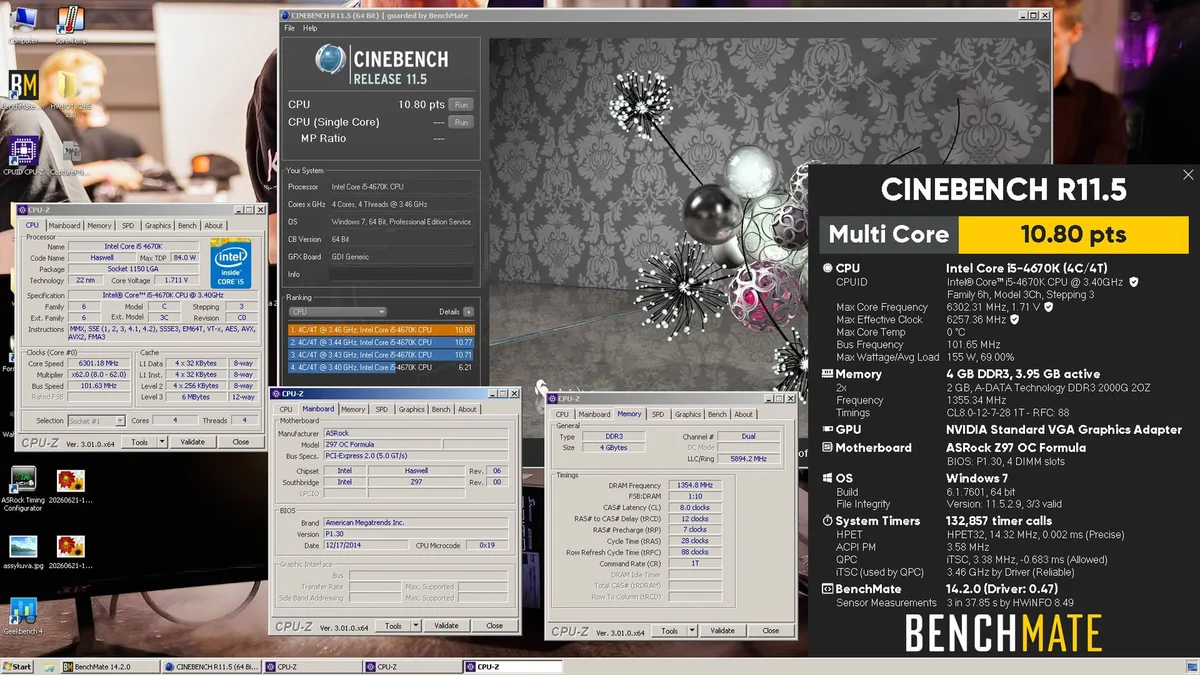
Twelve years later, official submission HWBot #6081541 by Finnish extreme overclocker Luumi officially rewrote the leaderboard. By dropping the delidded silicon well below -180°C using liquid nitrogen (LN2) cooling, Luumi kept all four Haswell cores rock-solid at 6,301.18 MHz (reaching a peak clock of 6,302.31 MHz) across the entire 3D rendering workload. That represents an 85% frequency jump over Intel's 3.4 GHz base specification (+66% above stock Boost), dialed in via a 62.0x multiplier, a 101.63 MHz base clock (BCLK), and a 1.711V core voltage (Vcore). The result is a benchmark score of 10.80 points (10.8 cb), securing first place out of 359 Core i5-4670K submissions and #28 overall among all quad-core processors ever tested in Cinebench R11.5.
Check Availability for Intel Core Unlocked CPUs on Amazon→
5.9 GHz Uncore and DDR3 at CL8-12-7-28 1T: Inside the ASRock Z97 OC Formula Testbed
On Intel's Haswell architecture, raw core clock alone is never enough to topple a twelve-year-old world record if the internal ring interconnect and memory subsystem cannot feed the execution engines fast enough. In stark contrast to modern platforms where motherboard engineers focus on stabilizing massive 192GB DDR5 kits at high transfer rates, legacy extreme benchmarking revolves around ultra-low-latency small-capacity DIMMs. To keep the 6MB L3 cache saturated, Luumi pushed the Uncore (NB / Ring Bus) frequency to 5,894.2 MHz (nearly 5.9 GHz at a 58x ratio), running within 400 MHz of the actual CPU cores.
The entire setup was anchored by the iconic ASRock Z97 OC Formula motherboard running BIOS P1.30, a board purpose-built for sub-zero memory and CPU tuning. For system memory, Luumi paired the processor with 4GB of XPG DDR3 in dual-channel clocked at 2,708 MT/s (1,354.6 MHz actual clock, 1:10 FSB:DRAM ratio) using razor-sharp timings of CL8-12-7-28 at 1T Command Rate and a tightened row refresh cycle time (tRFC) of just 88 clocks.
- Processor: Intel Core i5-4670K (22nm Haswell, 4 cores / 4 threads) clocked at 6,301.18 MHz (62.0x multiplier, 101.63 MHz BCLK, 1.711V Vcore) under liquid nitrogen (LN2).
- Uncore (Ring Bus) Clock: 5,894.2 MHz (58.0x multiplier) to maximize L3 cache bandwidth during rendering.
- Motherboard & Memory: ASRock Z97 OC Formula (BIOS P1.30) with 4GB XPG DDR3 Dual-Channel at 2,708 MT/s (1,354.6 MHz) timed at 8-12-7-28 1T (tRFC 88).
- Power, Storage & OS: Corsair AXi 1600W power supply, Corsair Force GT SATA SSD, and a stripped-down Windows 7 Professional 64-bit installation.
Why Windows 7 and Cinebench R11.5 Remain the Ultimate Proving Ground for Haswell Silicon
While booting into Windows 7 Professional 64-bit to run Cinebench R11.5 might look unusual in 2026, both choices are essential for competitive parity on HWBot's legacy leaderboards. Unlike newer iterations such as Cinebench R23 or Cinebench 2024, Cinebench R11.5 was the premier multi-core rendering benchmark during the Sandy Bridge, Ivy Bridge, and Haswell eras. Running a lightweight Windows 7 image stripped of background telemetry and later microcode mitigations ensures zero instructions-per-clock (IPC) overhead, funneling every last cycle into Maxon's rendering buckets.
This milestone is part of a broader LGA 1150 liquid nitrogen campaign documented on Luumi's official YouTube channel, where he has been binning and delidding retail Haswell chips to bypass Intel's original internal thermal paste and push past sub-zero cold bugs below -180°C.
Check Availability for Thermal Grizzly Kryonaut on Amazon→
My Benchmark Take: What stands out to me most in Luumi's HWBot #6081541 validation isn't just the 6,301.18 MHz core clock at 1.711V, but the sheer balance of the entire Z97 subsystem. Anyone who tuned a retail Core i5-4670K back in 2013 remembers how Haswell's integrated voltage regulator (FIVR) and factory thermal paste turned voltage scaling into a thermal wall. Watching a delidded chip complete a full multi-threaded Cinebench R11.5 pass twelve years later with a 5,894.2 MHz Uncore clock and dual-channel DDR3 running 2,708 MT/s at CL8-12-7-28 1T on the ASRock Z97 OC Formula is a masterclass in silicon binning and sub-timing optimization to claim those extra 0.04 points that stood unbeaten since 2014.

PC hardware enthusiast and competitive gamer, Arthur 'Heimdall' splits his time between France and the UK working in enterprise B2B software solutions. A business school graduate passionate about component benchmarking, he has been building, modding, and tuning PCs since childhood, optimizing every thermal degree and millisecond of display latency. An avid gamer across Assassin's Creed and sandbox titles, he forged his alliance with Grimtag and Chaya during late-night World of Warcraft raids before joining Pro-Gamer.