Generation Super Sampling Patent: How Sony’s Predictive AI Reads DualSense Inputs to Generate Frames Without Latency
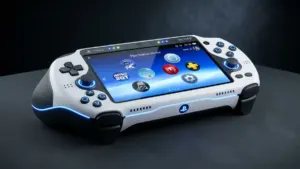
The fundamental flaw of modern AI frame generation has always come down to a single trade-off: input latency. Because existing frame generation pipelines rely on interpolation, the graphics processor must hold back an already rendered frame in order to synthesize an intermediate image between two completed frames. Now, a newly published patent from Sony Interactive Entertainment (SIE) outlines a radically different neural architecture. Titled "Generation Super Sampling" and published by the United States Patent and Trademark Office (USPTO) on October 15, 2026 under publication number US 2026/0320740 A1, the filing by Sony engineer Denis Dupeyron details a predictive AI model that reads live controller inputs to extrapolate upcoming frames ahead of the GPU.
From Passive Interpolation to Predictive Extrapolation: Inside US 2026/0320740 A1
To understand why US 2026/0320740 A1 represents a major architectural departure, it helps to examine how current frame generation works on PC and consoles. Solutions such as NVIDIA DLSS 3 Frame Generation and AMD FSR 3 wait for the GPU to render frame N and frame N+1, temporarily delaying the display of frame N+1 so an optical-flow and neural pipeline can insert a synthetic frame N+0.5 between them. While perceived motion smoothness increases dramatically, input-to-photon latency inevitably climbs because the newest real frame is held in a buffer.
The system designed by Denis Dupeyron at Sony Interactive Entertainment flips that timeline by shifting from interpolation to forward extrapolation. Instead of waiting for two completed GPU frames, Sony’s pipeline takes a single newly rendered frame and immediately predicts the upcoming frame so it can be sent to the display while the GPU is still busy rendering the next true frame in the background. This engineering push builds naturally on the rollout of QSSR and PSSR neural upscaling across the PlayStation 5 ecosystem, addressing frame pacing and responsiveness simultaneously.
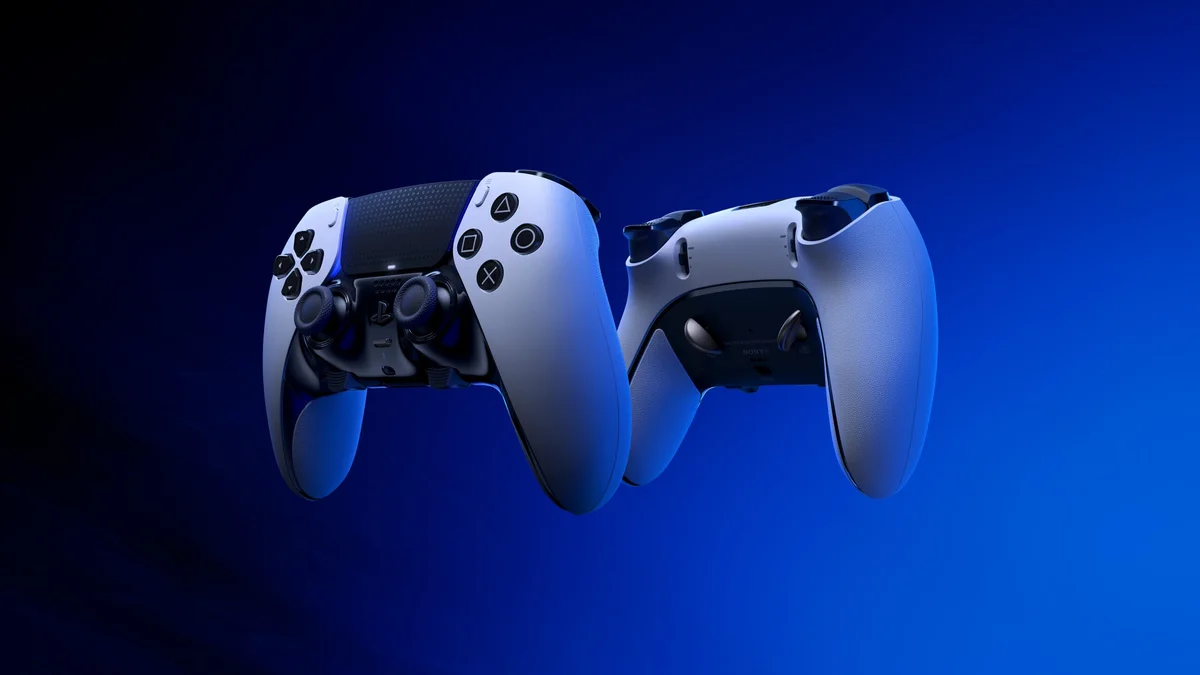
How Live DualSense Stick and Trigger Inputs Guide the Encoder-Decoder Network
In real-time graphics research, pure frame extrapolation has historically struggled with one major obstacle: sudden player movement. Whenever a player snaps the right analog stick to whip the camera around or triggers a split-second dodge, a neural network that only inspects past frames cannot anticipate the sudden directional change, resulting in severe disocclusion artifacts and edge warping.
Sony’s Generation Super Sampling patent solves this blind spot by pairing visual data with hardware telemetry inside a two-stage neural network:
- An Encoder Network: compresses the freshly rendered GPU frame into a compact, low-dimensional numerical representation known as a latent embedding.
- A Decoder Network: ingests that compact embedding alongside engine motion vectors and the player’s most recent controller inputs (analog joystick deflection angles, adaptive trigger pressure, and button presses) to predict and synthesize the upcoming frame.
Because electrical controller signals register several milliseconds before the game engine finishes translating them into 3D camera transformations and rasterized pixels, feeding DualSense telemetry directly into the decoder gives the AI model advance notice of where the viewport is heading. That tight hardware-software integration aligns closely with Sony’s recent DualSense 2.0 hardware patents for the PlayStation 6, turning the controller itself into a predictive sensor for the rendering pipeline.
Check Availability on Amazon (DualSense Wireless Controller)→
Multi-Frame Prediction, Hardware Fallback, and the Road to PlayStation 6
Beyond controller-guided inference, the USPTO filing details three practical mechanisms designed to keep real-time console rendering rock-solid under heavy workloads:
- Multi-Frame Prediction: using a single encoded frame embedding and continuous controller state updates, the decoder can forecast multiple consecutive frames ahead when the GPU encounters demanding ray-traced scenes.
- Non-AI Motion Vector Fallback: if neural processing units are saturated or prediction confidence drops below a set threshold, the pipeline includes a deterministic fallback that shifts pixel blocks directly using engine motion vectors.
- Self-Supervised Training on Gameplay Streams: rather than requiring human-labeled datasets, the neural network trains directly on video streams by comparing its predicted frame against the actual GPU-rendered frame as soon as it finishes rendering, automatically updating its weights to minimize error.
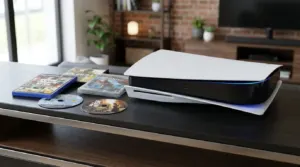
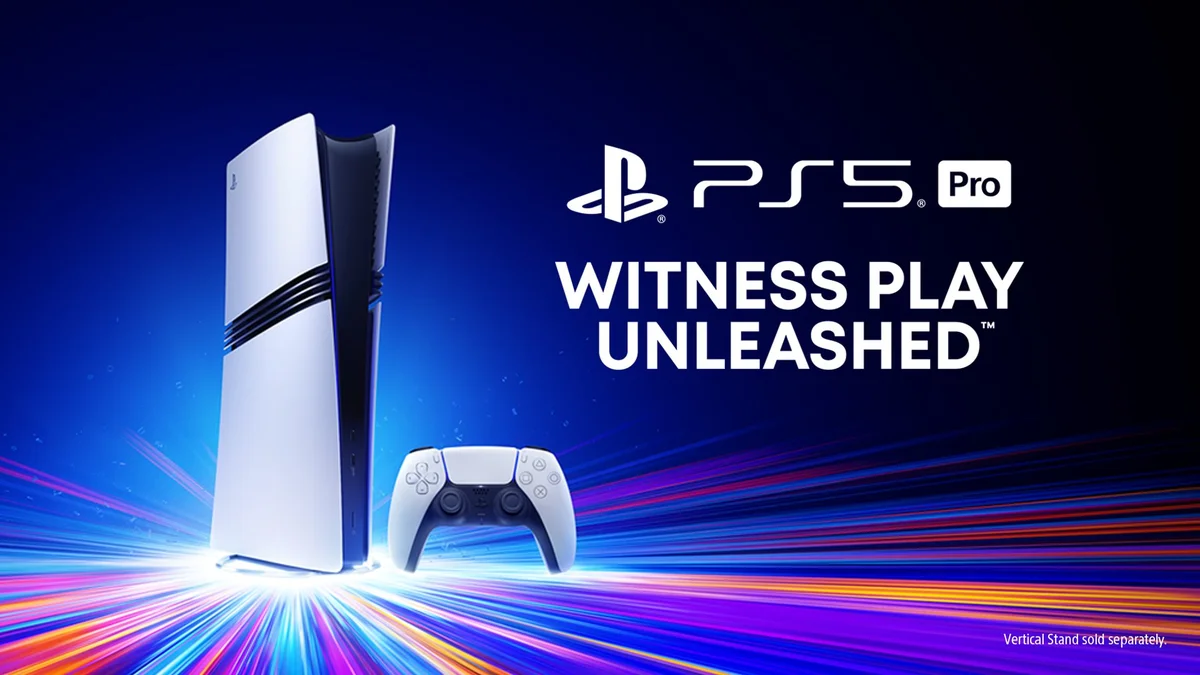
While a patent application does not guarantee immediate commercial deployment, the architecture fits squarely into the long-term roadmap established by lead architect Mark Cerny and AMD under Project Amethyst. Having introduced custom machine-learning upscaling with PlayStation Spectral Super Resolution (PSSR) on the PlayStation 5 Pro, Sony Interactive Entertainment is clearly laying the neural groundwork for a future PlayStation 6 capable of boosting frame rates without sacrificing controller responsiveness.
Check Availability on Amazon (PlayStation 5 Pro)→
My Perspective: Why Controller-Guided Extrapolation Is the Missing Link in Neural Rendering
Looking at this architecture from a deep learning and real-time rendering standpoint, I find Denis Dupeyron’s filing to be one of the most pragmatic neural graphics patents to surface in recent years. Up to now, GPU makers have largely treated frame generation as a passive video-processing problem: look at two finished frames and guess what happened in between. Yet a video game is not a passive movie stream; it is a closed-loop interactive simulation driven by human hands.
In my view, conditioning the latent decoder on live DualSense telemetry changes the mathematical foundation of frame synthesis. Instead of treating a sudden camera pan as an unpredictable visual anomaly, the neural network receives the causal input signal the exact millisecond the player’s thumb moves the analog stick. If Sony and AMD can execute this encoder-decoder pass within a sub-two-millisecond budget on next-generation matrix hardware, the wall between synthetic smoothness and competitive responsiveness could finally come down.

Based on the outskirts of New York City, Chaya 'Chayane' spent five years studying software engineering in Montreal before returning to her home state. A Full-Stack developer and Deep Learning AI architecture researcher, she explores neural networks and algorithmic optimization while engineering data pipelines for Retrocharting and Gamescharting alongside Grimtag. A gamer for over 20 years and an avid collector of Nintendo history and The Legend of Zelda, she explored World of Warcraft's Azeroth before bringing her deep technical background to video game analysis.