576 GPUs Fused via Co-Packaged Optics and 15 Exaflops: How NVIDIA Turns a Rubin Ultra NVL576 Rack Into One Giant GPU
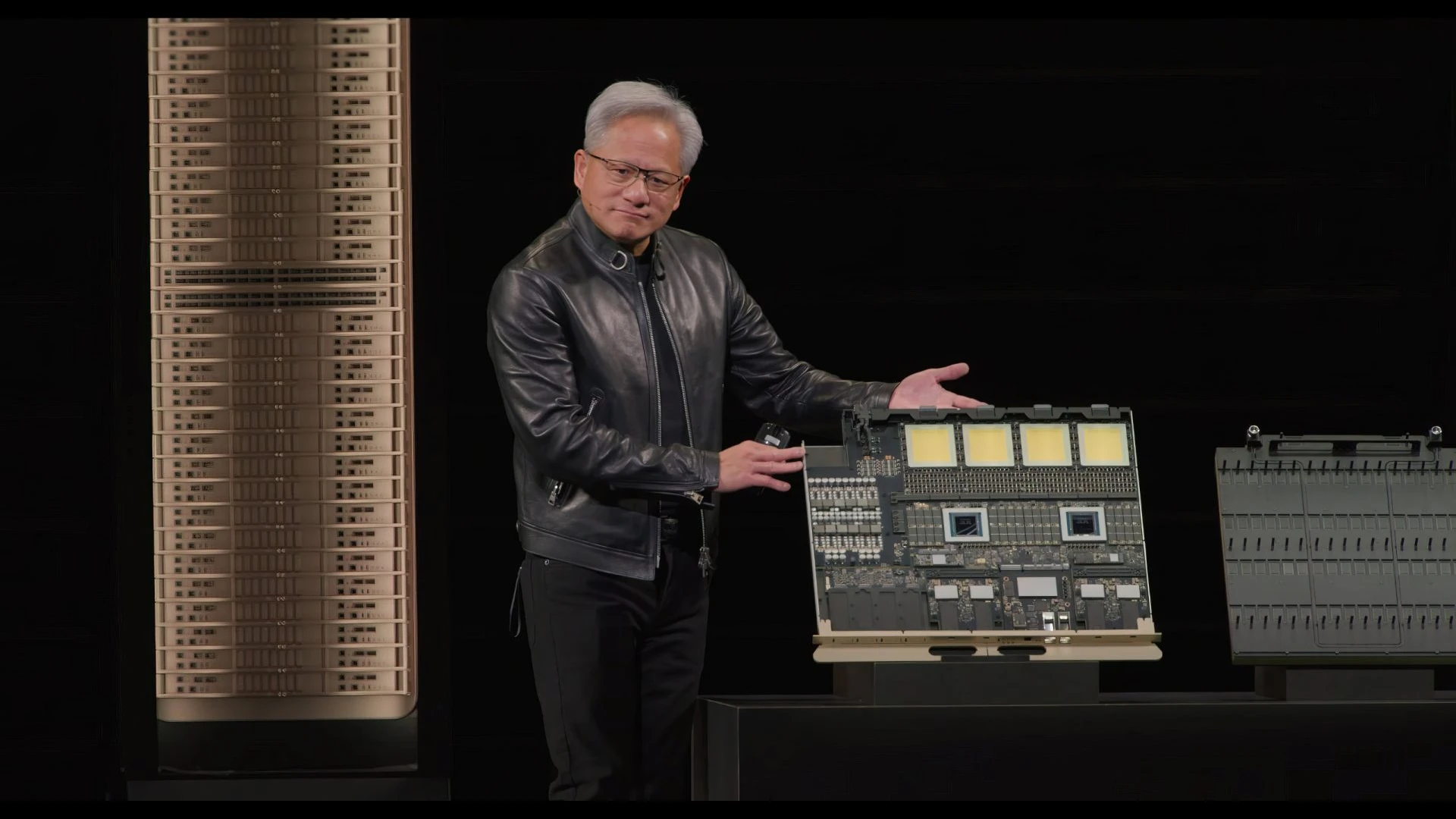
Making 576 Rubin Ultra graphics processors operate as a single, unified giant GPU is the engineering milestone NVIDIA showcased during the Open Compute Project (OCP) Global Summit. By replacing traditional copper traces with Co-Packaged Optics (CPO) paired with NVLink 7 interconnects inside its fully liquid-cooled Kyber rack chassis, the Santa Clara chipmaker is preparing a 2027 platform capable of delivering 15 Exaflops of FP4 inference compute to train and run next-generation AI models exceeding 10 trillion parameters.
From Oberon NVL72 to the Kyber NVL576 Rack: 576 Chips in a Single Cohesive Domain
Until now, NVIDIA's flagship rack-scale systems relied on the Oberon NVL72 enclosure, engineered to link 72 graphics accelerators inside a single server cabinet, a form factor that the initial Vera Rubin "VR200" generation will still retain. For its successor, dubbed Vera Rubin Ultra NVL576 and slated for deployment next year, NVIDIA's hardware architects are scaling up dramatically with the new Kyber rack design, a fully liquid-cooled infrastructure built around modular Open Compute Project (OCP) standards.
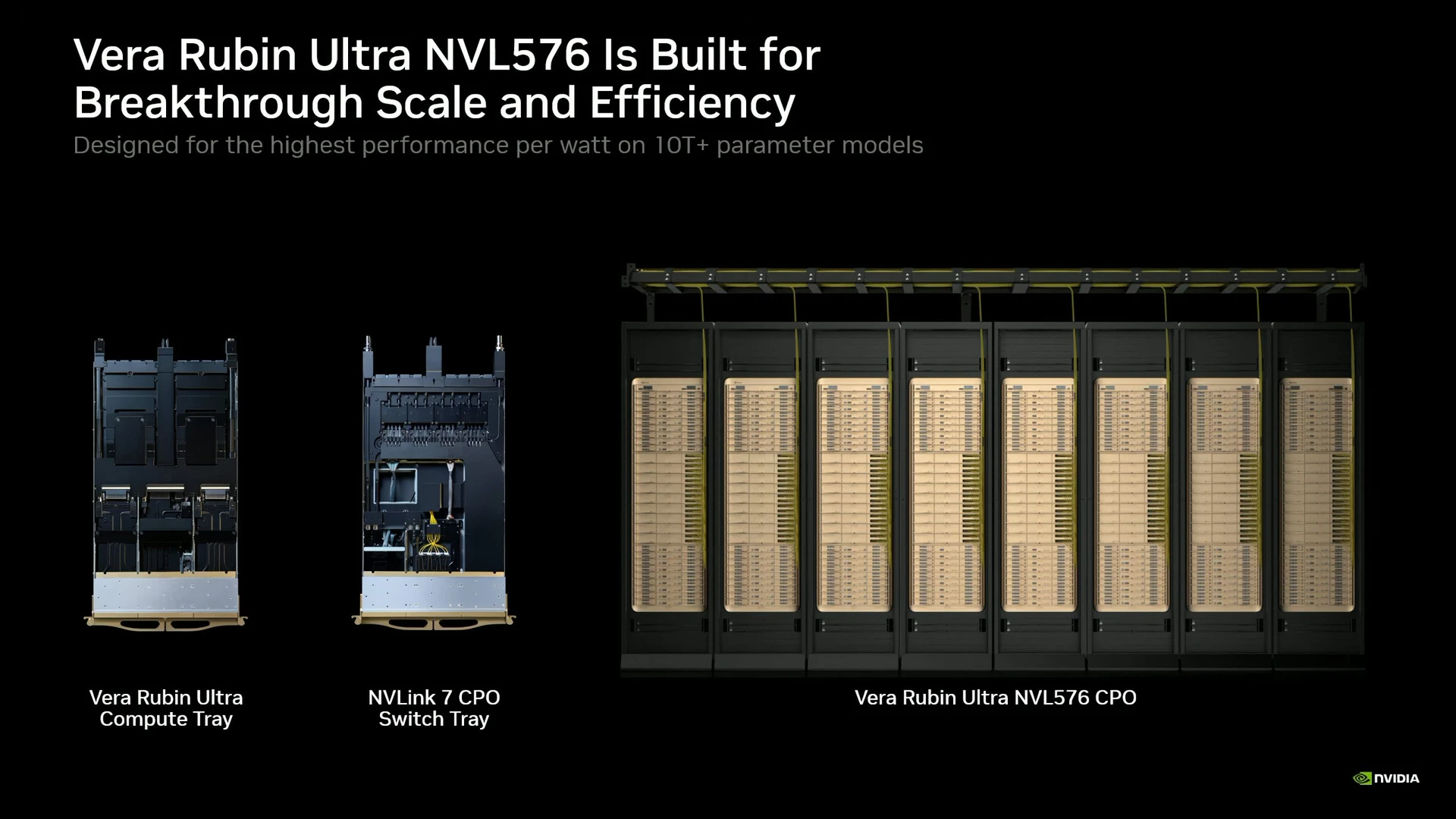
During his technical presentation at the OCP Global Summit, Ian Buck, Vice President and General Manager of Hyperscale and High-Performance Computing (HPC) at NVIDIA, offered a first physical look at the hardware trays powering this platform. Each Vera Rubin Ultra Compute Tray houses two Rubin Ultra GPUs alongside a single Vera CPU featuring 88 custom Olympus ARM cores, all cooled via direct-to-chip liquid plates. Rather than stringing separate server nodes together over conventional network fabrics prone to latency bottlenecks, the Kyber architecture scales the unified NVLink domain eightfold compared to NVL72, binding 576 GPUs into one seamless compute fabric.
"We're already working on the next generation. Here's a sneak peek of Vera Rubin Ultra. This actually is not 72 GPUs in a single rack, but actually 576 GPUs that are all NVLink connected. This is using our next generation NVLink CPO switch tray, and I have a picture of it here, along with our next generation Vera Rubin tray. This is all based on the OCP standards and it's actually going to be connecting all of those GPUs and all of those individual racks together with CPO networking to build one giant 576 GPUs all connected with NVLink. There's little yellow fibers there connecting those optical engines. This will be the highest performance per watt NVLink giant GPU on the planet, and is designed to take us to 10 trillion parameter models to enjoy when we get there next year."
Ian Buck, Vice President and General Manager of Hyperscale and HPC at NVIDIA (OCP Global Summit)
Why Co-Packaged Optics (CPO) Replaces Copper at the Petabyte Scale
Understanding NVIDIA's transition to Co-Packaged Optics requires looking at the physical wall facing electrical copper interconnects. As data transfer rates climb into multiple terabits per second per package, passive copper traces suffer severe signal attenuation beyond a few feet while consuming massive amounts of power for signal retiming. To link 576 multi-die accelerators across adjacent racks without losing the low-latency memory coherency of a single GPU, photons have to replace electrons.
Inside the NVLink 7 CPO Switch Tray shown by Ian Buck, silicon photonics optical engines are mounted directly next to the switch ASICs. Bundles of yellow optical fibers route light signals across the backplane, pushing aggregate NVLink 7 scale-up bandwidth to 1.5 PB/s (petabytes per second) per rack, complemented by ConnectX-9 Spectrum networking processors delivering 115.2 TB/s. Meanwhile, NVIDIA CEO Jensen Huang confirmed during GTC Berlin that CPO switch racks have officially entered volume production, dismissing industry rumors of optical packaging delays as NVIDIA competes head-on with AMD's massive Helion rack architecture packing up to 32,768 Zen 6 cores.
4-Reticle GPU Packages, 365 TB of HBM4e Memory, and 14-Day Factory Deployment
Beyond silicon photonics, the core specifications of each Rubin Ultra chip push semiconductor packaging to its limits. Rather than relying on a single monolithic die constrained by TSMC's reticle limit, each Rubin Ultra processor combines four reticle-sized GPU dies onto a massive interposer paired with up to 1 TB of stacked HBM4e memory. Across a full NVL576 rack system, the architectural numbers represent a generational leap:
- AI Compute Density: Up to 15 Exaflops of FP4 inference performance and 5 Exaflops of FP8 training performance, representing a 14x compute multiplier over the Blackwell Ultra GB300 NVL72 rack.
- Memory Capacity and Bandwidth: 365 TB of pooled HBM4e memory per rack delivering 4.6 PB/s of aggregate memory bandwidth, an 8x memory scaling jump over predecessor platforms.
- Optical Scale-Up and Networking: 1.5 PB/s NVLink 7 Co-Packaged Optics interconnect fabric paired with 115.2 TB/s ConnectX-9 Spectrum networking.
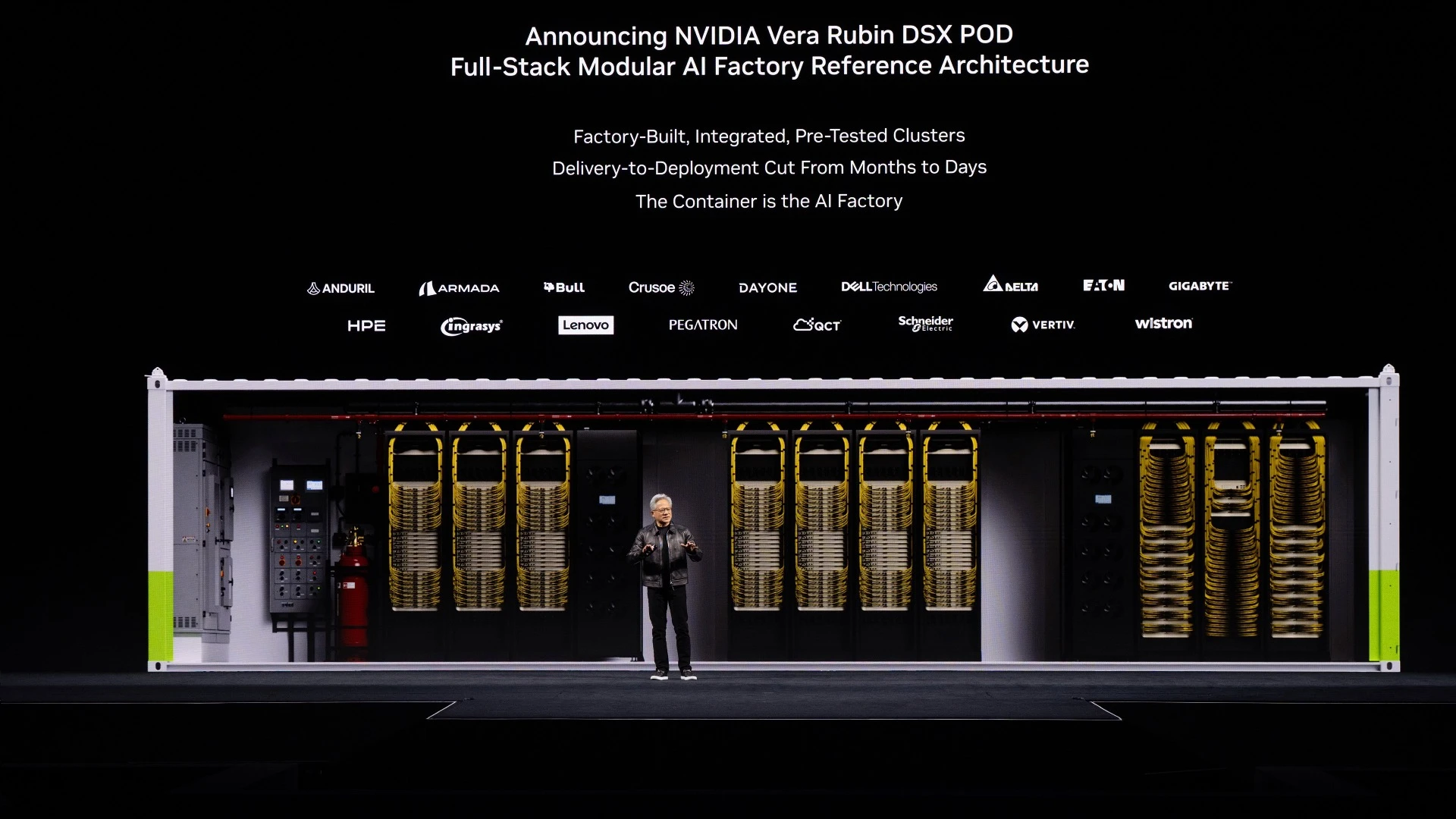
- Modular Turnkey Deployment: Using OCP-compliant blind-mate cartridges that cut tray installation time from hours down to minutes, alongside the pre-tested Vera Rubin DSX Pod container reference architecture that shrinks full AI data center deployment from months to just 14 days.
My Test Bench: What the Rubin Ultra Behemoth Means for Future GeForce RTX GPUs
Looking at the physical layout of the Vera Rubin Ultra NVL576 from my hardware test bench, one supply-chain reality stands out immediately: the sheer silicon and packaging appetite of NVIDIA's data center roadmap. Every single Rubin Ultra package consumes four reticle-sized GPU dies surrounded by dense HBM4e stacks on TSMC's advanced CoWoS interposers. When a single Kyber rack swallows 576 of those quad-reticle monsters, thousands of leading-edge foundry wafers and optical packaging lines are locked in years in advance for hyperscale buyers.
For PC enthusiasts and workstation builders, this relentless push toward 576-GPU optical super-racks explains why NVIDIA continues to prioritize enterprise silicon allocation and why the delay of consumer Rubin-based GeForce RTX 60 graphics cards to 2028 makes complete industrial sense. While Co-Packaged Optics and high-efficiency liquid cooling set impressive engineering benchmarks for 10-trillion-parameter models, they also confirm that desktop GeForce RTX flagships will keep competing for every square millimeter of foundry capacity against multi-million-dollar AI racks.

PC hardware enthusiast and competitive gamer, Arthur 'Heimdall' splits his time between France and the UK working in enterprise B2B software solutions. A business school graduate passionate about component benchmarking, he has been building, modding, and tuning PCs since childhood, optimizing every thermal degree and millisecond of display latency. An avid gamer across Assassin's Creed and sandbox titles, he forged his alliance with Grimtag and Chaya during late-night World of Warcraft raids before joining Pro-Gamer.