Up to 32,768 Zen 6 Cores: AMD Unveils Giant Helion Rack for Agentic AI
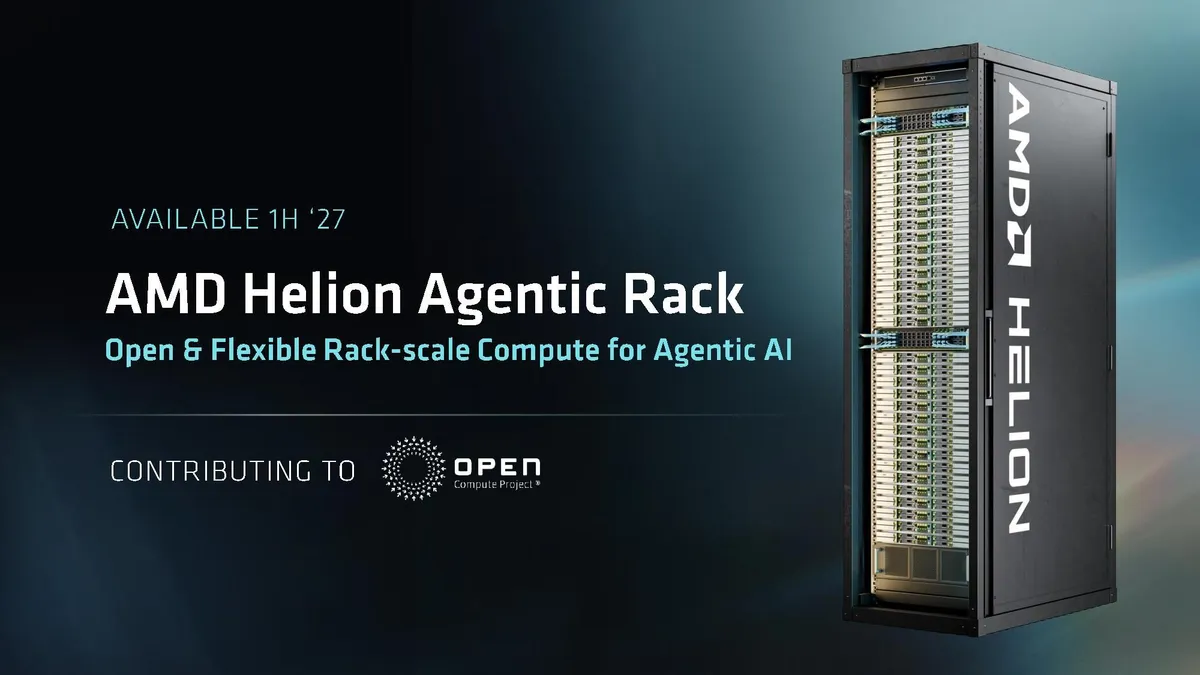
The Open Compute Project (OCP) Global Summit 2026 has opened with a major announcement for enterprise infrastructure. AMD engineers led by CEO Lisa Su have officially revealed an open rack-scale blueprint named AMD Helion.
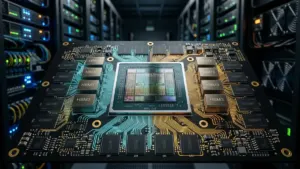
Built upon the standardized 21-inch OCP specification, this massive architecture is designed to accommodate up to 32,768 processor cores based on AMD's upcoming Zen 6 architecture, codenamed "Venice".
Why Agentic AI Workloads Demand Specialized Architecture
Unlike standard large language models that primarily rely on matrix calculation on GPUs, agentic artificial intelligence introduces a completely different compute challenge.
Networks of autonomous agents must chain multi-step reasoning tasks, execute code in real time, and coordinate complex tool-calling routines. Running these intensive sequential loops on GPU clusters often leads to severe memory bottlenecks.
Dan McNamara, senior vice president and general manager of Compute and Enterprise AI at AMD, highlighted this shift during the OCP keynote:
"Agentic AI is not a single workload. It spans personal agents, enterprise applications, code execution and complex workflows, each with different compute requirements. To do that takes optimized compute and infrastructure that can adapt to different workloads."
Up to 32,768 EPYC Zen 6 Cores: The CPU-Only Powerhouse
To address these demands, AMD designed two distinct Helion configurations. The flagship configuration is an entirely CPU-only rack powered by 6th Gen AMD EPYC processors.
In this hyperscale setup, the rack aggregates up to 32,768 interconnected Zen 6 cores. This provides massive, dedicated execution capacity for autonomous agents while offloading heavy model inference to external accelerator clusters.
By bypassing GPU memory constraints for agent orchestration, this design delivers superior efficiency for concurrent workflows. The blueprint supports both traditional air cooling and high-density liquid cooling options.
An All-in-One Hybrid Solution with AMD Instinct
For organizations looking to deploy an integrated agentic stack within a single footprint, AMD also introduced an all-in-one blueprint.
This hybrid configuration combines AMD EPYC Zen 6 CPU nodes with AMD Instinct MI350P GPU accelerators on the same platform. Enterprise teams can balance real-time agent execution and local model inference within one unified rack.
The growing hardware appetite of AI infrastructure continues to reshape the global semiconductor supply chain. As enterprise demand absorbs high-bandwidth silicon and manufacturing capacity, the ripple effects are felt across consumer memory markets, as detailed in our report on DDR4 supply constraints caused by AI priorities.
The Battle for AI Factories: AMD Helion vs Nvidia Vera Rubin
AMD's unveiling arrives amidst fierce competition on the OCP show floor. At the same event, Nvidia contributed its own Vera Rubin rack specifications to the Open Compute Project, stripping compute trays of loose cabling and fans.
Hardware partners including Asus immediately showcased complementary designs, signaling an all-out engineering race to power the AI data centers of 2027 and 2028.
AMD confirmed that the complete Helion specification will be contributed directly to OCP as an open standard. The first systems developed with ecosystem partners are scheduled to roll out in November 2026.

SEO consultant for over 20 years and digital entrepreneur, Charles 'Grimtag' Ronchain is the founder of Pro-Gamer.gg, Retrocharting.com, and Gamescharting.com. A competitive gamer, streamer, and retro game collector, he has worked in the video game industry for over 15 years, notably as a consultant for leading game price comparison platforms. Passionate about real-time performance data and gaming technology, he analyzes competitive esports, gaming hardware benchmarks, and creator workflows on Pro-Gamer.gg with an authentic player perspective.