A Custom "PS3 Pro" Pushes Sony's Cell CPU From 3.2 to 5.1 GHz Under Dual PC Tower Coolers
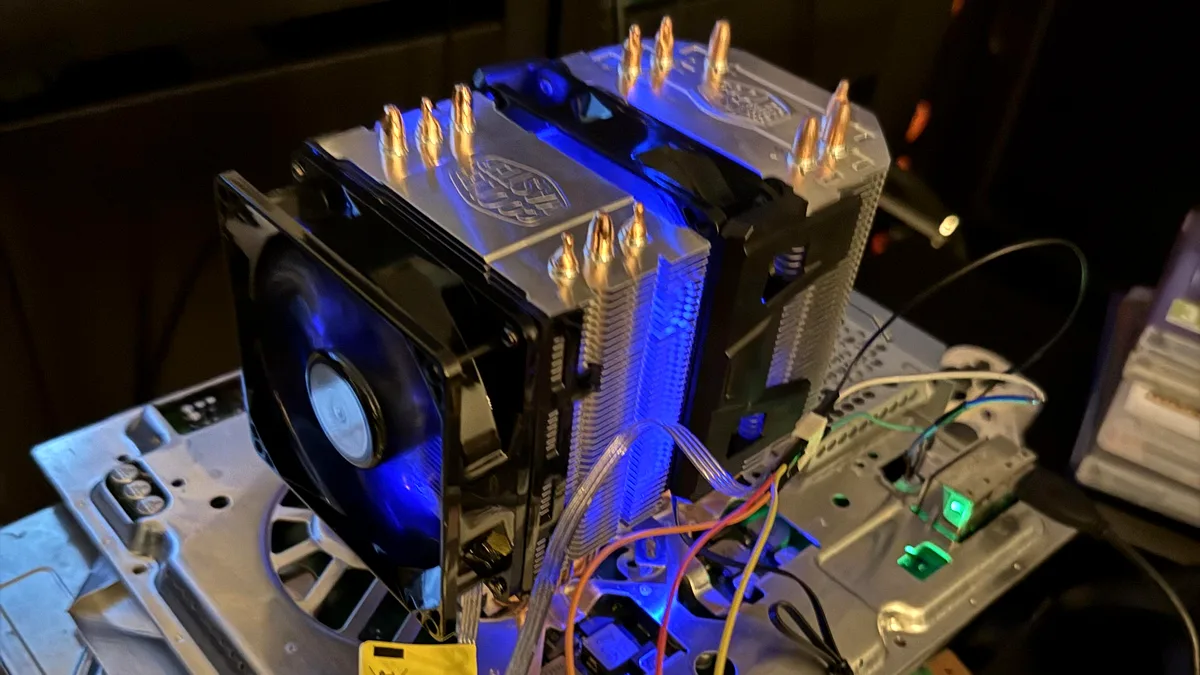
For nearly two decades after the PlayStation 3 launched in November 2006, the clock speed of its exotic Cell Broadband Engine processor seemed permanently locked at 3.2 GHz. Over on the r/PS3 subreddit, hardware modder chrispy_PS3 has shattered that historical ceiling by building a custom "PS3 Pro" with its Cell CPU overclocked to 5.1 GHz alongside a 900 MHz RSX GPU.
A CECHG Donor Board, a 65nm Cell CPU, and a 40nm "Frankenstein" RSX Swap
Reaching past the 5 GHz barrier on twenty-year-old silicon starts with picking the right donor motherboard. Rather than sacrificing an original backward-compatible launch model (CECHA or CECHB) equipped with a power-hungry 90nm Cell processor, chrispy_PS3 built this rig around a PlayStation 3 Fat CECHG chassis (SEM-001 motherboard), a revision still widely available among pre-owned PlayStation 3 CECHG consoles on eBay.
The CECHG revision holds a critical advantage for extreme frequency scaling: it introduced Sony's shrunk 65nm Cell processor, which offers vastly superior overclocking headroom compared to the original 90nm die. By pushing the core clock from 3.2 GHz to 5.1 GHz, the build achieves a massive 59.4% frequency increase, matching the experimental lab speeds IBM engineers only saw on test benches before the same architecture powered the US Air Force's 1,760-PS3 Condor Cluster supercomputer.
On the graphics side, the failure-prone stock 90nm RSX chip was desoldered and replaced with a "Frankenstein" 40nm RSX (A1GB revision) harvested from a later PS3 Slim. Running far cooler and more efficiently, that 40nm GPU was pushed to 900 MHz on the core and 1,050 MHz on the GDDR3 VRAM, up from the factory 500 MHz core and 650 MHz memory clocks (an 80% GPU core boost and 61.5% memory bandwidth jump).
Dual Cooler Master PC Tower Heatsinks Held by "Pure Gravity" vs. RGL's Liquid-Cooled Build
Unlocking these clock speeds relies on recent reverse-engineering breakthroughs targeting the console's Syscon system controller and clock generator chip, documented by researchers on PSX-Place. By directly modifying the PLL registers governing the Cell and XDR memory bus multipliers, modders have bypassed hardware locks once thought permanent.
To keep a 5.1 GHz Cell processor from immediately thermal throttling on an open bench, chrispy_PS3 went with an unapologetically industrial setup: two full-size Cooler Master PC tower heatsinks with copper heatpipes and blue LED fans protruding straight through the motherboard's metal RF shield. As the builder candidly noted in the thread, the two PC coolers aren't even bolted to a custom bracket, sitting directly atop the Cell and RSX dies held down by "pure gravity" in a single directional airflow path.
Check Availability Cooler Master Hyper 212 Availability on Amazon→
The build was shared as a friendly flex aimed at Polish modding workshop RGL (Retro Gaming Lab) and Paweł Igras (Fix Mix Electronics). Just days earlier, RGL showcased their own custom-cased "PS3 Pro" build on Reddit, cooled by dual independent 120mm AIO liquid loops with Noctua G2 fans and powered by an APS-226 supply (380W on the 12V rail), running its Cell CPU and XDR RAM synchronously at 4.525 GHz (at 1.250V).
| Specification | Stock PS3 CECHG (2007) | RGL PS3 Pro V4 (Dual AIO) | chrispy_PS3 "PS3 Pro" |
|---|---|---|---|
| Cell BE CPU (65nm) | 3.2 GHz | 4.525 GHz (+41.4%) | 5.1 GHz (+59.4%) |
| RSX GPU | 90nm at 500 MHz | 40nm A1GB at 900 MHz | 40nm A1GB at 900 MHz (+80%) |
| GDDR3 VRAM | 650 MHz | 1,000 MHz (+53.8%) | 1,050 MHz (+61.5%) |
| Cooling Solution | Stock radial blower fan | Dual 120mm AIO + Noctua G2 | Dual Cooler Master PC tower coolers |
50 FPS in inFAMOUS, a Locked 60 FPS in Gran Turismo 6, and the Timebase Hurdle
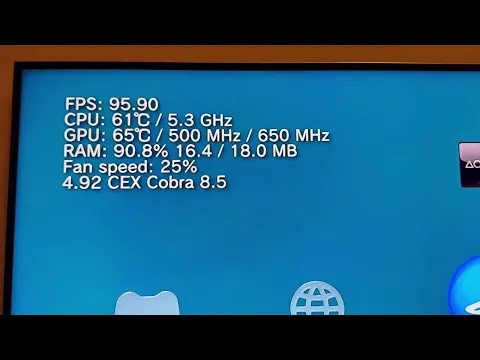
With custom clock speed monitoring enabled through webMAN MOD, the raw frequency uplift delivers dramatic gains in titles that historically struggled on seventh-generation hardware. In Sucker Punch's open-world action title inFAMOUS, which routinely dipped between 25 and 30 FPS on retail hardware, frame rates now climb to roughly 50 FPS.
Meanwhile, Gran Turismo 6 leverages both the 5.1 GHz Cell and the 900/1,050 MHz RSX to hold a solid 60 FPS on track. Still, pushing the Cell processor this far highlights a major architectural quirk familiar to both console modders and developers working on the RPCS3 PlayStation 3 emulator on PC: Timebase Correction.
Because PS3 game engines were hardcoded around the assumption that the Cell ticks strictly at 3.2 GHz, raising the CPU clock without adjusting the internal timebase register can cause game physics, animations, and audio cues to run too fast. Combined with accelerated electromigration in 65nm silicon subjected to extreme voltages and frequencies, a 5.1 GHz setup remains an extreme benchmark showcase rather than a daily-driver configuration.
My Take on the Spec Sheet
Balancing two full-size Cooler Master PC tower heatsinks by pure gravity on an exposed CECHG motherboard to push a 2007 Cell processor to 5.1 GHz is the kind of raw, unfiltered silicon madness we love dissecting when putting rigs through our full hardware protocol. Seeing inFAMOUS jump from a choppy 25 FPS to 50 FPS on real PlayStation 3 silicon proves just how much untapped headroom IBM and Sony left on the table once you ditch the toaster-like 90nm RSX for a 40nm die. Still, exhausting hot air from a 900 MHz GPU straight into the fins of a 5.1 GHz CPU cooler will inevitably heat-soak the second tower during longer sessions, and without proper timebase correction across every title, half your library risks running in fast-forward. We have not yet had a physical unit on our desk—if the manufacturer's team would like to send over a review sample so we can put it through our full real-world testing protocol, our lab doors are wide open.

PC hardware enthusiast and competitive gamer, Arthur 'Heimdall' splits his time between France and the UK working in enterprise B2B software solutions. A business school graduate passionate about component benchmarking, he has been building, modding, and tuning PCs since childhood, optimizing every thermal degree and millisecond of display latency. An avid gamer across Assassin's Creed and sandbox titles, he forged his alliance with Grimtag and Chaya during late-night World of Warcraft raids before joining Pro-Gamer.