60 FPS on an RTX 5080 and 9800X3D in Zelda: Ocarina of Time: Inside the Lichii Build 75 PC Emulator Telemetry
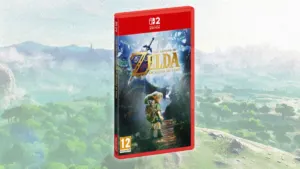
Officially launched this Thursday, November 5, 2026, as a Nintendo Switch 2 exclusive, the ground-up remake of The Legend of Zelda: Ocarina of Time took less than twenty-four hours to boot and render live gameplay on a Windows 11 PC. Thanks to the newly released Build 75 update of the experimental open-source Switch 2 emulator Lichii, maintained by developer Zortos293, the game now gets past its opening sequence and reaches 60 FPS on a high-end rig powered by an NVIDIA GeForce RTX 5080 and an AMD Ryzen 7 9800X3D. Looking closely at the hardware telemetry inside the first dungeon, however, reveals a heavy dual-core CPU bottleneck and an active shader translation battle beneath the surface.
RTX 5080 at 25% Load and 19.2 GB of RAM: Inside the Lichii Build 75 Telemetry
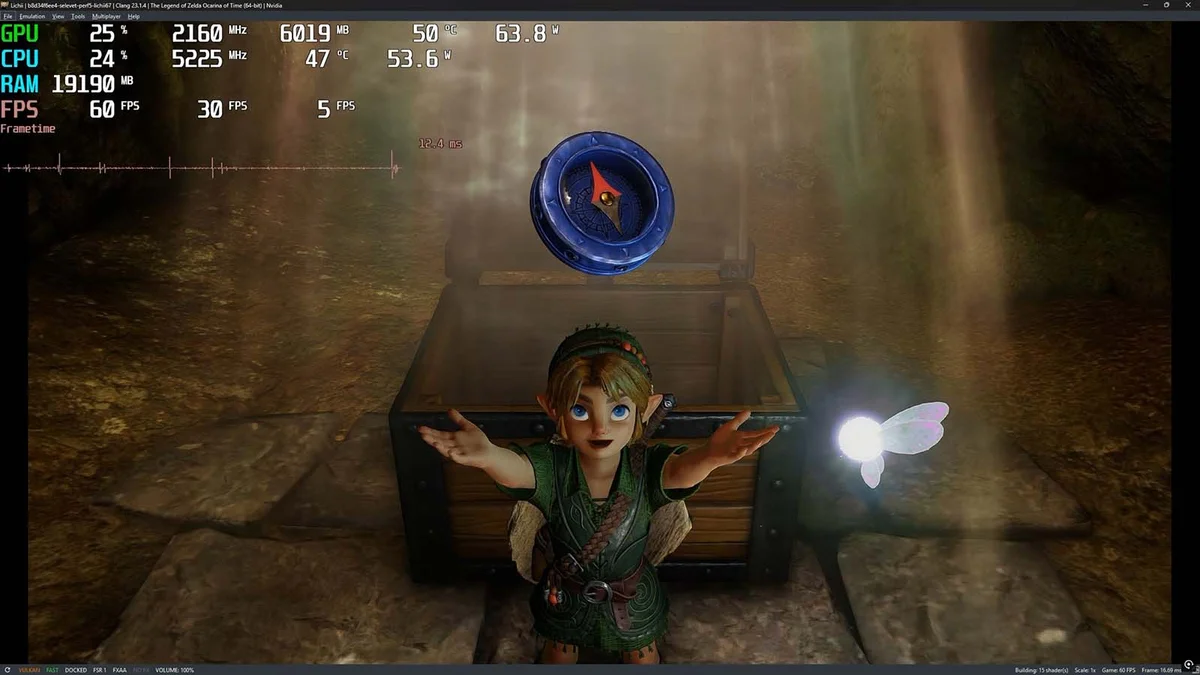
The hardware test published by benchmarking channel Finn Benchmarks provides an exact look at how current flagship PC components behave when emulating Nintendo's latest console. Running on an AMD Ryzen 7 9800X3D paired with an NVIDIA GeForce RTX 5080 (16GB GDDR7) and 64GB of DDR5 system memory, the emulator operates under the Vulkan API in Docked mode (1x internal resolution scale) with FXAA and Nintendo's built-in AMD FSR 1.0 upscaler in Zelda: Ocarina of Time on Switch 2 enabled. Inside the Great Deku Tree dungeon, as young Link opens the compass chest, the frame counter locks onto 60 FPS with a flat 16.69 ms frame time.
The on-screen telemetry makes it immediately clear that raw GPU shading power is not the limiting factor. While rendering at 60 frames per second, NVIDIA's Blackwell-based GeForce RTX 5080 graphics card idles at just 25% GPU utilization, clocked at 2,160 MHz at a cool 50°C while drawing only 63.8W of board power and allocating 6,019 MB of VRAM. System memory consumption, by contrast, climbs to a hefty 19,190 MB of RAM (~19.2 GB), while the Ryzen 7 9800X3D runs at 5,225 MHz and 53.6W (24% overall package load concentrated across the primary emulation threads).
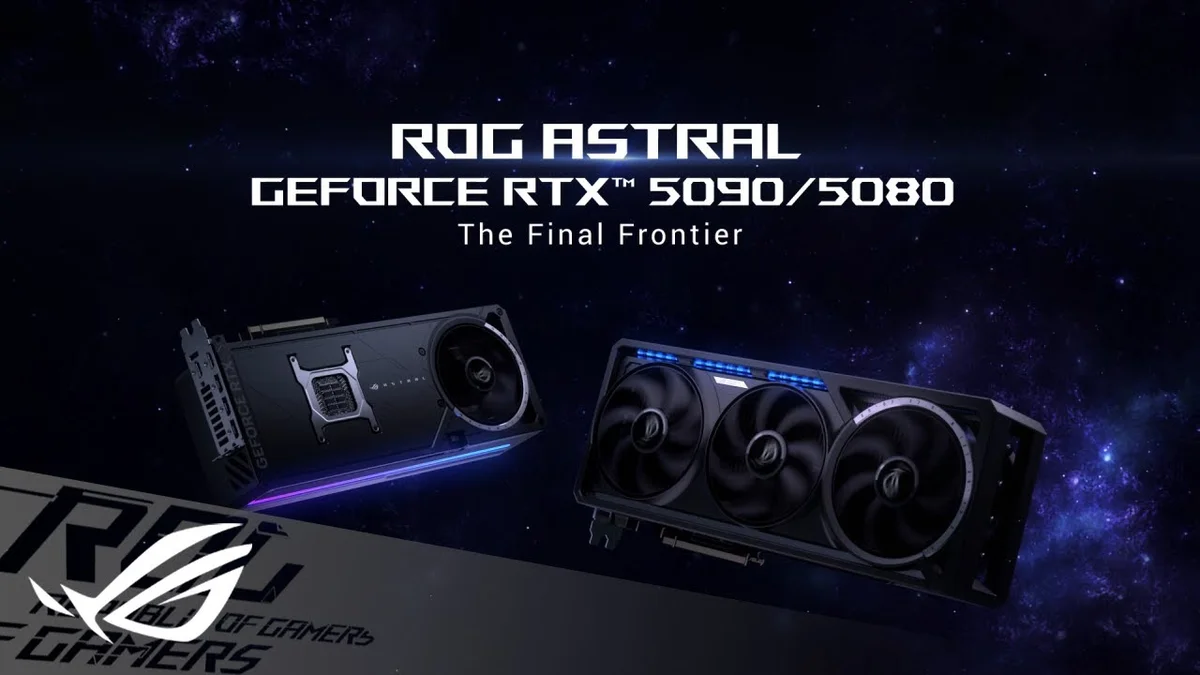
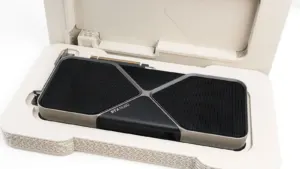
NVIDIA GeForce RTX 5080 (16GB GDDR7)
- NVIDIA Blackwell Architecture (GB203) with Full DLSS 5 Support
- 16GB GDDR7 Memory on 256-bit Bus
- 6,019 MB VRAM and 63.8W Power Draw Logged in Lichii Build 75
- From $1,799 to $1,899 Across US Retailers
80 Newly Translated Shaders by Zortos293, Yet a 29 FPS Dual-Core CPU Wall Outdoors
Getting the Switch 2 remake (title ID 0400486024DEC000 in .nup package format) past its opening cutscene required rapid low-level fixes in Lichii nx2 Build 75 (commit c9ebb5c), an independent C++ fork building upon Eglantine, Eden, Yuzu, and Sudachi. In earlier revisions, the game aborted roughly 20 seconds after launch due to an unhandled 64-bit kernel wait-on-address instruction. By porting upstream fix #567 and translating approximately 80 previously unsupported shaders (tracked in PR #87), Build 75 eliminated the solid white screen that previously blocked 3D world rendering.
That breakthrough still leaves outdoor exploration far short of a locked 60 FPS experience. Once Link steps out of enclosed rooms into wider areas like Kokiri Forest, frame rates frequently fluctuate between 15 and 30 FPS. According to frame-dump diagnostics filed on the project's GitHub issue tracker, the game requests a 60 Hz swap interval, but emulation becomes strictly CPU-bound across two cores, settling at a steady 28 to 29 FPS (34.4 to 35.5 ms per frame) with 1% lows at 30 FPS and 0.1% lows dipping to 5 FPS whenever Vulkan compiles 15 new shaders on the fly. On a mid-range system pairing a Ryzen 9 5900X with an RTX 3080, developer release notes report 12 to 22 FPS.
- Handheld Mode Black Screen: booting the game in Handheld mode produces a completely black 3D viewport (leaving only the 2D HUD visible) on both GeForce RTX 50-series GPUs and AMD Radeon RX 7800 XT / RX 9070 XT cards. Switching the emulator to Docked mode and running the Windows MSVC build (the only package compiled with NVIDIA DLSS support) restores 3D rendering.
- Overexposed Bloom and Heavy Fog: three rare shaders remain unsupported, and a half-resolution mesh pass (
427x240MRT) causes blinding outdoor fog and dark ground blotches. Community testers on RTX 5070 Ti and RTX 5080 cards currently bypass the issue by rejecting specific pixel shader hashes (f2b14c43ca0e4300,96dd01c5b0361fcb, andc72b6ea746c00433), which cleans up Link and the foreground at the cost of disabling bloom accumulation and river water surfaces. - AV1 Cutscene Decoding and 14 GB Memory Allocation: missing AV1 video decoding causes pre-rendered cutscenes to display black or solid green frames, while the emulator requires 14,336 MiB of backing memory (requiring a system-managed Windows page file). Meanwhile, a separate native PC recompilation effort shared by community developer Remarkable-Net6962 currently plays only the opening introduction before crashing as gameplay begins.
My Take on the Spec Sheet
In full transparency, I have not run a dumped image of the game on our own test bench, but I closely examined the Lichii Build 75 frame-dump logs and the hardware telemetry recorded on the Ryzen 7 9800X3D and GeForce RTX 5080 setup. From a pure software engineering perspective, watching an experimental C++ emulator resolve 64-bit kernel waits, translate 80 custom Switch 2 shaders, and hit 60 FPS inside the Great Deku Tree on launch day is a remarkable feat of reverse engineering. We have not yet had a physical unit on our desk,if the manufacturer's team would like to send over a review sample so we can put it through our full real-world testing protocol, our lab doors are wide open.
Speaking strictly from a hardware standpoint, however, those telemetry numbers prove once again that throwing an $1,800 graphics card at a day-one emulator cannot brute-force unoptimized CPU thread scheduling. Seeing an RTX 5080 cruise at 25% load and 63.8W while 0.1% lows drop to 5 FPS during shader compilation,or having to strip out water surfaces via shader hash overrides just to clear away blinding fog,shows how early this software really is. Right now, Lichii Build 75 is a fascinating technical showcase for PC hardware enthusiasts, but Nintendo's Switch 2 console remains the only way to actually play through Hyrule without visual compromises.

PC hardware enthusiast and competitive gamer, Arthur 'Heimdall' splits his time between France and the UK working in enterprise B2B software solutions. A business school graduate passionate about component benchmarking, he has been building, modding, and tuning PCs since childhood, optimizing every thermal degree and millisecond of display latency. An avid gamer across Assassin's Creed and sandbox titles, he forged his alliance with Grimtag and Chaya during late-night World of Warcraft raids before joining Pro-Gamer.