Cell Processor, Linux, and 1,760 Networked PS3s: How the US Air Force Built a 500 TFLOPS Supercomputer Hardware Cluster for $2 Million
When the PlayStation 3 launched in Japan on November 11, 2006, followed by North America six days later, Sony was delivering far more than a Blu-ray home console. Through an official system feature known as OtherOS and massive hardware subsidies on every unit sold, the Japanese manufacturer inadvertently turned its living-room machine into the most cost-effective parallel-computing Linux workstation on the market, drawing in university researchers and the United States Air Force.

The Cell Broadband Engine Processor: Supercomputer Silicon Sold at a Loss
At the heart of this hardware anomaly was the Cell Broadband Engine processor, the product of a four-year, $400 million joint research alliance between Sony, Toshiba, and IBM (STI) based in Austin, Texas. Unlike conventional symmetric x86 processors of the mid-2000s, the Cell chip relied on a radical heterogeneous layout: a 64-bit PowerPC-based main core called the PPE (Power Processing Element) clocked at 3.2 GHz, paired with eight vector coprocessors known as SPEs (Synergistic Processing Elements) engineered for heavy single-precision floating-point workloads.
In retail PlayStation 3 consoles, seven of the eight SPEs were active to improve 90nm silicon manufacturing yields, while one active SPE was reserved exclusively for the system's security hypervisor. While that asymmetric layout notoriously challenged game developers during the console's early lifecycle, it delivered unmatched raw floating-point throughput for the price. At launch in November 2006, both the 20GB model ($499) and the 60GB model ($599) cost Sony over $800 per unit to manufacture. By absorbing a loss of more than $200 on every console to establish the Blu-ray disc format and its custom silicon, Sony unintentionally handed scientists a high-performance computing node priced hundreds of dollars below its bill of materials.
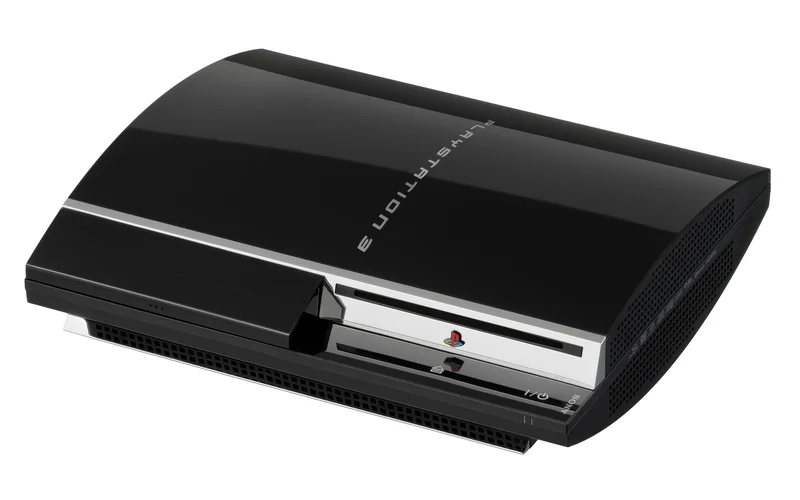
Sony PlayStation 3 Original Fat Console
- 3.2 GHz Cell Broadband Engine Processor (1 PPE + 7 SPEs)
- 256MB XDR Main RAM + NVIDIA RSX Reality Synthesizer GPU
- Blu-ray Disc Drive & Legacy OtherOS Linux Support (Pre-3.21)
OtherOS and Yellow Dog Linux: Turning a Console Into a PowerPC Workstation
Right out of the box, a submenu inside the XrossMediaBar (XMB) system settings allowed owners to partition the internal 2.5-inch SATA hard drive and select "Install Other OS" (OtherOS). Championed by PlayStation architect Ken Kutaragi, who envisioned the PS3 as a full-fledged home computer (while also hoping to qualify for lower European Union customs tariffs applied to personal computers rather than video game machines), the feature booted native 64-bit PowerPC GNU/Linux distributions directly on the console.
Through an official partnership with Terra Soft Solutions, which tailored Yellow Dog Linux 5.0 specifically for the console (soon joined by PowerPC builds of Ubuntu, Fedora, and Debian), anyone could plug in a USB keyboard and mouse to run a complete Linux desktop environment. Sony's hypervisor enforced strict boundaries: the guest operating system could access 6 of the 7 SPEs and the 256MB of XDR main memory, while direct 3D hardware acceleration on the NVIDIA RSX Reality Synthesizer GPU remained locked out. Even with that graphics restriction, the internal Element Interconnect Bus (EIB) moving over 200 GB/s made a Linux-equipped PS3 a formidable scientific number-cruncher, a bold engineering era that echoes the unreleased R&D concepts and hardware prototypes from PlayStation's archives.
From Stanford's Folding@home to the US Air Force's 1,760-PS3 Condor Cluster
Academic institutions quickly capitalized on Sony's subsidized silicon. In March 2007, Stanford University launched a dedicated Folding@home client on PlayStation 3, harnessing idle Cell processors worldwide to simulate protein folding for Alzheimer's and Parkinson's disease research. Within weeks, tens of thousands of consoles outpaced hundreds of thousands of traditional desktop PCs, pushing the distributed network past the historic 1 petaflop milestone (one quadrillion floating-point operations per second) in September 2007. Meanwhile, astrophysicists such as Gaurav Khanna at the University of Massachusetts Dartmouth wired together small clusters of eight to sixteen Linux PS3s to model gravitational waves from colliding black holes.
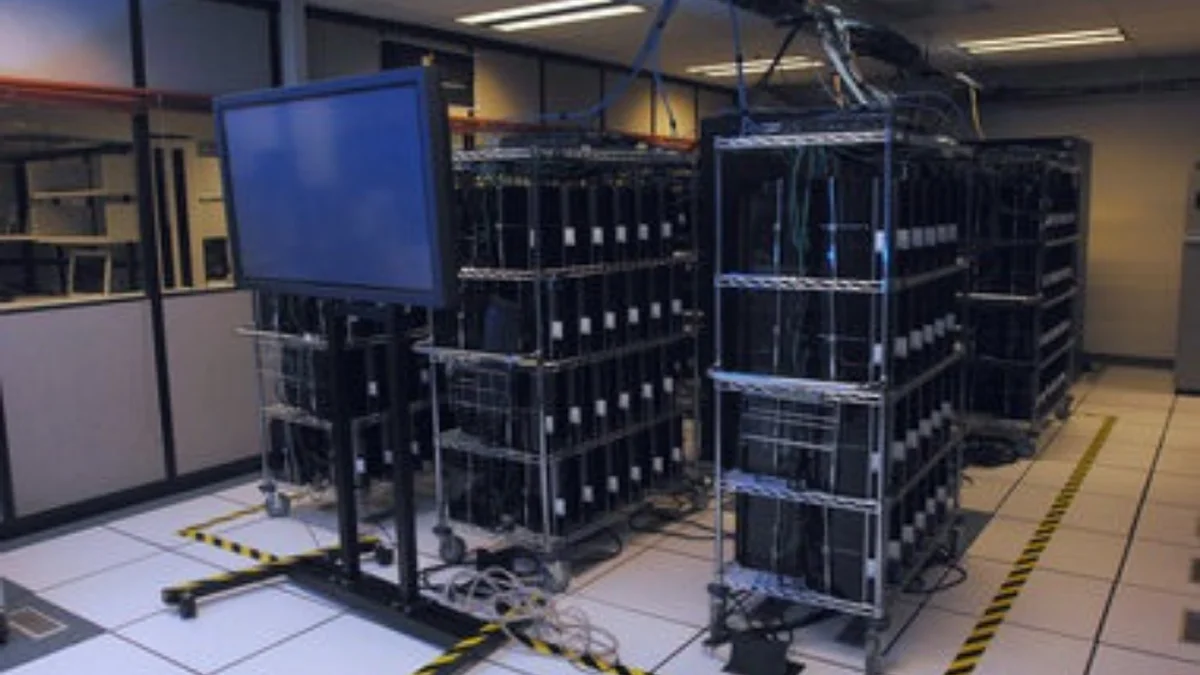
The most ambitious deployment took shape at the Rome Research Site in New York. Led by High-Performance Computing Director Mark Barnell at the US Air Force Research Laboratory (AFRL), engineers tested a 336-console proof of concept in 2008 before officially unveiling the Condor Cluster in December 2010. The military supercomputer linked together 1,760 original "Fat" PlayStation 3 consoles alongside 84 dual-Xeon head servers and 168 NVIDIA GPUs.

The Condor Cluster's specifications were staggering for its budget: delivering a peak performance of 500 TFLOPS (500 trillion floating-point operations per second), it ranked as the 33rd fastest supercomputer in the world upon completion and served as the fastest interactive computer across the entire US Department of Defense. Tasked with processing ultra-high-resolution Synthetic Aperture Radar (SAR) imagery at 15 billion pixels per minute as well as neuromorphic artificial intelligence research, the entire system cost roughly $2 million to build, representing just 5% to 10% of the cost of a conventional supercomputer of equivalent power while consuming only 10% of the electricity.
Firmware 3.21 and the $3.75 Million Settlement: The Abrupt End of OtherOS
That golden era of console computing came to an abrupt halt in two stages. In September 2009, Sony released the redesigned PS3 Slim (CECH-2000) without OtherOS support, prompting the US Air Force to stockpile remaining 160GB Fat consoles before retail inventory vanished. Then, in January 2010, security researcher George Hotz (GeoHot) published a hardware and software exploit that leveraged the OtherOS hypervisor layer to access system memory. Sony responded decisively on April 1, 2010, with the release of System Software Update 3.21.
Billed as an optional security update, Firmware 3.21 permanently stripped the "Install Other OS" feature from every existing Fat PlayStation 3. Owners who declined the update to preserve their Linux partitions were locked out of the PlayStation Network, online multiplayer, and any newer game discs or Blu-ray movies requiring firmware 3.21 or higher. For university labs and the US Air Force, it also meant that any broken console sent to Sony for servicing returned with updated firmware, rendering it useless as a cluster node. Removing an advertised feature retroactively triggered an eight-year federal class-action battle in California (In re Sony PS3 "Other OS" Litigation), which concluded between 2016 and 2018 with a $3.75 million settlement fund offering up to $65 per claimant who could document active Linux usage.
The Strategist's Take
As we follow Sony's next-generation PlayStation 6 development and memory supply strategy, I still look back at the 2006 Cell processor era as one of the boldest hardware experiments in computing history. Allowing a student, an astrophysicist, or a defense laboratory to walk into a retail store and buy a 64-bit vector computing node capable of booting Linux for under $600 remains an unmatched anomaly. Since the security fallout of 2010, console makers have standardized on tightly locked x86 architectures that mirror PC internals while walling off the operating system completely, ensuring we will never again see an official "Install Other OS" button on a mainstream console. We have not yet had a physical unit on our desk,if the manufacturer's team would like to send over a review sample so we can put it through our full real-world testing protocol, our lab doors are wide open.

Born and based in Montreal's Mile End district, Maëlle "Kaelen" became close friends with Chaya during their university software engineering years, bonding over late-night coding labs, campus LANs, and World of Warcraft raids alongside Grimtag and Heimdall. A game systems balancing consultant and lifelong theorycrafter, she cut her teeth in the early 2010s writing boss walkthroughs, frame-data breakdowns, and competitive meta guides for specialized French-language MMORPG and esports portals, including Mondes Persistants, as well as North American strategy collections. On Pro-Gamer, she leads in-depth walkthroughs, build optimization, and tactical esports coverage.