Tom Clancy's H.A.W.X. 2 Finally Boots: RPCS3 Clears the Loadable Category With Zero PS3 Games Stuck on a Black Screen
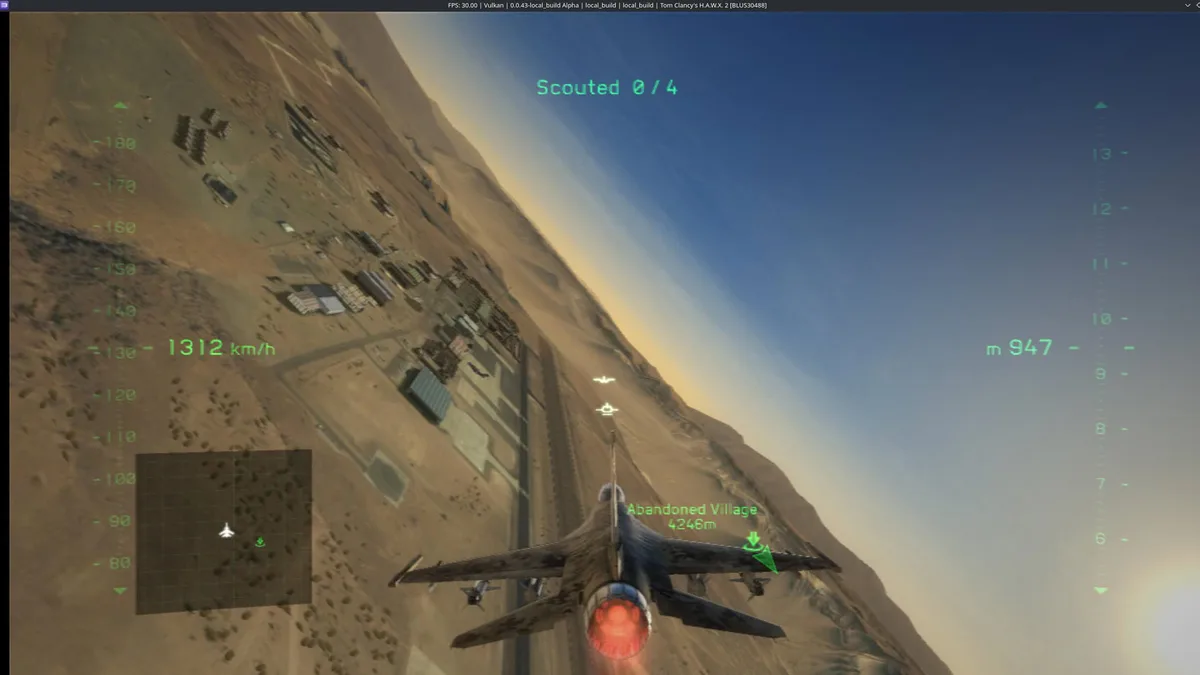
Long regarded as one of the toughest architectural puzzles in console history, the PlayStation 3's Cell Broadband Engine has just surrendered another major stronghold. The development team behind the open-source RPCS3 emulator officially announced that its "Loadable" compatibility category has reached zero games. By pushing Ubisoft's aerial combat title Tom Clancy's H.A.W.X. 2 into active rendering, RPCS3 has ensured that not a single commercial PS3 release remains stuck on a black screen upon booting on PC.
Until this week, Tom Clancy's H.A.W.X. 2 (title ID BLUS30488) stood as the lone holdout in the Loadable tier, a classification reserved for binaries that initialize an active framerate counter in the window title bar while failing to produce any visual output. Thanks to a low-level SPU accuracy fix, the 2010 flight action game now renders full 3D gameplay under the Vulkan API and moves up into the "Ingame" category.
Check Tom Clancy's H.A.W.X. 2 deals on Allkeyshop→
How Yahfz's SPU and LV2 Kernel Fix Rescued Tom Clancy's H.A.W.X. 2 From a Black Screen
The root cause keeping Ubisoft's jet fighter simulation trapped in a blank state lay deep within the handoff between the PlayStation 3's operating system kernel and the Cell processor's vector co-processors. Contributor Yahfz unlocked the bottleneck by engineering a precision fix targeting the SPU (Synergistic Processing Units) subsystem.
Specifically, the patch accurately recreates the behavior of the SPU thread loader. On genuine PlayStation 3 hardware, the LV2 (Level 2) kernel writes critical startup arguments directly into the beginning of each SPU group's ultra-fast 256 KB Local Store memory right before the executable code image is loaded.
Previously, improper handling of those LV2 kernel arguments inside the Local Store caused the loader in Tom Clancy's H.A.W.X. 2 to become corrupted before the first frame could be drawn. Running on RPCS3 build 0.0.43 Alpha, the initialization data is now preserved intact, allowing the game to hit 30 FPS in active 3D flight sequences under Vulkan.
3,557 PS3 Games Tested With 0.00% Left in Loadable and Nothing
With the promotion of this final holdout, the official RPCS3 compatibility database reflects a major milestone for seventh-generation console preservation. Across all 3,557 unique PlayStation 3 games tracked by the team (excluding defunct online-only titles whose official servers have been permanently decommissioned), the bottom two compatibility tiers now sit at an absolute zero.
This breakthrough builds directly upon the momentum seen when RPCS3 crossed the 80% Playable milestone across the entire PS3 library on PC. Today, 100% of all tested PS3 games successfully boot, compile their shaders, and output active graphics past a black screen.
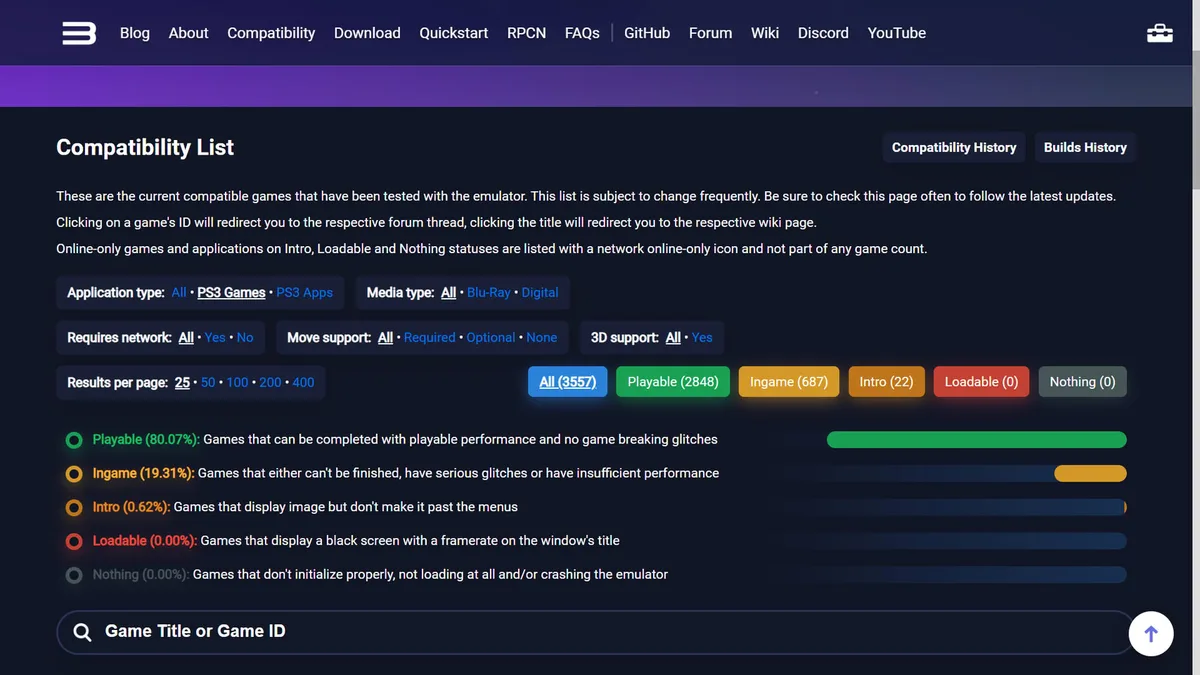
| RPCS3 Category | Library Share | Game Count (of 3,557) | Technical Behavior on PC |
|---|---|---|---|
| Playable | 80.07% | 2,848 games | Completable from start to finish with stable performance and no game-breaking glitches |
| Ingame | 19.31% | 687 games | Reaches active gameplay or menus but exhibits graphical bugs, crashes, or frame drops |
| Intro | 0.62% | 22 games | Displays intro logos or title menus without progressing into full gameplay |
| Loadable (Black Screen) | 0.00% | 0 games | Completely cleared following the SPU/LV2 accuracy fix for Tom Clancy's H.A.W.X. 2 |
| Nothing | 0.00% | 0 games | Zero titles fail to initialize or crash upon binary startup |
Only 22 titles (representing just 0.62% of the catalog) remain in the "Intro" tier, most of which rely on specialized hardware peripherals such as PlayStation Move motion wands, the PlayStation Eye camera, or dedicated USB controllers.
Open-Source Firepower and AI-Assisted Reverse Engineering Are Shattering Hardware Locks
Emptying the Loadable category also highlights a major technological shift in how complex silicon is reverse-engineered. When Sony launched the PlayStation 3 in 2006, industry veterans widely believed that the asymmetric architecture of the Cell Broadband Engine (combining a central PowerPC PPU core with six independent vector SPUs over a high-speed Element Interconnect Bus) would leave portions of the catalog permanently impossible to emulate on standard PC processors.
That skepticism underestimated the sheer firepower of the global open-source community when paired with modern AI-assisted analysis and reverse-engineering tools. Tracing an undocumented memory collision inside the LV2 kernel or SPU local store once required months of manual assembly debugging in the dark. Today, contributors combine advanced decompilation suites like Ghidra and IDA enhanced with automated pattern analysis, real-time execution tracers, and collaborative GitHub code reviews across hundreds of specialist engineers.
This workflow compresses months of low-level hardware investigation into days, while modern desktop CPUs equipped with AVX-512 vector instruction sets, such as AMD's Ryzen series, translate the Cell's 128-bit SPU workloads on the fly with massive headroom.
My Take: How Open-Source Collaboration and AI Analysis Prove the Skeptics Wrong
Seeing both the Nothing and Loadable columns sit at 0.00% on my test bench puts RPCS3's fifteen-year journey into clear focus. Isolating a subtle argument corruption between the LV2 kernel and a 256 KB SPU Local Store in a sixteen-year-old flight game like Tom Clancy's H.A.W.X. 2 is the definition of surgical systems engineering.
More importantly, this milestone answers every doubt to skeptics who claimed that exotic proprietary silicon would lock away console history forever. When a worldwide open-source community combines collective persistence with modern AI-assisted reverse-engineering and binary analysis tools, even the most notoriously complex hardware black boxes are dismantled instruction by instruction. With only 22 games left in Intro and 687 titles actively progressing in Ingame, full preservation of the PlayStation 3 generation on PC is no longer a distant theory: it is an engineering certainty entering its final stretch.

SEO consultant for over 20 years and digital entrepreneur, Charles "Grimtag" is the founder of Pro-Gamer.gg, Retrocharting.com, and Gamescharting.com. A competitive gamer, streamer, and retro game collector, he has worked in the video game industry for over 15 years, notably as a consultant for leading game price comparison platforms. Passionate about real-time performance data and gaming technology, he analyzes competitive esports, gaming hardware benchmarks, and creator workflows on Pro-Gamer.gg with an authentic player perspective.