Stellar Blade Hits 60 FPS on Nintendo Switch 2: Frame Generation Toggle, 1080p Upscaling, and Live-Action Launch Video
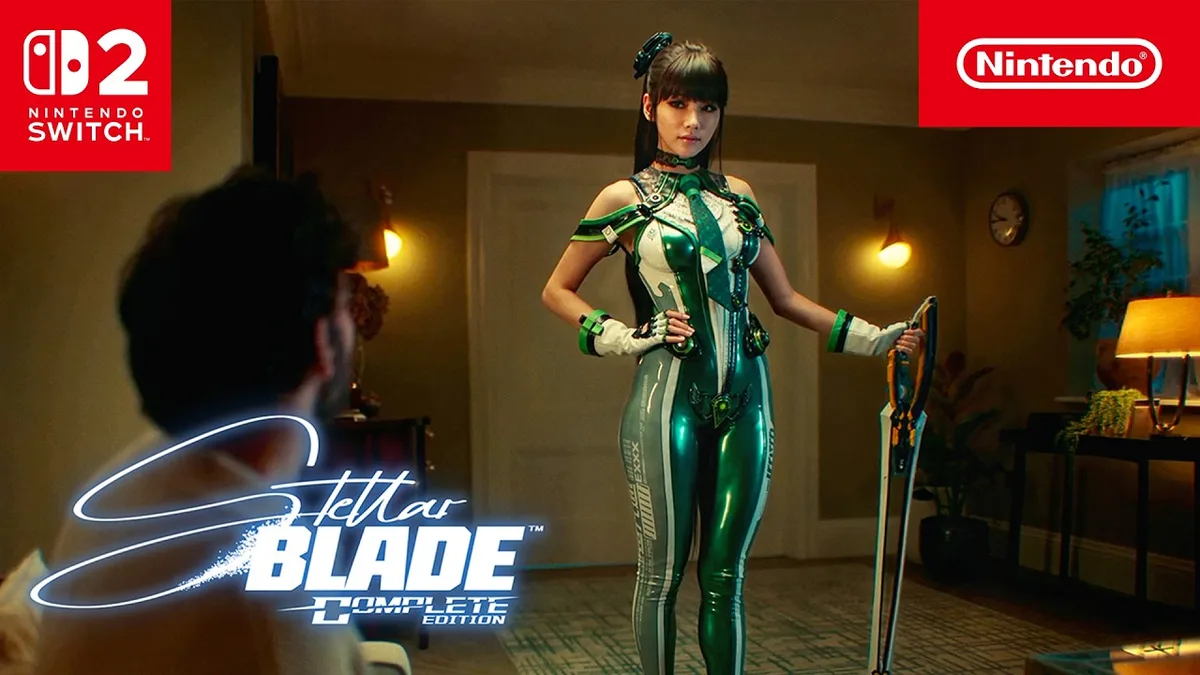
Now officially available on Kyoto's new hybrid console, Stellar Blade Complete Edition is celebrating its retail and Nintendo eShop debut with a brand-new live-action launch trailer mixed with fast-paced combat footage. Alongside this promotional video released by Nintendo of America and South Korean developer Shift Up, in-depth technical breakdowns of the retail build have revealed the unusual cross-vendor rendering pipeline that enables the action RPG to target 60 FPS on Nintendo Switch 2.
An Unusual Hybrid Pipeline Pairing NVIDIA DLSS with AMD FSR 3.1 to Target 60 FPS
Bringing a visually demanding action title like EVE's adventure to portable hardware required clever engineering compromises. To maximize the custom silicon inside the Nintendo Switch 2, Shift Up's engineers built a hybrid graphics pipeline that combines technologies from two rival GPU giants: NVIDIA and AMD.
Specifically, image reconstruction relies on NVIDIA DLSS (Deep Learning Super Sampling) to deliver a clean upscaled output of 1080p in docked TV mode and 720p in handheld mode. However, to double the frame rate without stripping away environmental geometry, the studio layered AMD FSR 3.1 frame interpolation (Frame Generation) on top of DLSS. As a result, the game engine runs at an internal base simulation rate of 30 FPS, using frame generation to output a smooth 60 FPS target both on the television and on the go.
Retail Build vs. Demo: The Frame Generation Toggle and Combat Trade-Offs
When the free playable demo launched ahead of release, players and technical analysts pointed out several drawbacks inherent to interpolating from a 30 FPS baseline: a slight input latency penalty during tight parry windows, shimmering around EVE's hair in handheld mode, and minor visual artifacts in heavy rain, while user interface (HUD) elements continued to update at 30 FPS.
Responding directly to community feedback, Shift Up refined the experience for the full retail launch, which is already competing alongside top sellers on the Nintendo Switch 2 eShop charts in November 2026. The launch build runs noticeably cleaner and more consistently than the early demo, while introducing crucial graphics toggles in the settings menu:
- A Dedicated Frame Generation Toggle: Players can now enable or disable FSR 3.1 frame interpolation at any time, choosing between the visual smoothness of 60 FPS output or the crisp, lower-latency responsiveness of a native 30 FPS lock during demanding boss encounters.
- Customizable Visual Filters: The full game allows users to adjust or turn off motion blur, chromatic aberration, and sharpening filters to eliminate image grain on the portable screen.
A Live-Action Launch Trailer to Celebrate the Complete Edition
To mark the game's release, Nintendo of America's official launch trailer embraces a playful live-action concept built around the tagline "Take EVE everywhere you go." The video shows protagonist EVE stepping directly into a player's living room before cutting to high-octane boss battles and sci-fi set pieces captured on the hybrid system.
Priced at $59.99, this package bundles every major content update released since the franchise's debut. As we covered in our breakdown of the Stellar Blade Complete Edition Switch 2 content and full 32 GB cartridge, the physical edition fits entirely onto a real game card with no mandatory download required, packing in the NieR: Automata and GODDESS OF VICTORY: NIKKE expansions, four free Bayonetta outfits, and Joy-Con 2 motion control support right out of the box.
My Perspective
Pairing NVIDIA's DLSS upscaling with AMD's FSR 3.1 frame generation inside a single handheld rendering pipeline is a fascinating display of pragmatic engineering from Shift Up. Even better is the studio's decision to listen to demo feedback by adding a dedicated frame generation toggle in the retail release: in an action game where parry windows come down to fractions of a second, letting players choose between 60 FPS interpolated smoothness and native 30 FPS input responsiveness is the exact standard every third-party Switch 2 port should follow.
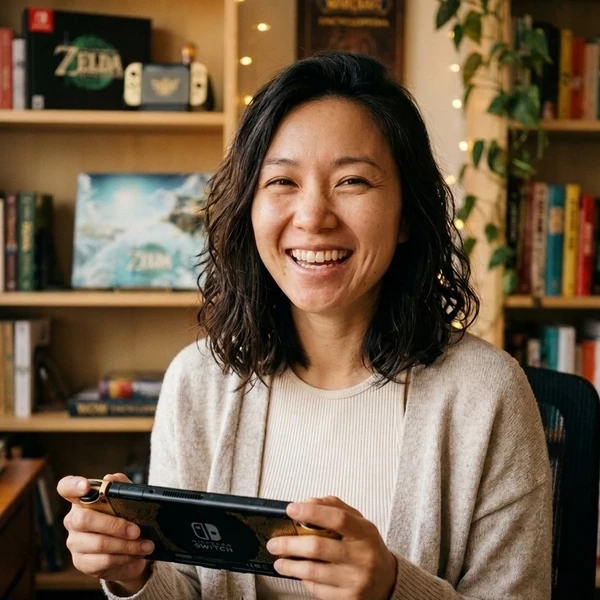
Based on the outskirts of New York City, Chaya 'Chayane' spent five years studying software engineering in Montreal before returning to her home state. A Full-Stack developer and Deep Learning AI architecture researcher, she explores neural networks and algorithmic optimization while engineering data pipelines for Retrocharting and Gamescharting alongside Grimtag. A gamer for over 20 years and an avid collector of Nintendo history and The Legend of Zelda, she explored World of Warcraft's Azeroth before bringing her deep technical background to video game analysis.