By Doubling DDR5 Bandwidth With Upcoming 1-Delta DDR6 Memory, Micron Sets the Stage for the 2027 PC Hardware Leap
During its latest investor technology briefing in October 2026, U.S. memory giant Micron Technology outlined the next several years of its DRAM and NAND flash engineering roadmap. Highlighted by upcoming DDR6 memory that doubles the bandwidth of DDR5, a decisive pivot away from 4F² DRAM cells after twenty years of internal research, and Generation 11 (G11) NAND surpassing 400 layers, the presentation reveals what will power client PCs and AI data centers starting in late 2027.
1-Delta DRAM Node and DDR6: Doubling DDR5 Bandwidth by Late 2027
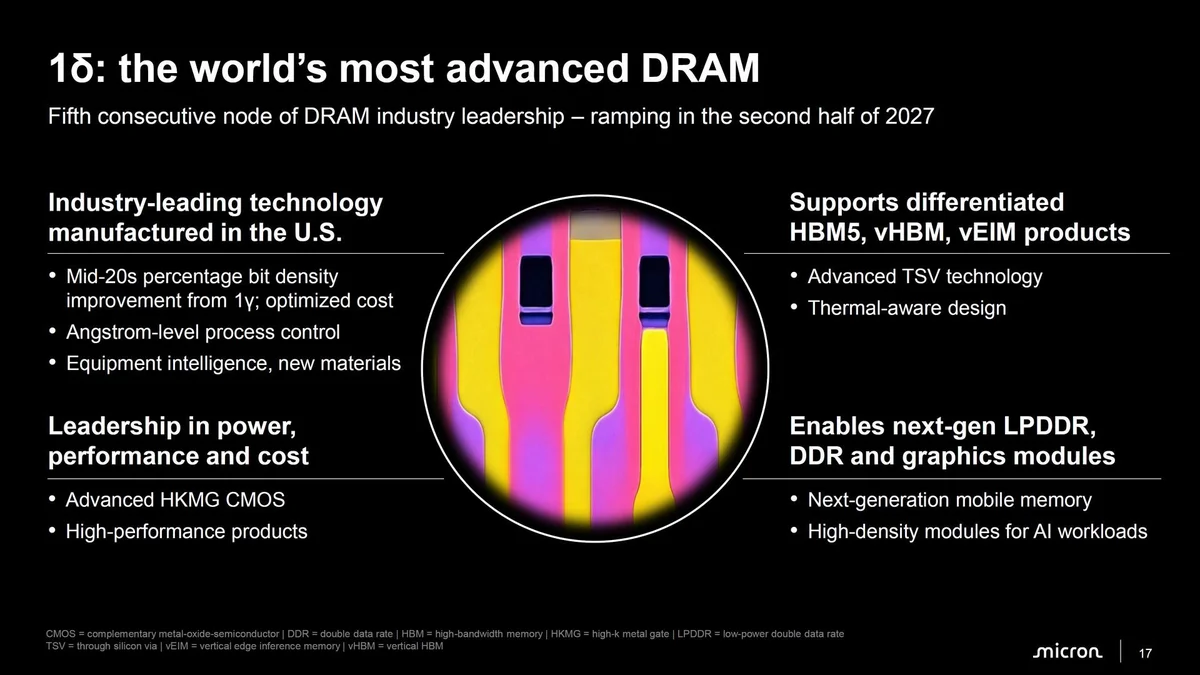
At the core of Micron's planar memory scaling is the upcoming 1-delta (1δ) DRAM node, which follows the current 1-gamma (1γ) generation. Manufactured in the United States and currently progressing through its yield ramp phase, the 1-delta process is scheduled to enter volume production in the second half of 2027. According to Micron's engineering team, 1-delta delivers a mid-20s percentage improvement in bit density over 1-gamma while incorporating advanced High-K Metal Gate (HKMG) CMOS transistors and angstrom-level process control.
This 1-delta foundation will underpin both DDR6 and LPDDR6 memory products. On the high-performance side, Micron states that DDR6 will deliver twice the bandwidth of DDR5, initially targeting high-reliability enterprise servers alongside massive next-generation 1TB RDIMM server modules (doubling the capacity of recent 512GB modules). Meanwhile, low-power LPDDR6 is engineered to provide 35% better power efficiency compared to LPDDR5, and even higher savings on select densities. While Micron is already co-designing LPDDR6 data center implementations with Meta, that 35% efficiency leap will also be pivotal for gaming laptops and next-generation handhelds like the Steam Deck 2 and PS6 portable.
Check Availability Crucial DDR5 RAM Availability on Amazon→
Scrapping 4F² DRAM After Two Decades and Stacking vHBM Vertically
One of the most striking disclosures from Micron CTO Scott DeBoer and his engineering team is the complete termination of future 4F² DRAM development. For decades, memory makers viewed 4F² cell layouts (which stand transistors upright to theoretically shrink cell area by 33% compared to conventional 6F² designs) as a primary scaling target. However, after more than twenty years of R&D, Micron concluded that 4F² has no viable long-term scaling path, offering negligible real-world density gains while driving up manufacturing complexity and wafer costs.
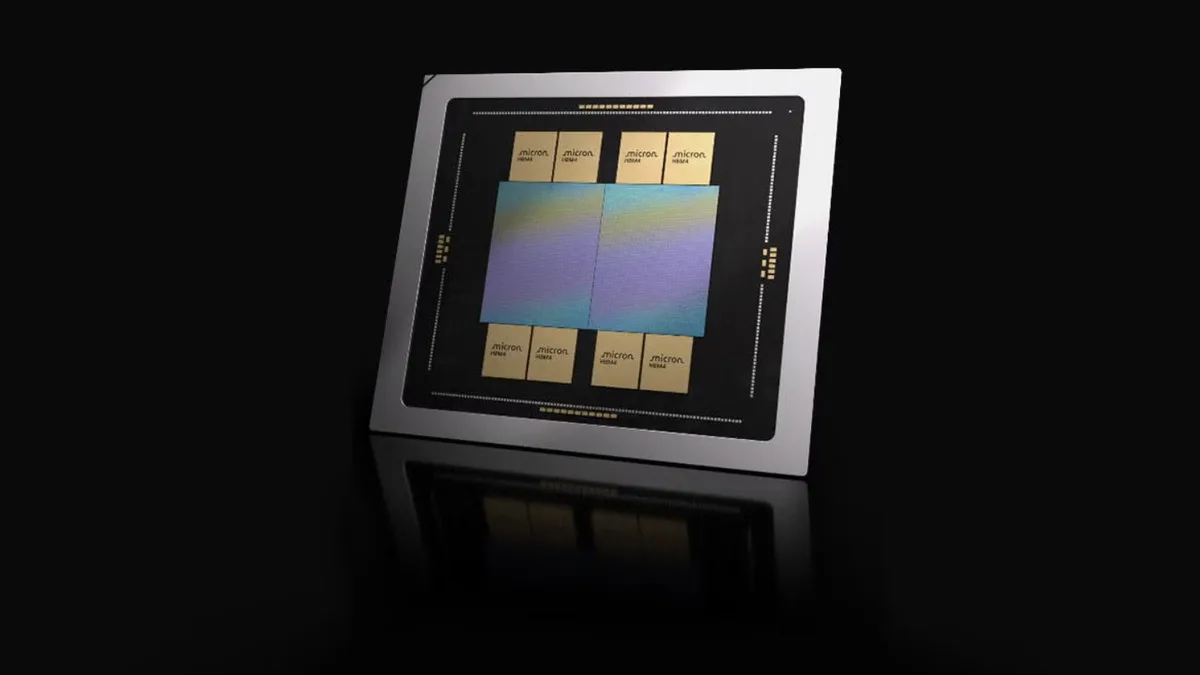
In contrast to Asian rivals such as CXMT that continue to pursue vertical-channel 4F² prototypes, Micron is doubling down on refined 6F² planar DRAM enhanced by High-NA EUV lithography, wafer bonding, and novel materials before transitioning directly to true 3D DRAM. In the high-bandwidth accelerator space, this vertical philosophy is already taking shape. Alongside 12-high HBM4 (rated at 2.8 TB/s per stack) and upcoming HBM4E and HBM5 generations, Micron is developing vHBM (vertical HBM) for the 2028 to 2030 window. Using tight-pitch hybrid bonding, vHBM stacks memory directly atop the compute die to minimize latency and maximize tokens per watt, complemented by a new vEIM (vertical edge inference memory) module targeting 2 TB/s of bandwidth at under 1 picojoule per bit.
G11 NAND Flash Surpasses 400 Layers for Next-Gen NVMe Storage
On the storage front, Micron is preparing to follow its current G9 flash with Generation 11 (G11) NAND, also slated for volume ramp in the second half of 2027. Built using wafer-on-wafer bonding to push past 400 layers with a tighter cell pitch, G11 NAND is projected to deliver roughly twice the bit density of G9 NAND, a 1.5x uplift in I/O speeds, and more than 25% better power efficiency per data transfer.
Yet the company's presentation leaves no doubt about which sector gets priority access to these wafers. Micron highlighted specialized "AI-class" NAND variants, including High-IOPS SLC NAND for fine-grained GPU data access and TSV-stacked high-bandwidth NAND placed near compute dies to handle model weights and KV caches. This relentless enterprise focus explains why consumer RAM prices continue to surge amid an AI-driven supply crunch that shows no sign of easing before 2028.
My Test Bench
From an engineering standpoint, seeing DDR6 double DDR5 bandwidth while G11 NAND breaks past 400 layers in late 2027 is genuinely exciting, and Micron's blunt decision to kill off 4F² DRAM after twenty years proves that real-world wafer economics always beat theoretical density slides. Still, looking at this roadmap as a PC builder, it is hard to ignore the elephant in the room. Micron openly notes that "agentic AI" requires up to thirty times more memory capacity than standard AI inference, meaning every early 1-delta wafer and DDR6 module will go straight to hyperscale data centers willing to pay top dollar. By the time DDR6 actually trickles down to consumer motherboards around 2028, it will require a brand-new CPU socket after the AM5 era and carry a steep early-adopter tax. If you are building or upgrading a gaming rig right now, waiting for DDR6 makes zero sense: a well-tuned DDR5 kit still has plenty of headroom before modern game engines come close to saturating its bandwidth.

PC hardware enthusiast and competitive gamer, Arthur 'Heimdall' splits his time between France and the UK working in enterprise B2B software solutions. A business school graduate passionate about component benchmarking, he has been building, modding, and tuning PCs since childhood, optimizing every thermal degree and millisecond of display latency. An avid gamer across Assassin's Creed and sandbox titles, he forged his alliance with Grimtag and Chaya during late-night World of Warcraft raids before joining Pro-Gamer.