PCIe 6.0 Without a New Socket and Support Past 2029: How AMD Plans to Stretch the AM5 Lifespan
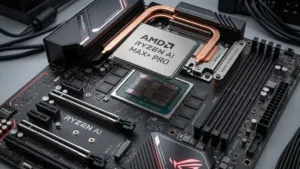
Upgrading your processor three or four years after building a gaming rig without ripping out the motherboard or buying a brand-new memory kit remains one of the strongest selling points of the AMD Ryzen ecosystem. While the Santa Clara chipmaker used Computex 2026 to officially extend its commitment to Socket AM5 (LGA 1718) through at least 2029, fresh technical remarks from AMD's client product leadership indicate that the platform launched in late 2022 could live well past that milestone while potentially accommodating the upcoming PCIe 6.0 standard.
Why 2029 Is Not a Hard Stop for the AM5 Ecosystem
In an in-depth interview in Tokyo with hardware journalist Yusuke Ohara for Japanese tech publication MyNavi Tech+, Travis Kirsch, Senior Director of Client Product Management at AMD, detailed the company's long-term socket strategy. Asked whether a next-generation AM6 platform would overlap with AM5 prior to 2029, Kirsch dismissed the idea of a rigid cutoff date: "Personally, 2029 does not feel that far away, and it does not necessarily mean it ends there."
According to Kirsch, AMD sets conservative public timelines simply because the company refuses to make a platform promise it cannot keep. In practice, AMD intends to stretch the AM5 lifecycle as long as technically possible, following the exact blueprint of Socket AM4, which celebrates its tenth anniversary in 2026. Every time a CPU maker introduces a new socket, motherboard pricing takes months to stabilize and partner lineups take time to mature. Avoiding premature socket transitions protects everyday PC builders, system integrators, and motherboard manufacturers alike.
Why PCIe 6.0 Does Not Automatically Require a Socket Change
The most intriguing takeaway from the discussion revolves around next-generation I/O standards. When pointed out that PCIe Gen 6 SSDs are already seeing wide adoption in enterprise data centers with consumer drives expected as early as next year, alongside JEDEC finalizing the DDR6 memory specification, Kirsch offered a telling engineering insight: "When it comes to PCIe, I am not sure whether we necessarily have to change the socket from AM5. We introduce a new socket when technical constraints force us to make a change, and that is not necessarily limited to memory or PCIe; it can stem from other factors."

When AMD transitioned from AM4 to AM5 in 2022, moving from a 1,331-pin PGA layout to the 1,718-pin LGA socket was justified by the simultaneous leap to DDR5 memory, PCIe 5.0 connectivity, and higher power delivery envelopes up to 170W TDP (230W PPT). Because Ryzen desktop processors rely on a modular chiplet architecture, AMD could theoretically pair future compute dies with an updated I/O die (cIOD) supporting PCIe 6.0 (which doubles bandwidth to 64 GT/s per lane using PAM4 signaling) while keeping the physical LGA 1718 pinout intact.
Still, keeping the same physical socket does not mean existing motherboards would magically unlock PCIe 6.0 speeds through a simple BIOS update. Sustaining 64 GT/s PAM4 signaling requires ultra-low-loss PCB traces and new chipset designs. However, just as AMD brought PCIe 4.0 to Socket AM4 with Ryzen 3000 processors on X570 and B550 boards while maintaining drop-in CPU compatibility on older 300- and 400-series motherboards at PCIe 3.0 speeds, future Zen 6 or Zen 7 chips could slot into current B650, B850, or X870E boards while reserving PCIe 6.0 lanes for next-generation AM5 chipsets.
CUDIMM Memory, DDR5 Sweet Spots, and Shared 12-Core Zen 6 Chiplets
While Micron's roadmap toward next-generation DDR6 memory starting in 2027 lays the groundwork for the next decade, the interview also touched on newer CUDIMM, CAMM2, and HUDIMM DDR5 modules that push native speeds to 8,800 MT/s and overclocked kits past 10,000 MT/s. Here, Kirsch admitted candidly that AMD does not currently see "a very large opportunity" for those niche form factors on AM5. Because of internal memory controller and infinity fabric clock ratios, speeds around the 6,000 MT/s range remain the optimal sweet spot for minimizing latency on current Ryzen platforms, even as recent X870E motherboards capable of running 192GB of low-latency DDR5 continue to refine four-slot signal integrity.
Finally, when asked about the 12-core Zen 6 CCD (and 32-core Zen 6c) chiplets unveiled in July at AMD Advancing AI 2026 for 6th Gen EPYC server processors (codenamed Venice and Verano), Kirsch reaffirmed that AMD's foundational strategy remains sharing core architectures and silicon dies across server and client desktop lineups whenever it maximizes manufacturing efficiency. Bound by the pre-earnings quiet period, he declined to confirm specific desktop SKU configurations, but for PC gamers facing steep DDR5 pricing, knowing that Socket AM5 has runway beyond 2029 is a major vote of confidence.
My Test Bench
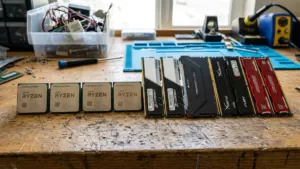
From an electrical engineering standpoint, Travis Kirsch's remarks about decoupling PCIe 6.0 from a mandatory socket change make complete sense if you look back at how AMD handled Socket AM4 in 2019. On my own test bench, the transition to Ryzen 3000 Matisse proved that a CPU can carry an upgraded PCIe controller without altering the socket footprint: pairing that chip with a freshly routed X570 or B550 board unlocked full PCIe 4.0 bandwidth, while dropping it into an older B350 or X470 board still delivered every ounce of Zen 2 compute performance at PCIe 3.0 speeds. If AMD applies that exact playbook to LGA 1718 across Zen 6 and Zen 7 past 2029, buying a well-built B850 or X870E motherboard with sturdy VRMs today locks in at least four more years of drop-in CPU upgrades without forcing a costly RAM and motherboard overhaul.

PC hardware enthusiast and competitive gamer, Arthur 'Heimdall' splits his time between France and the UK working in enterprise B2B software solutions. A business school graduate passionate about component benchmarking, he has been building, modding, and tuning PCs since childhood, optimizing every thermal degree and millisecond of display latency. An avid gamer across Assassin's Creed and sandbox titles, he forged his alliance with Grimtag and Chaya during late-night World of Warcraft raids before joining Pro-Gamer.