Patent US 2026/0357800 A1: Sony Designs an 8-Blower Piezoelectric Collar for the PS VR2 Headset
When you are standing in a pitch-black room inside a virtual reality horror game, your eyes and ears still leave one glaring blind spot: whatever is creeping silently behind your back. To close that sensory gap, Sony Interactive Entertainment Inc. has published a new filing with the United States Patent and Trademark Office (USPTO) on November 12, 2026 under publication number US 2026/0357800 A1 (filed April 30, 2026, claiming priority from provisional application No. 63/802,735 submitted on May 9, 2025). Authored by five Sony engineers (Yasushi Okumura, Akihito Nishiike, Kentaro Yoshida, Kyosuke Uchida, and Koichi Shiono), the 13-sheet document details a wearable curved collar designed to fire targeted puffs of air onto a player's neck, chin, and lower face to "increase the sense of immersion."
8 Ultrasonic Piezoelectric Blowers Spaced 30 Degrees Apart
Blowing air at a player to simulate wind is easy in theory, but traditional spinning fan blades fail in virtual reality for two obvious reasons: mechanical whine right next to the user's ears and rotational inertia that causes noticeable lag between on-screen action and physical airflow. As illustrated in Figures 1 and 4 of patent US 2026/0357800 A1, Sony solves both problems with a horseshoe-shaped curved neckband (labeled 20 and 22 in the schematics) that rests around the user's neck alongside a headset such as the PlayStation VR2.
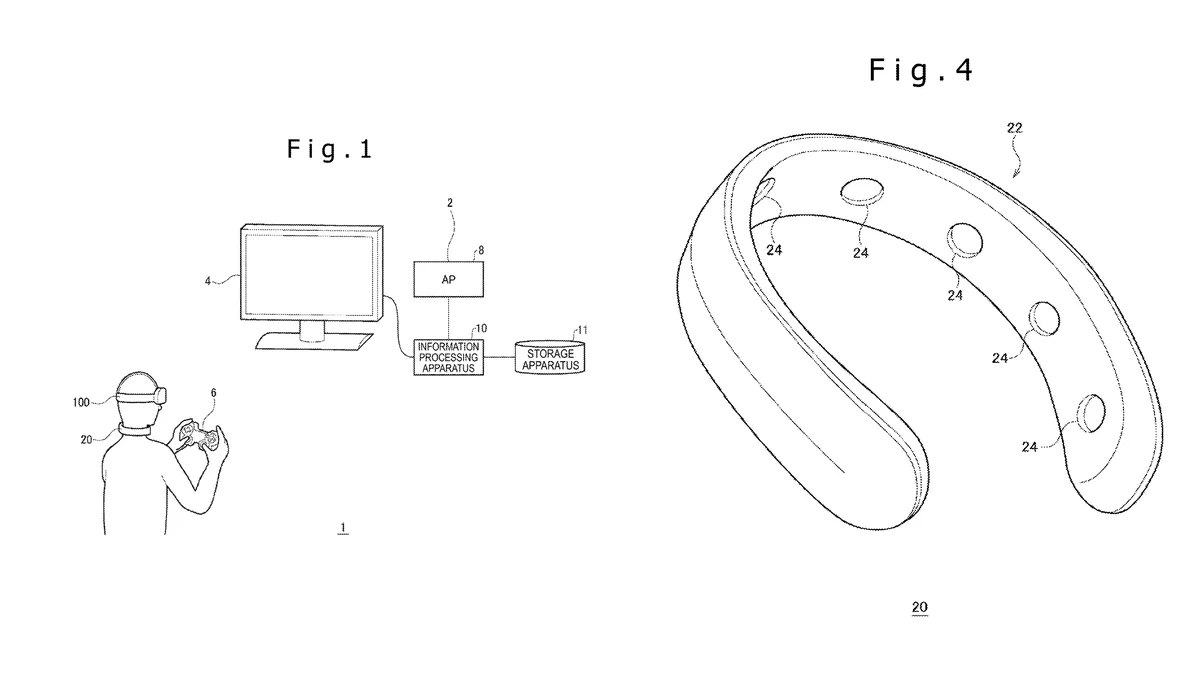
In the primary configuration outlined by Sony, the inner surface of the collar is lined with a row of circular vents (24) housing 8 miniature air blowers spaced roughly 30 degrees apart so that each unit covers a distinct angle around the throat and the back of the neck. Instead of conventional rotary motors, each blower relies on a piezoelectric element that vibrates a thin plate at ultrasonic speed when electrical current is applied. Because piezoelectric plates have almost zero spin-up inertia, the vents can start, stop, or pulse air streams nearly instantaneously and without audible fan noise that would interfere with 3D spatial audio.
Check Availability for Sony PlayStation VR2 on Amazon→
From Monsters Circling in the Dark to Doors Swinging Open
Linked wirelessly to a PlayStation 5 console or PC via an onboard communication unit, the collar receives real-time control signals calculated from the player character's position relative to surrounding threats and objects. Across Figures 10 through 13 of the filing, Sony's engineering team walks through several concrete gameplay triggers:
- Opening a door in first-person view: when a player pushes a door open to enter an adjacent room, the two front-facing blowers fire simultaneously to mimic a head-on draft coming through the doorway.
- An enemy circling in the dark (Figure 11): if an unseen monster moves around the player in a dark room, the vents fire in sequence (traveling from the front to the right side and then to the back of the neck), making a physical breeze crawl across the skin to betray the creature's trajectory.
- An attacker closing in from behind (Figure 13): as a threat creeps closer to the player's back, the rear vents emit pulsed puffs of air that grow both stronger and more frequent as the distance shrinks.
- Sprinting speed, voice modulation, and psychological tension: the controller can also scale head-on wind intensity to match the character's running speed, apply a gradual ramp-up delay for natural weather transitions, fire random gusts to build dread in horror scenes, or even shape airflow pulses to match a character's voice or breathing close to the player.

Sony's 14th Wearable Patent Since June Casts a Wide Legal Net
As spotted by patent analytics tracker Patentlyze, which notes that this is Sony's 14th wearable hardware filing published since June (following applications for ear-cup cooling fans inside VR headsets and biometric noise filters), the legal scope of the document reaches well beyond horror games. Claim 1 of the patent is written in deliberately broad terms: it covers any neck-worn apparatus that receives a control signal from an external machine and activates multiple blowers toward the neck or head, with no strict requirement that the host device be a game console.
That broad claim structure protects Sony Interactive Entertainment whether the collar is sold as a dedicated PlayStation peripheral or adapted for interactive cinema, mobile apps, and smart home hardware. It also underscores how actively Sony's hardware R&D labs are experimenting with sensory peripherals as the PlayStation 5 install base surpasses 100 million units, arriving just days after patent US 2026/0273403 A1 revealed a contactless NFC card reader built into a PlayStation controller.
Check Availability for DualSense Wireless Controller on Amazon→
My Field Notes
Looking closely at the 13 drawing sheets in US 2026/0357800 A1, the engineering detail that stands out to me is the choice of ultrasonic piezoelectric plates over standard micro-fans. Anyone who has spent hours inside a VR headset knows that mechanical fan buzz ruins quiet atmospheric scenes immediately, whereas a silent, zero-latency puff of air brushing the back of your neck when an enemy stalks you in a dark corridor would trigger an instant physical goosebump response. The real hurdle is ergonomic adoption: convincing players to strap on a separate collar alongside a headset and two controllers is a tough sell for a standalone accessory. If Sony ever integrates these ultrasonic vents directly into the rear headband of a future PlayStation VR headset, however, both the spatial awareness and the added cooling during long sessions could make it a genuinely smart hardware upgrade.

Originally from Lyon, France, gaming journalist Bastien "Orion" relocated nearly a decade ago to Quebec City's Saint-Roch district, right in the heart of eastern Canada's development studio hub. Before crossing the Atlantic, he honed his versatile reporting style across classic French gaming web portals and specialist television outlets in the 2000s and 2010s, notably with JeuxVideo.fr and JeuxNews. Equally passionate about AAA blockbusters, North American studio culture, retro preservation, and community modding projects, he anchors Pro-Gamer's transatlantic desk and real-time coverage of US and Japanese industry announcements.