Trading 256 GB of TLC Storage to Back Up GPU VRAM and DDR5: Inside ORICO's FlashMem FM9800 PCIe 5.0 SSD and Its pSLC Cache
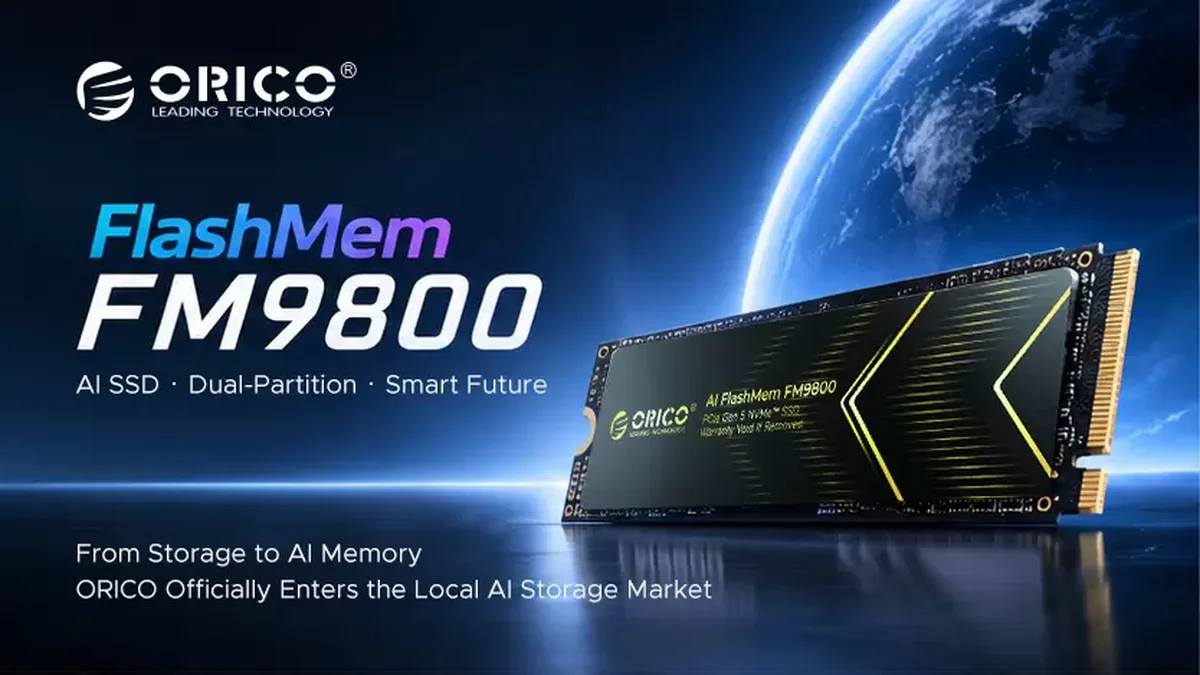
As system memory prices continue to climb and high-capacity GPU VRAM remains locked behind flagship price tags, storage manufacturer ORICO is taking an unconventional hardware approach with its new FlashMem FM9800 SSD. Built in a standard M.2 2280 form factor over a PCIe 5.0 x4 interface, the drive intentionally sacrifices a portion of its raw flash capacity to carve out a permanent, high-endurance pSLC partition designed to act as an overflow memory tier alongside GPU VRAM and system RAM.
768 GB or 1,638 GB of Standard Storage Paired With a Dedicated pSLC Cache
On a conventional consumer NVMe drive built with 3D TLC NAND flash (three bits per cell), dynamic SLC caching shrinks dramatically as the drive fills up, causing sustained write speeds to plummet and accelerating cell wear under heavy swap workloads. With the FlashMem FM9800, ORICO divides the drive at the hardware and firmware level into two distinct volumes right out of the box: a general-purpose Storage OS partition for your operating system, games, and applications, and an isolated AI Cache partition permanently locked into pSLC mode (one bit per cell).
The math behind the drive's unusual capacity numbers comes directly from this three-to-one bit conversion. On the 1 TB model (1,024 GB of raw NAND), ORICO keeps 768 GB as standard 3D TLC storage and converts the remaining 256 GB of TLC flash into single-bit pSLC mode, yielding an exact 85 GB high-endurance cache partition. On the 2 TB version (2,048 GB raw), the main operating partition provides 1,638 GB of usable space while the remaining 410 GB of raw flash forms a dedicated 128 GB pSLC buffer.
Check Availability for ORICO M.2 SSDs on Amazon→
A Three-Tier Memory Hierarchy to Back Up Soldered RAM and GPU VRAM
To prevent heavy caching cycles from prematurely wearing out the drive, the FM9800 controller enforces independent wear-management strategies and separate read/write scheduling queues for each partition. Constant read and write operations generated by model weights, long-context windows, and KV Cache offloading stay strictly confined within the pSLC region, leaving the OS and personal data blocks untouched. To keep PCIe 5.0 controller temperatures in check during sustained transfers, ORICO includes a graphene thermal pad across the M.2 2280 PCB.
On the software side, the drive integrates with specialized AI storage middleware and the Herdsman local inference engine to coordinate data across a three-tier hierarchy: GPU VRAM at the top, system RAM in the middle, and the 85 GB or 128 GB PCIe 5.0 pSLC flash cache underneath. At a time when a 322% surge in DDR5 RAM pricing has made high-capacity memory kits prohibitively expensive for desktop builders, ORICO is also targeting compact workstations with non-upgradeable memory.
Specifically, ORICO points to systems powered by the AMD Ryzen AI Max+ 395 platform, where unified LPDDR5X memory is soldered onto the board and cannot be expanded after purchase. Meanwhile, on desktop rigs running modern AM5 motherboards with PCIe 5.0 M.2 slots, dropping in a dual-partition drive allows local workloads to spill over into fast pSLC flash without thrashing the primary system partition.
My Field Notes
What stands out to me about the FlashMem FM9800 isn't the AI branding on the label, but the straightforward physics of a fixed pSLC partition over PCIe 5.0. Enthusiasts have manually over-provisioned NVMe drives for years to preserve sustained write speeds, yet conventional controllers still fold those cells back into standard TLC storage once the dynamic buffer fills up. By permanently locking 256 GB or 410 GB of raw 3D TLC into single-bit pSLC mode with its own independent wear-leveling and I/O scheduler, ORICO is effectively building a dedicated high-endurance scratch disk right next to your boot drive. Two key details will determine whether this hardware hits the mark once full specifications drop: the official Terabytes Written (TBW) endurance rating on that pSLC partition, and whether power users can mount that 85 GB or 128 GB pSLC zone as a raw scratch volume in Windows or Linux without relying exclusively on the Herdsman middleware.

Originally from Lyon, France, gaming journalist Bastien "Orion" relocated nearly a decade ago to Quebec City's Saint-Roch district, right in the heart of eastern Canada's development studio hub. Before crossing the Atlantic, he honed his versatile reporting style across classic French gaming web portals and specialist television outlets in the 2000s and 2010s, notably with JeuxVideo.fr and JeuxNews. Equally passionate about AAA blockbusters, North American studio culture, retro preservation, and community modding projects, he anchors Pro-Gamer's transatlantic desk and real-time coverage of US and Japanese industry announcements.