
U.S. Military Uses Xbox-Style Controllers for Lasers: The Dangerous Gamification of Warfare
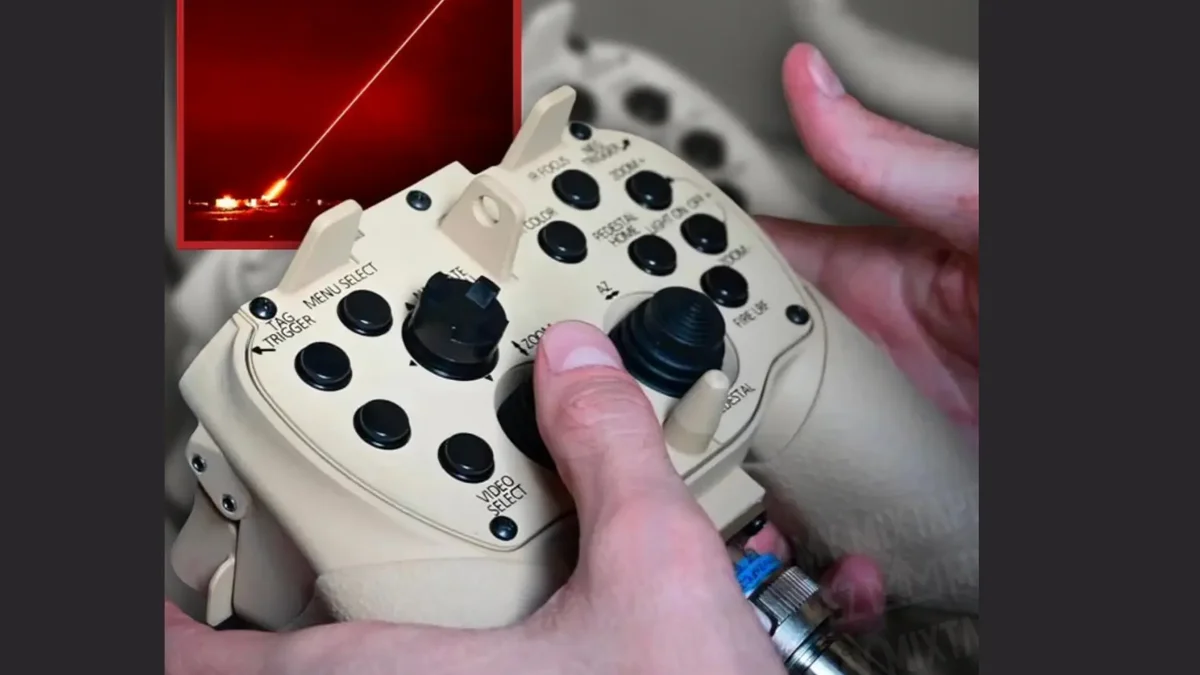
Two asymmetrical thumbsticks, a directional pad, four face buttons under the right thumb, and twin analog triggers. The device resting on U.S. military tactical consoles looks virtually identical to the controller plugged into our living room setups.
While viral social media posts cite an unverified $2,200 price tag, the technical reality is undeniable. This is not an official Microsoft retail product, but a ruggedized, militarized control unit designed specifically around the Xbox layout to operate high-energy directed-energy weapons.
Tactical Lasers Powered by Gamer Muscle Memory
Mounted on warships and tactical ground vehicles, particularly in tense hotspots like the Strait of Hormuz, these high-energy lasers are fundamentally shifting tactical air defense. Systems such as AeroVironment's LOCUST and Lockheed Martin's HELIOS track and neutralize suicide drones and cruise missiles mid-flight.
The economic math is compelling for defense planners. While firing a traditional interceptor missile burns through one to two million dollars per shot, an operational laser pulse costs merely a few dollars worth of electricity.
To operate these optical turrets with surgical precision, military contractors discarded cumbersome custom joysticks. Younger recruits enter the ranks with thousands of hours already logged on consoles and PC controllers.
Their muscle memory is pre-calibrated to twin thumbsticks and analog triggers. Training operators on high-energy laser targeting no longer requires weeks in complex simulators, but just a few minutes in the field.
When Consumer Ergonomics Enter the Kill Chain
Borrowing consumer gaming hardware is not without precedent for the Pentagon. In 2018, the U.S. Navy made headlines by replacing $38,000 periscope control sticks on Virginia-class submarines with commercial Xbox 360 controllers.
However, today's transition carries far more serious ethical implications. The familiar joypad layout is no longer just steering an observation camera; it is actively weaponized to acquire targets and open fire.
Even as a specialized mil-spec derivative rather than an official corporate tie-in, the visual association remains unsettling for the gaming medium. Seeing hardware designed for play linked to live-fire military engagement creates an uncomfortable dissonance.
Drone Warfare and the Psychological Buffer of the Screen
Beyond the physical interface, militarizing game controllers highlights a chilling psychological reality: the well-documented detachment of drone warfare taken to its logical extreme.
Stationed in an air-conditioned command module thousands of miles away, an operator executes lethal strikes while looking at a monitor. Even with full intellectual awareness of the action, the physical, sensory impact of combat is absent.
The screen functions here as an emotional shield. It mirrors the exact subconscious barrier that enables a war photographer to keep pressing the shutter under heavy fire, believing the viewfinder isolates them from surrounding danger.
It is the same mental filter that allows a broadcast cameraman to document traumatic violence without flinching. The screen interposes an artificial boundary that mutes terror and insulates the human mind from raw carnage.
When the Interface Erases the Gravity of Reality
Screens naturally position humans as detached observers, insulated from the visceral weight of the outside world. We consume live footage without feeling its physical consequences.
By pairing optical feeds with an interface patterned after a game console, the military eliminates the last point of physical friction. Taking out a target mimics the exact same hand gestures as scoring an elimination in a multiplayer shooter.
Directed-energy weapons reduce ammunition costs and accelerate response times. But when lethal force is channeled through an interface designed for games, the boundary between digital simulation and lethal combat begins to vanish.

SEO consultant for over 20 years and digital entrepreneur, Charles 'Grimtag' Ronchain is the founder of Pro-Gamer.gg, Retrocharting.com, and Gamescharting.com. A competitive gamer, streamer, and retro game collector, he has worked in the video game industry for over 15 years, notably as a consultant for leading game price comparison platforms. Passionate about real-time performance data and gaming technology, he analyzes competitive esports, gaming hardware benchmarks, and creator workflows on Pro-Gamer.gg with an authentic player perspective.