144 GitHub Repositories Wiped Out at Once: Nintendo Targets Picofly and RP2040 Switch Modchip Firmware in New DMCA Strike
After methodically dismantling the software emulator ecosystem over the past two years, Nintendo of America's legal team has opened a major new hardware front on GitHub. According to an official DMCA takedown notice published in the platform's public transparency repository, the company has secured the immediate removal of 144 repositories linked to the open-source Picofly hardware modchip firmware for the Nintendo Switch.
A Targeted Takedown Against the Ansem-SoD/Picofly Network and Its 143 Forks
Submitted to GitHub Trust & Safety by an authorized agent of Nintendo of America Inc., the enforcement notice primarily targeted the parent repository Ansem-SoD/Picofly, which hosted boot binaries and wiring diagrams for the popular hardware modification project. Because the repository's fork tree exceeded GitHub's hundred-repository threshold and Nintendo certified under penalty of perjury that all or most of those forks infringed to the same extent as the parent project, the platform triggered its network-wide takedown protocol.
In a single sweep, GitHub disabled the entire network of 144 repositories, wiping out both the original project and 143 community forks at once. This legal strike complements Nintendo's broader security lockdown across both console generations, arriving just days after the company rolled out Nintendo Switch 2 firmware update 23.5.0 to patch the ns2jb system exploit and halt unauthorized cartridge dumping.
Why a Sub-$4 Raspberry Pi RP2040 Microcontroller Became Nintendo's Primary Target
To understand why Picofly drew such aggressive scrutiny from Redmond's legal counsel, one has to look at the evolution of Nintendo Switch hardware revisions. While original launch units released in March 2017 (codenamed Erista) contained an unpatchable BootROM vulnerability in their NVIDIA Tegra X1 processor, every 16 nm revision manufactured since mid-2019 (codenamed Mariko, powering the extended-battery Switch, Switch Lite, and Switch OLED Model) fixed that software flaw at the silicon level.
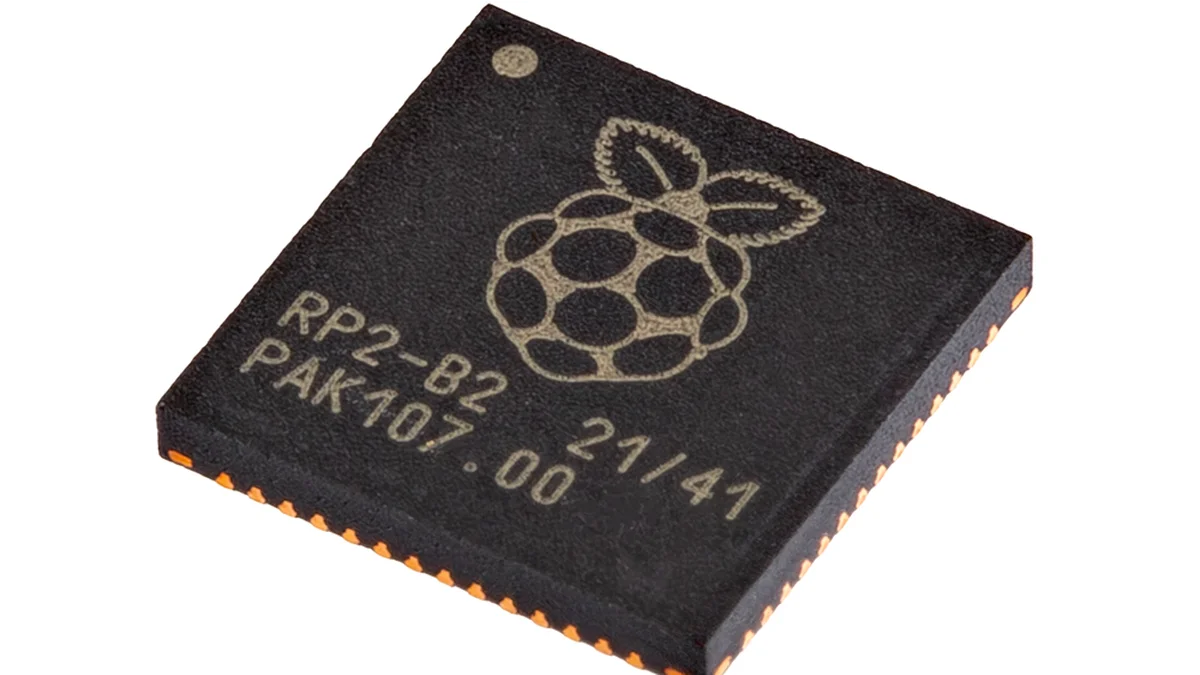
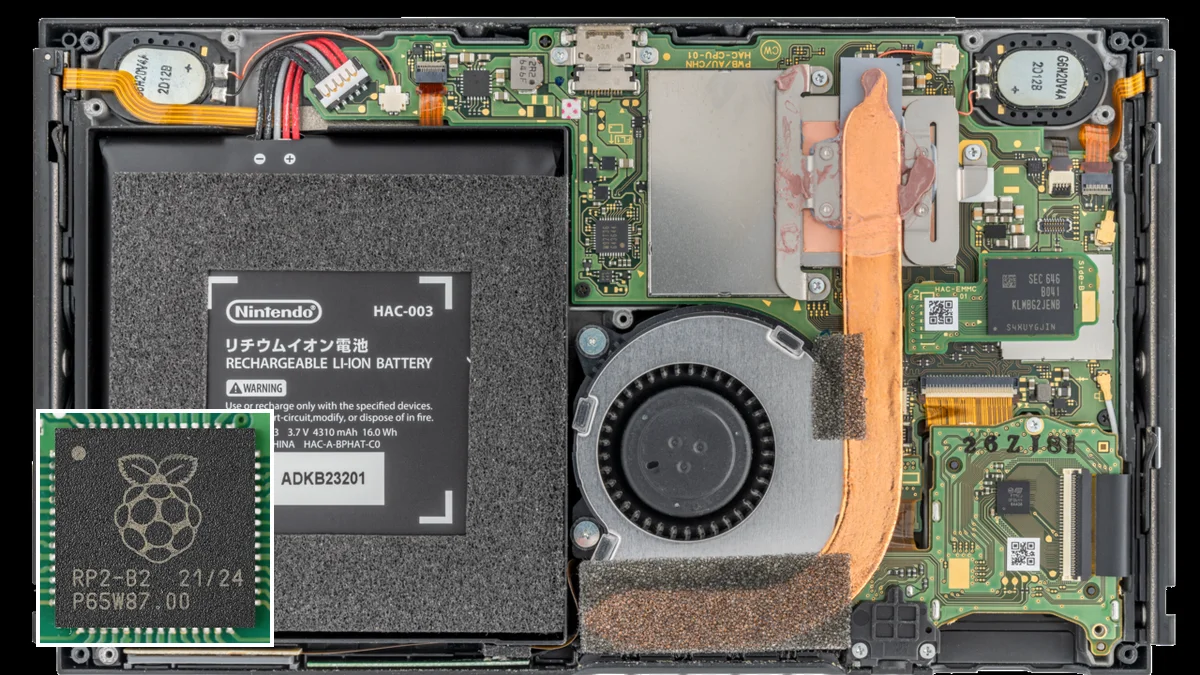
For years, bypassing the secure boot chain on Mariko and OLED motherboards required expensive proprietary modchips such as SX Core and SX Lite, followed by Chinese HWFLY clones built around costly Lattice FPGA chips retailing between $60 and $100. The Picofly project upended that underground economy overnight: as our hardware specialist Arthur "Heimdall" often points out, the firmware replaced those custom FPGAs with a tiny, off-the-shelf Waveshare RP2040-Zero development board powered by the Raspberry Pi RP2040 microcontroller,a completely legal, dual-core ARM Cortex-M0+ chip costing less than $4.
By leveraging the deterministic timing of the RP2040's Programmable I/O (PIO) state machines running at 133 MHz, the Picofly firmware monitors traffic along the console's internal eMMC flash memory bus (HAC-EMMC) during startup. At the exact nanosecond the processor checks the cryptographic signature of the Boot Configuration Table (BCT), the microcontroller injects a precise voltage pulse onto the CMD line (a hardware attack known as voltage glitching), causing the bootrom to skip the signature check and load unsigned code prior to the Horizon OS kernel.
Check Availability Nintendo Switch OLED on Amazon→
17 U.S.C. § 1201 Anti-Circumvention Law and the Team-Xecuter Precedent
Because Nintendo obviously cannot ban the sale of a general-purpose Raspberry Pi microcontroller, its attorneys targeted the specialized firmware required to orchestrate the eMMC glitch. In its filing, Nintendo explicitly names four modchip families,SX Core, SX Lite, HWFLY, and Picofly,and anchors its claim in 17 U.S.C. § 1201(a)(1) and (2) of the Digital Millennium Copyright Act, which prohibits trafficking in technology primarily designed to circumvent technological protection measures (TPMs).

To establish the copyrighted works protected by its secure boot sequence and cryptographic signatures, Nintendo cites four flagship U.S. Copyright Office registrations in the notice:
- Mario Kart 8 Deluxe (U.S. Copyright Registration
PA0002051900); - Animal Crossing: New Horizons (U.S. Copyright Registration
PA0002233840); - Super Smash Bros. Ultimate (U.S. Copyright Registration
PA0002151614); - The Legend of Zelda: Breath of the Wild (U.S. Copyright Registration
PA0002028142).
Notably, Nintendo's legal brief directly invokes federal criminal case law,citing United States v. [private], No. 2:20-cr-00127-RSL, the Western District of Washington prosecution brought by the U.S. Department of Justice against the leaders of Team-Xecuter. On the very same day, a parallel DMCA notice took down the IpwnedU/yuzu-android-master repository over unauthorized use of prod.keys decryption keys, underscoring how closely the company is policing every hardware and software vector following the CivSwitch cartridge vulnerability discovered on Nintendo Switch 2 earlier this month.
My Take
By going after Picofly firmware repositories on GitHub nearly ten years into the original Switch lifecycle, Nintendo is sending an unmistakable warning to the hardware reverse-engineering scene. As long as modchips relied on expensive, custom-manufactured boards shipped through gray-market channels, customs seizures and supply-chain lawsuits were enough to contain them. Once clever PIO programming turned a $4 off-the-shelf RP2040 board from any electronics retailer into a reliable eMMC glitcher, the open-source firmware itself became the only choke point left to strike. With Nintendo Switch 2 hardware security now at the center of the company's long-term strategy, Kyoto is making it clear that even clean-room glitching code containing zero proprietary Nintendo keys will face the full weight of Section 1201 on mainstream code-hosting platforms.

SEO consultant for over 20 years and digital entrepreneur, Charles "Grimtag" is the founder of Pro-Gamer.gg, Retrocharting.com, and Gamescharting.com. A competitive gamer, streamer, and retro game collector, he has worked in the video game industry for over 15 years, notably as a consultant for leading game price comparison platforms. Passionate about real-time performance data and gaming technology, he analyzes competitive esports, gaming hardware benchmarks, and creator workflows on Pro-Gamer.gg with an authentic player perspective.