168 Hand-Wired Pins and DOOM Running Smoothly: How an Engineer Built a 66 MHz Intel 486 DX2 Retro PC on Breadboards in 16 Days
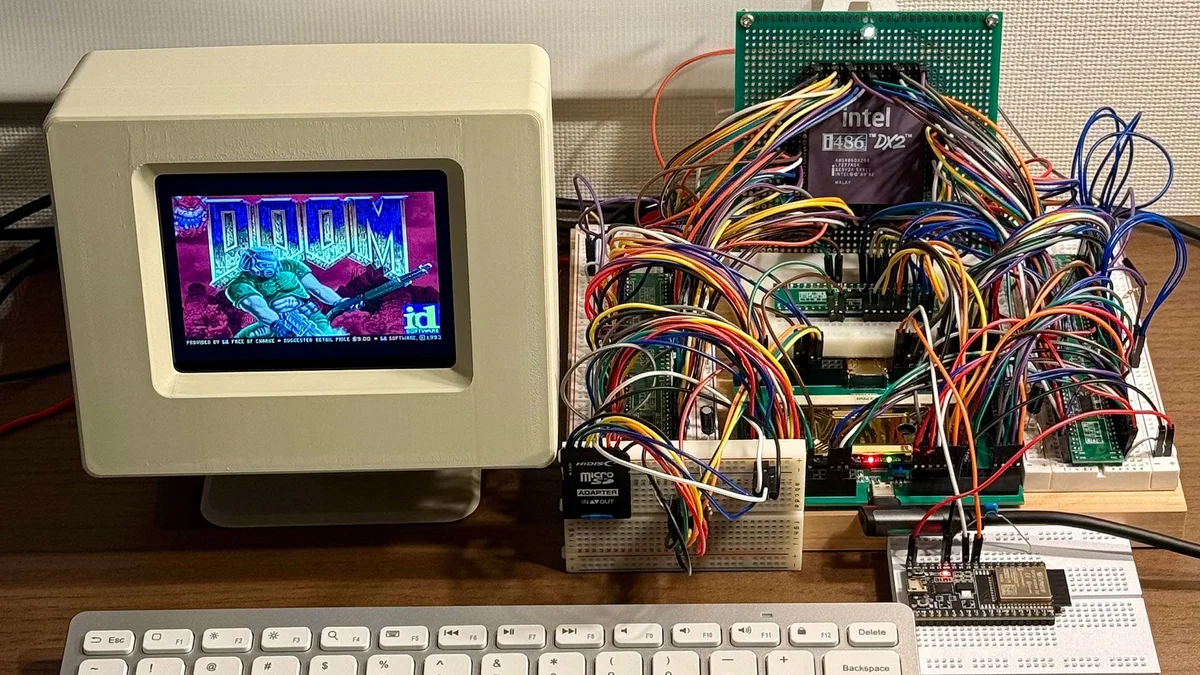
Getting an 8-bit microprocessor from the 1970s to run at a few megahertz on a solderless breadboard is already a rewarding electronics project. Applying that same approach to a 32-bit 66 MHz Intel i486 DX2 processor, however, pushes physical signal integrity to the brink: at those clock speeds, stray capacitance across metal contact strips and crosstalk between jumper wires usually turn any breadboard rig into a random crash generator. Yet Tokyo-based iOS application engineer Ryo, known as @nagakurage on X, pulled off the feat in just 16 days, assembling a working x86 breadboard PC from scratch and firing up DOOM.
168 Individually Wired CPU Pins Backed by a Colorlight i9 FPGA
The build kicked off on October 24 with the arrival of the centerpiece silicon: an authentic 1992 Malaysian-made ceramic Intel i486 DX2-66 processor (part number A80486DX2-66). Unlike modern high-density LGA or PGA chips, this early-1990s workhorse features 168 thick through-hole pins and runs internally at 66 MHz via a 2x clock multiplier over a 33 MHz front-side bus (FSB). Rather than stumbling upon a forgotten pre-assembled relic like the 1983 Humdinger 8-bit computer uncovered in a Goodwill keyboard bin, the goal here was to construct a working x86 host platform without a commercial motherboard.
Instead of ordering a custom multi-layer printed circuit board (PCB) right away, the builder first crafted an experimental socket on a green perfboard baseboard, routing every single one of the 486 CPU's 168 pins individually. From there, a dense canopy of multicolored jumper wires fans out across multiple white solderless breadboards. Because raw breadboard strips alone cannot handle high-speed chipset timing and video bus duties without severe signal degradation, the processor interfaces with a Colorlight i9 v7.2 FPGA board (built around a Lattice ECP5 FPGA) to handle core chipset logic, alongside a dedicated microcontroller module managing keyboard input.
From the First x86 LED Blink to Smooth DOOM Fragging in 16 Days
The pace of the hardware bring-up was remarkably brisk. By October 26, just forty-eight hours after wiring up the experimental socket, the Intel chip showed its first sign of life by blinking an LED through native x86 code execution. Five days later, on October 31, system RAM was wired into the breadboard array and fine-tuned until memory read and write cycles ran completely error-free despite the long jumper leads.
A major milestone followed on November 3 when a microSD card adapter was wired into the front breadboard, allowing the homemade 486 rig to boot FreeDOS 1.3 for the very first time. Finally, on November 9, exactly 16 days after the CPU first appeared on the workbench, the completed system booted straight into id Software's 1993 classic DOOM, delivering smooth early-1990s DOS performance right through its maze of jumper wires.

A 5-Inch 3D-Printed Beige CRT Monitor and Plans for NEC PC-98 Compatibility
To give the exposed tangle of wires a fitting visual companion, the developer also built a miniature desktop monitor modeled after thick-bezel beige CRT displays from the early 1990s. The enclosure was designed with help from Claude, printed on a Bambu Lab A1 mini 3D printer, and fitted around a 5-inch 800×480 Elecrow Raspberry Pi LCD panel. Standing at the opposite end of the custom hardware spectrum from the Ark Star Vessel open-frame spaceship PC mod, the pairing of a tiny beige CRT shell with an open-air 486 breadboard captures pure retro-engineering charm.
Running DOOM under FreeDOS 1.3 is only the beginning for this breadboard machine. Next on the roadmap is refining the FPGA chipset logic to make the homemade 486 system fully compatible with the NEC PC-9800 (PC-98) standard, the legendary Japanese personal computer architecture that dominated the domestic gaming and computing market throughout the early 1990s.
My Take on the Spec Sheet
When my night-shift colleague Bastien passed this build across my desk, my first instinct was to check whether an ESP32 was secretly emulating the whole thing under a decorative heatsink. Seeing a real 1992 ceramic Intel 486 DX2-66 push signals across dozens of long jumper wires and solderless breadboard strips without drowning in capacitive crosstalk is electrical wizardry. Pairing those 168 hand-wired vintage pins with a Lattice ECP5-based Colorlight i9 FPGA for chipset duties is a brilliant engineering shortcut, and I cannot wait to see this breadboard rig boot native NEC PC-98 classics next.

PC hardware enthusiast and competitive gamer, Arthur 'Heimdall' splits his time between France and the UK working in enterprise B2B software solutions. A business school graduate passionate about component benchmarking, he has been building, modding, and tuning PCs since childhood, optimizing every thermal degree and millisecond of display latency. An avid gamer across Assassin's Creed and sandbox titles, he forged his alliance with Grimtag and Chaya during late-night World of Warcraft raids before joining Pro-Gamer.