Inside the Ark Star Vessel PC Mod: An Open-Frame Spaceship Rig Powered by a Ryzen 7 9850X3D and RTX 5070
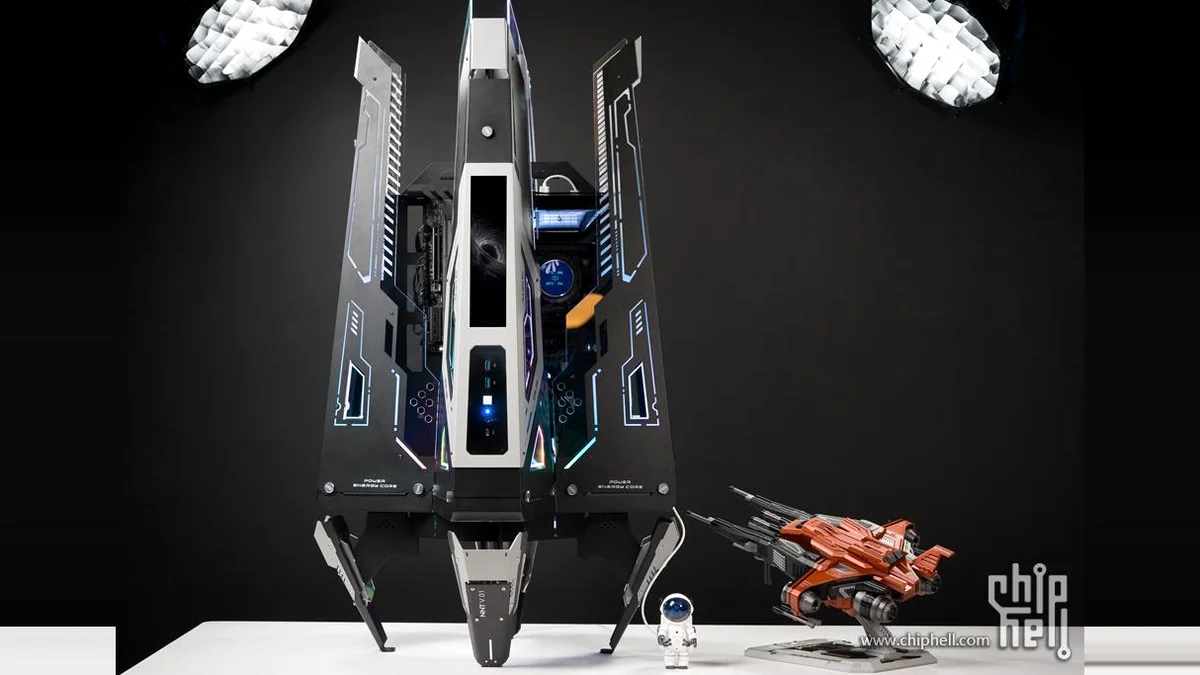
Standard tempered-glass mid-towers eventually start blending together on every gaming desk. For the 11th edition of the prestigious King of PC Building competition (机王争霸赛) hosted on the hardware enthusiast forum Chiphell, builder cp14228823 went in the exact opposite direction with Ark Star Vessel, earning second place in the fiercely contested ATX division.
Designed around an interstellar exploration ark concept, the rig ditches traditional closed side panels to mount its hardware vertically atop a three-legged mechanical landing gear. Between its angled black-and-silver armor plates, dual telemetry displays, and flagship AM5 silicon, the system looks far closer to an orbital lander on a launchpad than a conventional desktop PC.
An ALSEYE Star Ark Open-Frame Chassis Built Like a Lunar Lander
The unmistakable silhouette of the Ark Star Vessel starts with the ALSEYE Star Ark (方舟) open-frame chassis. Constructed from 3mm-thick SPCC steel and split wing-like side fairings, this modular exoskeleton leaves the core components exposed to ambient air to eliminate heat pockets.
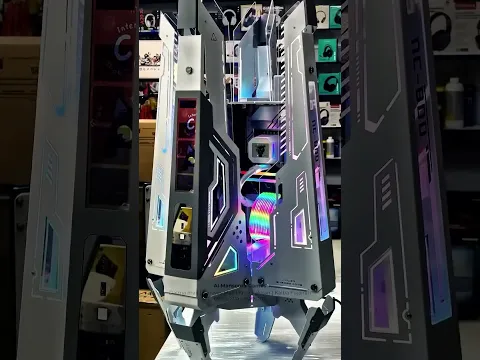
Along the central spine of the fuselage, a vertical display panel runs a live black-hole animation right above the front I/O cluster, which houses one USB Type-C port, two USB 3.0 ports, and HD audio jacks. To complete the sci-fi staging, cp14228823 tuned the ARGB strips to a crisp ice-blue and cosmic-white palette while flanking the landing struts with an astronaut figurine and a miniature escort gunship.
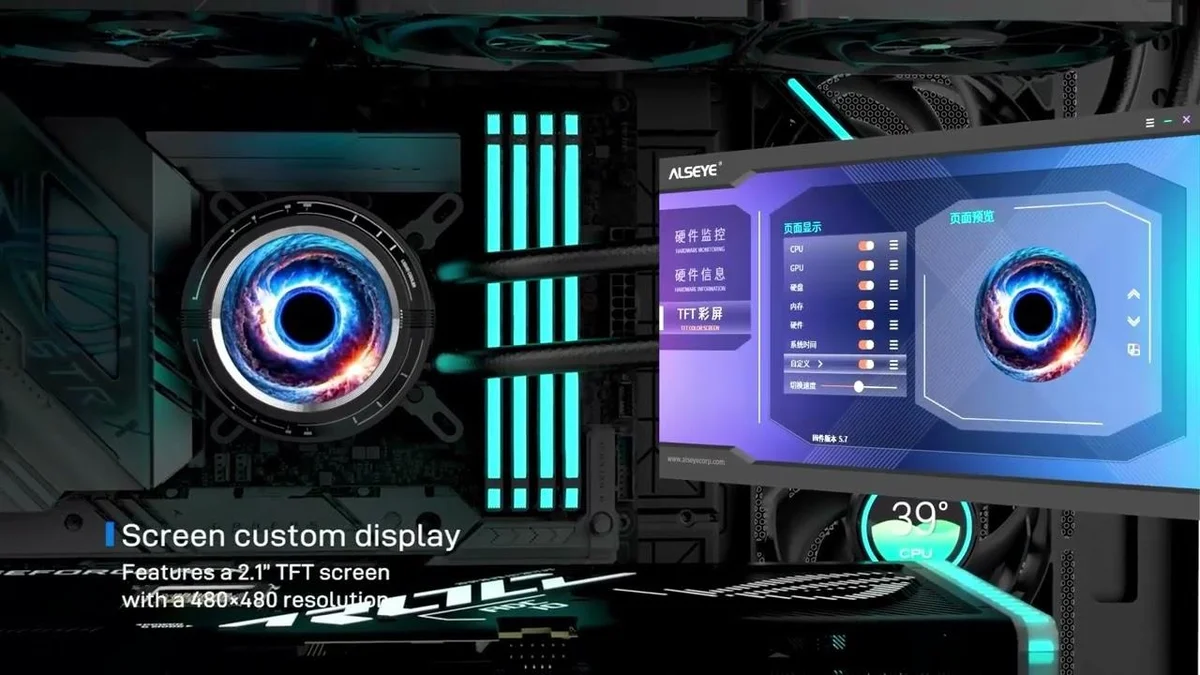
On the thermal front, the open-air frame accommodates an ALSEYE Warrior Series W360-V 360mm all-in-one liquid cooler. Its circular pump housing packs a 2.1-inch 480×480 color TFT screen that feeds real-time CPU temperatures and clock speeds straight through the right-hand viewport.
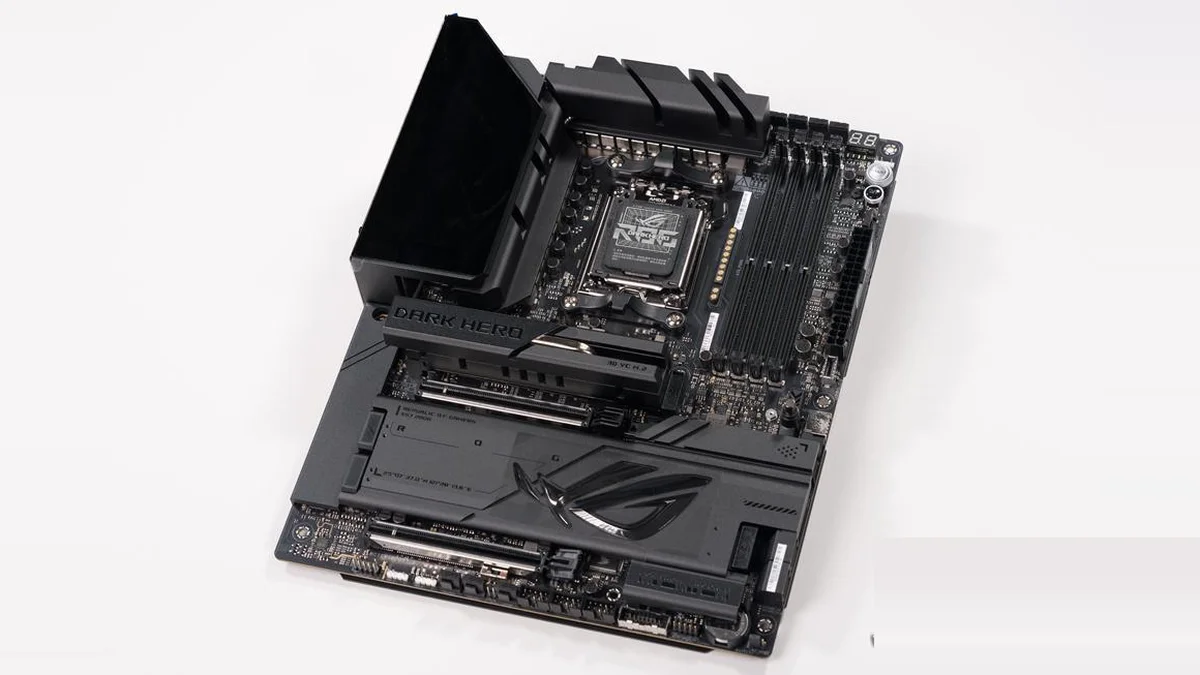
Ryzen 7 9850X3D and ROG Crosshair X870E Dark Hero Under the Hood
Far from being a pure showpiece, the rig backs up its spacecraft aesthetic with serious gaming hardware. At the center of the build sits the AMD Ryzen 7 9850X3D processor on the AM5 socket (retailing between $419 and $469 in the US and €430 to €550 in Europe as of November 2026), leveraging AMD's latest 3D V-Cache stack for low-latency frame delivery.
To feed the chip clean power without voltage droop, the modder selected the ASUS ROG Crosshair X870E Dark Hero motherboard (priced around $650 to $700 in the US). Its stealthy all-black armor and Polymo Lighting II array blend seamlessly into the dark inner frame, backed by a massive 20(110A)+2(110A)+2 power stage layout on an 8-layer 2oz copper server-grade PCB.
Check Availability AMD Ryzen 7 9850X3D Availability on Amazon→
ASUS also equips the board with five M.2 slots (including two PCIe 5.0 lanes topped by a 3D VC vapor-chamber heatsink), dual 40Gbps USB4 ports, Wi-Fi 7, and dual 10GbE + 5GbE Ethernet ports. System memory comes courtesy of a 32GB (2×16GB) ZHIKE DDR5-6000 kit running tight CL28 timings, a smart sweet-spot pairing at a time when global DDR5 RAM supply constraints are pushing low-latency memory kits higher every week.
GeForce RTX 5070 OC and a 1,200W ATX 3.1 Power Supply
Graphics duties are handled by an ASUS ATS (Atlas Shark) GeForce RTX 5070 OC powered by NVIDIA's Blackwell architecture (currently trading around $800 to $900 across custom partner listings). Primary storage is anchored by a 1TB GeIL G7Q PCIe 4.0 NVMe SSD locked beneath the motherboard's tool-free M.2 Q-Release heatsink.
To keep power delivery rock-solid, cp14228823 installed a SeaSonic Vertex GX-1200 ATX 3.1 power supply rated at 1,200W 80 Plus Gold. Given how recent hardware investigations have highlighted why even a 250W GeForce RTX 5070 demands a properly seated 16-pin power connection, using a native ATX 3.1 / PCIe 5.1 unit absorbs transient spikes effortlessly while leaving plenty of headroom for a future flagship GPU upgrade.
Check Availability ASUS ROG Crosshair X870E Dark Hero Availability on Amazon→
Ark Star Vessel Full Hardware Specifications
| Component | Model Selected by cp14228823 | Key Specs & Market Pricing (Nov. 2026) |
|---|---|---|
| Chassis | ALSEYE Star Ark (方舟) | Vertical 3mm SPCC open-frame, front LCD spine, $450 to $699 |
| Processor (CPU) | AMD Ryzen 7 9850X3D | Zen 5 with 3D V-Cache (Socket AM5), ~$419 to $469 |
| Motherboard | ASUS ROG Crosshair X870E Dark Hero | 20+2+2 (110A) VRM, 5× M.2, Dual USB4, Wi-Fi 7, ~$650 to $700 |
| Graphics Card (GPU) | ASUS ATS GeForce RTX 5070 OC | NVIDIA Blackwell architecture, ~$800 to $900 |
| CPU Cooling (AIO) | ALSEYE Warrior Series W360-V | 360mm radiator, 2.1-inch 480×480 color TFT pump screen |
| Memory (RAM) | ZHIKE DDR5 32GB (2×16GB) | 6000 MT/s frequency, tight CL28 timings |
| Storage (SSD) | GeIL G7Q 1TB | M.2 PCIe 4.0 NVMe interface |
| Power Supply (PSU) | SeaSonic Vertex GX-1200 | 1,200W 80 Plus Gold, native ATX 3.1 / PCIe 5.1 standard |
My Take on the Spec Sheet
Pairing a Ryzen 7 9850X3D with tight DDR5-6000 CL28 memory on a ROG Crosshair X870E Dark Hero is a textbook recipe for rock-steady 1% low frametimes at 1440p. Because the ALSEYE Star Ark is an open-frame skeleton, neither the GPU nor the 110A VRM heatsinks suffer from recycled hot air inside a closed box, though builders always have to accept the classic open-air trade-offs: zero acoustic damping for fan noise and frequent compressed-air dusting sessions.
Since this is a one-off Chiphell contest runner-up build, we obviously have not put this exact rig on our thermal probes and decibel meter in the lab, but backing an RTX 5070 OC with a 1,200W ATX 3.1 SeaSonic unit leaves massive upgrade headroom for future GPU generations.

PC hardware enthusiast and competitive gamer, Arthur 'Heimdall' splits his time between France and the UK working in enterprise B2B software solutions. A business school graduate passionate about component benchmarking, he has been building, modding, and tuning PCs since childhood, optimizing every thermal degree and millisecond of display latency. An avid gamer across Assassin's Creed and sandbox titles, he forged his alliance with Grimtag and Chaya during late-night World of Warcraft raids before joining Pro-Gamer.