57,628 Studio Layoffs and a Frozen Market: The Broken Promises of Video Game Design Colleges
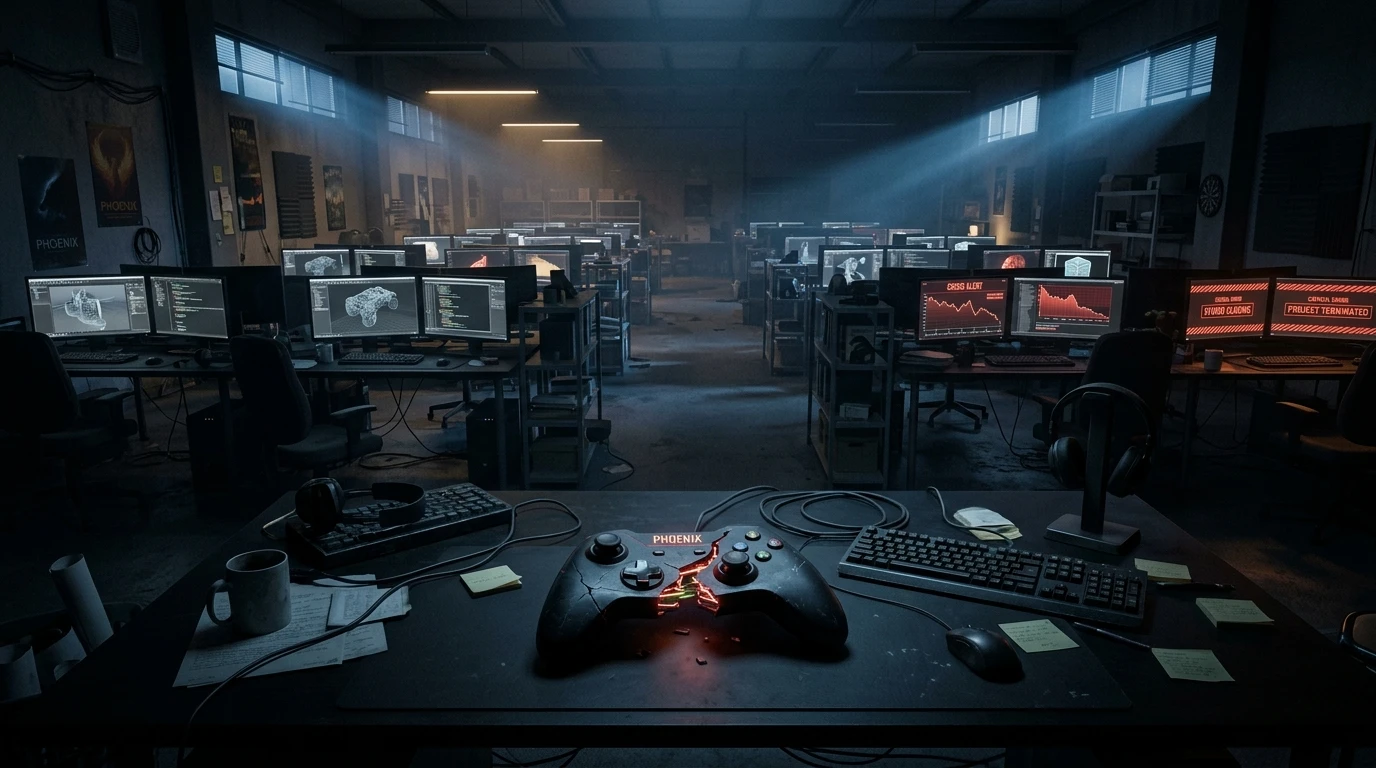
Lecture halls at specialized game development colleges remain packed, fueled by glossy brochures promising dream careers inside a multi-billion-dollar global industry. Yet on the other side of the screen, the hiring pipeline has slammed shut. With Microsoft, Sony, Electronic Arts, and Ubisoft cutting tens of thousands of developer roles over recent production cycles, an entire cohort of eager graduates is walking straight into a brick wall.
The contradiction is staggering. Private universities charge between $10,000 and $15,000 in annual tuition, yet studios have quietly frozen junior recruitment pipelines, leaving 600 to 800 applicants competing for a single entry-level 3D modeling or level design vacancy. This is the stark reality of the most severe employment contraction modern game development has ever experienced.
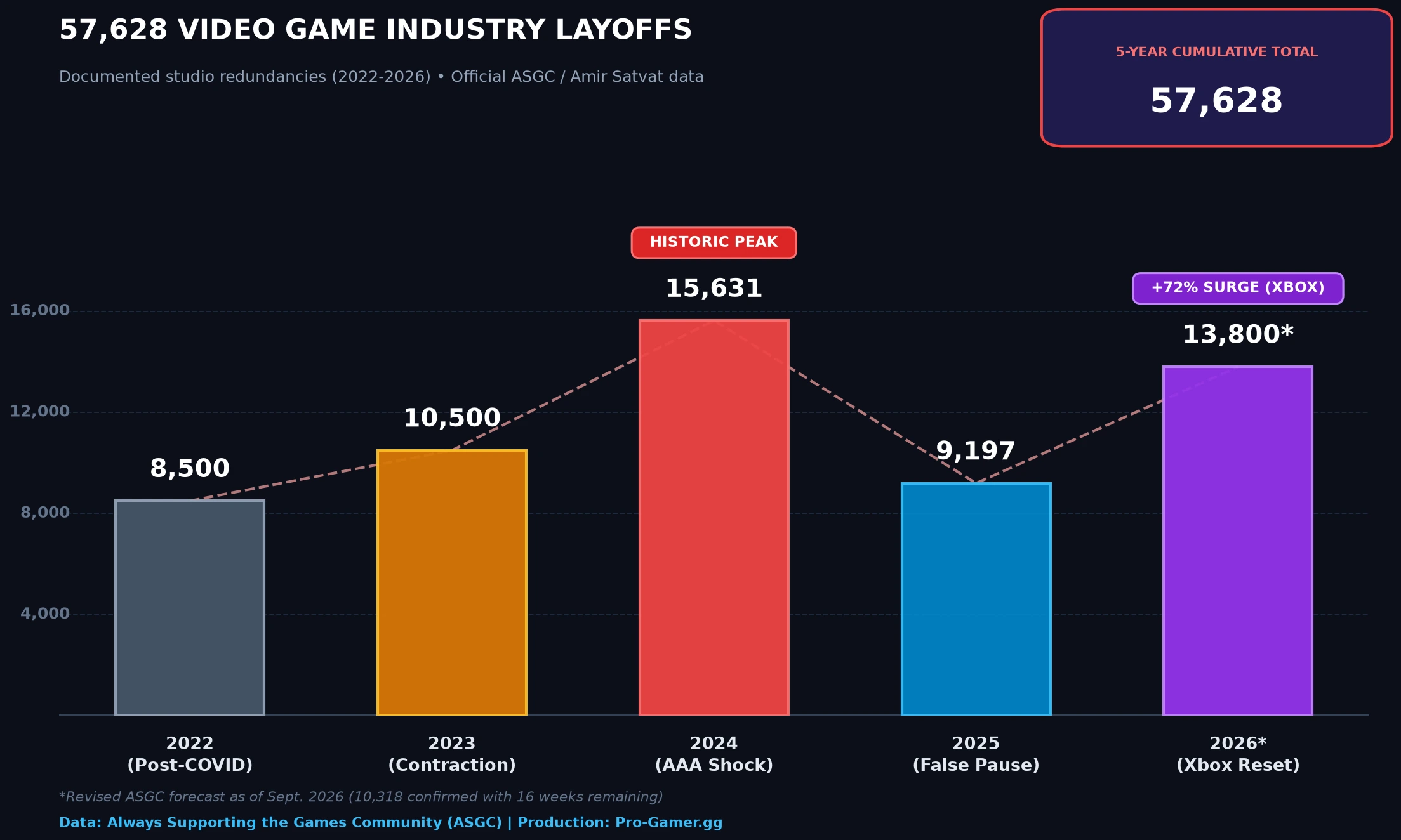
What the data actually reveals: The cumulative total of 57,628 job eliminations over five years compiled by the ASGC (Always Supporting the Games Community) Tracker shatters any belief that industry contractions were temporary. While 2025 offered brief optimism with cuts declining to 9,197 (compared to 15,631 during the 2024 peak), 2026 has reversed course with ferocity. With 10,318 redundancies already logged and projections revised upward to 13,800, total cuts have surged 72% beyond initial forecasts, largely propelled by Microsoft Gaming's comprehensive restructuring.
For emerging developers, this sustained downturn has created a nearly insurmountable hiring barrier. Over 57,000 experienced creators, many possessing multiple published commercial credits, are competing downward for mid-tier and entry-level positions simply to maintain employment. In this oversaturated talent pool, untested college graduates face near-zero statistical probability of securing standard interviews.
Inside the Struggle: Lucas, 23, on $40,000 in Debt and 400 Automated Rejections
Lucas is finishing his final year in Game Design and 3D Art at a private European academy. To finance his degree, he took on roughly $40,000 in student loans that will enter repayment in late 2026. What was pitched as a golden ticket into the creative industry has turned into a high-stakes survival battle.
« When we enrolled right after the pandemic production boom, the administration constantly claimed studios were desperate for talent. We were promised an 85 to 90 percent placement rate within six months of graduation. Fast forward to today: I spend my evenings polishing 3D assets on ArtStation and programming mechanics in Unreal Engine 5. Out of more than 400 applications submitted since last November for junior artist or design positions, I have secured exactly three preliminary screening calls. Everything else was an automated rejection email sent by applicant tracking systems within 48 hours. »
This obstacle does not stem from a lack of individual dedication or technical skill. It is driven by an unprecedented market imbalance. When entry-level job postings go live on LinkedIn or specialized game job boards, newly minted graduates find themselves competing directly against mid-level and senior developers who were displaced during massive publisher reorganizations. Faced with choosing between an untested graduate and an experienced developer with multiple shipped titles willing to take a lower-tier contract, studios rarely take a gamble on beginners.
« There aren't any jobs. Everyone's getting fired. It's fucked. »
Unfiltered feedback from a game design student in the official GDC 2026 State of the Game Industry Report.
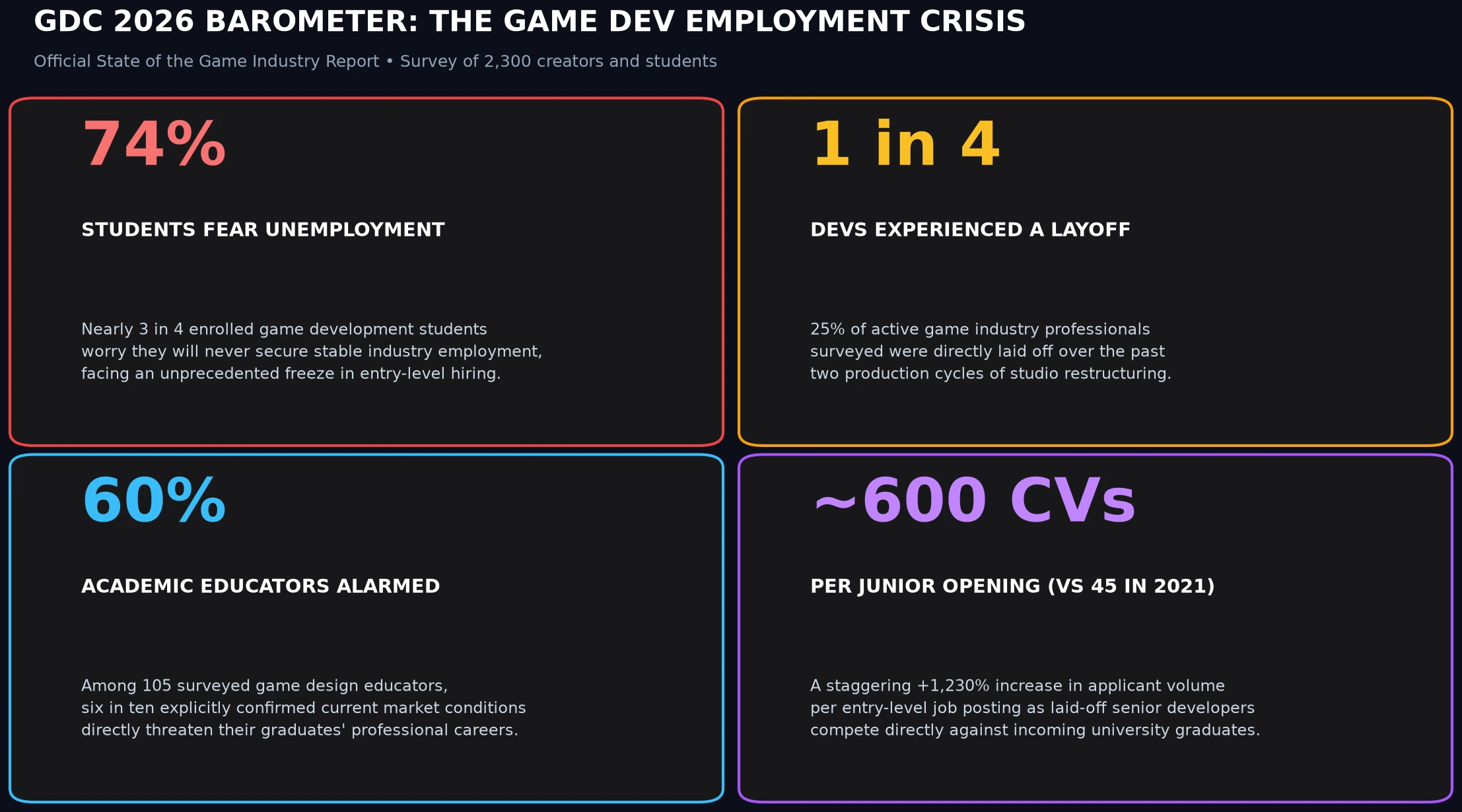
This candid reaction mirrors broader survey findings: 74% of enrolled game design students fear they will never secure stable industry employment, while one in four active developers experienced a layoff over the last two production cycles. Among 105 academic educators polled, 60% explicitly agreed that current industry conditions directly jeopardize their graduates' professional futures. One applicant noted they had spent three full years submitting internship applications without securing a single role.
The Private Academy Illusion Versus True Employment Rates
While studio floors contract, the private education business continues operating at full throttle. College fairs and virtual open houses prominently display marketing campaigns designed to reassure anxious parents and enthusiastic gamers. Yet the employment metrics showcased in promotional brochures often mask a far grimmer reality.
The 85 to 90 percent placement figures frequently touted by institutions are based on outdated surveys from the abnormal 2020 to 2022 lockdown surge. Crucially, these statistics often classify unviable freelance sole proprietorships, short-term contract work outside the entertainment sector, or unpaid internships as successful career placements. Schools expanded their cohort sizes to maximize tuition revenues, flooding the market with thousands of generalist art and design profiles just as production teams slashed their headcount.
Navigating this complex landscape requires a realistic evaluation of program value and hard technical curriculum, as detailed in our comprehensive guide to global game dev degrees and career tracks.
Layoffs Leaderboard: How Xbox, Sony, Ubisoft, and Embracer Compare
While the cumulative total of 57,628 industry layoffs covers the broader gaming ecosystem, accountability is heavily concentrated. These mass redundancies were not an inevitable market force; they stem directly from the aggressive capital deployment of publicly traded mega-publishers pursuing debt-fueled acquisitions, followed by severe cutbacks to maintain Wall Street operating margins.
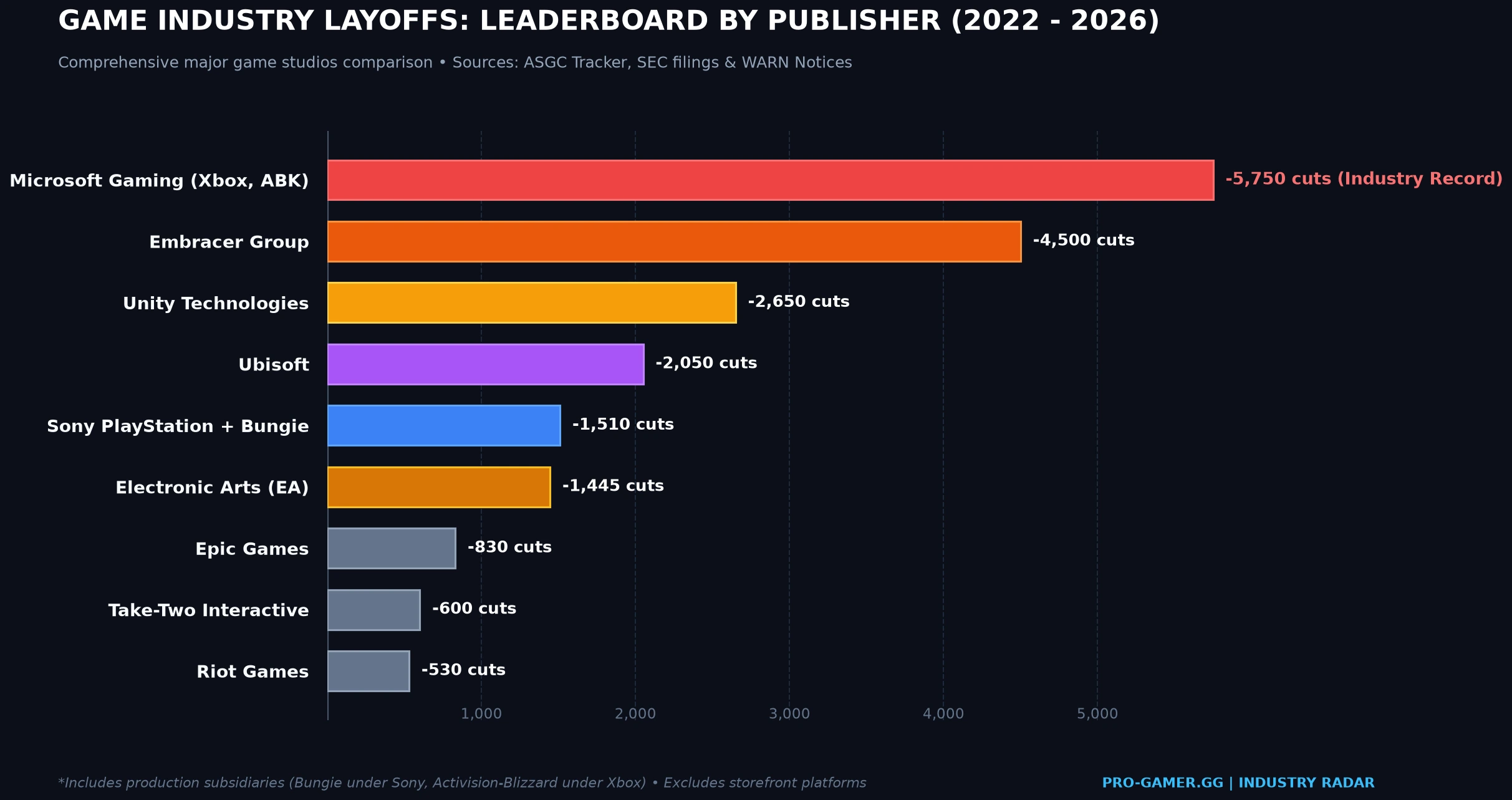
A closer look at verified data compiled by the ASGC Tracker, official SEC disclosures, and statutory WARN filings reveals how major corporations handled their workforces:
1. Microsoft Gaming (Xbox, Activision Blizzard, Bethesda)
-5,750 cuts (Record)
The undisputed leader in workforce reduction. Following its $69 billion absorption of Activision Blizzard King, Microsoft executed unprecedented austerity measures:
- 1,900 layoffs in January 2024 alongside the abrupt closures of Arkane Austin and Tango Gameworks.
- A secondary purge of 650 positions in late 2024.
- Asha Sharma's memo projecting 3,200 cuts across FY 2027, severely restructuring Halo Studios.
2. Embracer Group
~4,500 cuts
The rapid collapse of an acquisition binge. After purchasing dozens of studios on credit, the loss of a $2 billion partnership triggered severe liquidation:
- Over 40 studios closed or sold off under distress (Volition, Free Radical, Gearbox divestment).
- Dozens of unannounced game projects canceled overnight.
- A forced corporate split into three separate standalone companies.
3. Unity Technologies
-2,650 cuts
The dominant engine provider paid heavily for executive mismanagement:
- A disastrous attempt to implement retroactive Runtime Fees ignited a worldwide developer boycott.
- Eliminated 25% of its entire corporate workforce (1,800 roles in January 2024) to stem financial bleeding.
4. Ubisoft
~2,050 cuts
Struggling with creative stagnation and repeated production delays:
- Permanent closure of international branches (Stockholm, Halifax, San Francisco).
- Continuous rolling cutbacks and voluntary separation plans to bring headcount below 19,000.
5. Sony Interactive Entertainment & Bungie
~1,510 cuts
Even the market leader faced strict margin retrenchment:
- 900 layoffs across PlayStation Studios in February 2024 and the complete closure of London Studio.
- The $3.6 billion Bungie purchase triggered three downsizing rounds (over 600 departures) following Destiny 2 revenue declines.
6. Electronic Arts (EA)
-1,445 cuts
Uncompromising portfolio optimization focused on high-margin IP:
- Two major layoff rounds in 2023 (775 positions) and 2024 (670 positions).
- Canceled high-budget experimental projects (including Respawn's Star Wars FPS) to prioritize core sports franchises.
Also impacted by substantial workforce reductions:
Epic Games: 830 employees terminated (16% of staff) to curb metaverse burn rate. •
Take-Two Interactive: 600 roles eliminated in April 2024, closing Roll7 and Intercept Games. •
Riot Games: 530 departures (11% headcount) alongside the closure of Riot Forge.
Why Platform Storefronts Like Steam Escape the Dev Industry Bloodbath
Amid widespread studio closures, an obvious question arises: why has a platform giant like Steam (Valve) avoided the mass layoffs impacting virtually every major publisher?
The distinction lies in corporate architecture and product exposure. Unlike developers and traditional publishers (Xbox, Sony, Ubisoft, Embracer) who risk $200 million to $300 million per production cycle without guaranteed box office returns, Valve acts primarily as an infrastructure host and storefront distributor. By collecting an industry-standard 30% margin on digital PC game sales, Valve captures value across the ecosystem without shouldering upstream production risk.
As a private corporation free from public quarterly shareholder mandates, operated by a disciplined core of roughly 380 employees worldwide, Valve remains structurally insulated from the erratic boom-and-bust cycles that continue to destabilize traditional game development studios.
The Labor Pushback: Building Equity Across the Dev Community
In response to recurring layoffs and systemic precarity, an unprecedented wave of labor solidarity is reshaping developer culture. The long-standing notion that passion alone should compensate for unpaid overtime and arbitrary dismissals is losing its grip on the workforce.
Across North America, the CODE-CWA (Campaign to Organize Digital Employees - Communications Workers of America) movement achieved historic milestones by successfully organizing hundreds of quality assurance testers and developers at ZeniMax Media, Bethesda, and Activision Blizzard subsidiaries. In Europe, labor organizations like France's STJV are actively challenging deceptive recruitment claims made by commercial academies and providing legal backing for affected staff during restructuring programs.
This push for equity is crucial for the incoming generation of creators. Without established wage floors, protective union frameworks, and transparent redundancy protocols, breaking into the craft will remain an unforgiving gamble dictated by shareholder quarterly targets.
Junior Survival Guide: Pragmatic Steps to Build a Real Career
For aspiring developers currently studying or searching for their first opportunity, surrender is not the answer. Thriving in this environment requires stripping away academic romanticism and adopting an aggressive, pragmatic production mindset.
- Disregard the paper diploma: Lead technical directors and art supervisors never hire candidates based on a university seal. Hiring managers make decisions within thirty seconds based on verified output running on a screen.
- Publish completed, playable vertical slices: A concise, tightly scoped game released on itch.io or Steam with polished controls, clean game feel, and zero game-breaking bugs carries vastly more credibility than an unplayable fifty-page design document or a gallery of static 2D sketches.
- Pursue technical hybrid skill sets: The global talent pool is oversaturated with pure 3D asset modelers. In contrast, technical artists who bridge the gap between creative visual fidelity and engine performance remain in steady demand. Master Unreal Engine 5 Blueprints and C++, learn shader authoring in HLSL, and understand LOD budgets, Nanite, and rendering pipeline optimization.
- Look beyond the AAA horizon: Mid-tier AA studios, indie cooperatives, serious games developers, and industrial real-time simulation firms in architecture, medical visualization, or aerospace offer stable environments to build verifiable production experience.
The gaming medium will always reward ingenuity, mechanical craft, and technical resilience. But the era where a private school degree served as an automatic entry pass into major studios is over. Hard-nosed technical mastery, verified independent releases, and mutual community solidarity are now the essential foundations for any lasting game development career.

SEO consultant for over 20 years and digital entrepreneur, Charles 'Grimtag' Ronchain is the founder of Pro-Gamer.gg, Retrocharting.com, and Gamescharting.com. A competitive gamer, streamer, and retro game collector, he has worked in the video game industry for over 15 years, notably as a consultant for leading game price comparison platforms. Passionate about real-time performance data and gaming technology, he analyzes competitive esports, gaming hardware benchmarks, and creator workflows on Pro-Gamer.gg with an authentic player perspective.