EmuFive Runs PlayStation 5 Games on a Jailbroken PS4: How This Linux Project Bridges the Generational Gap
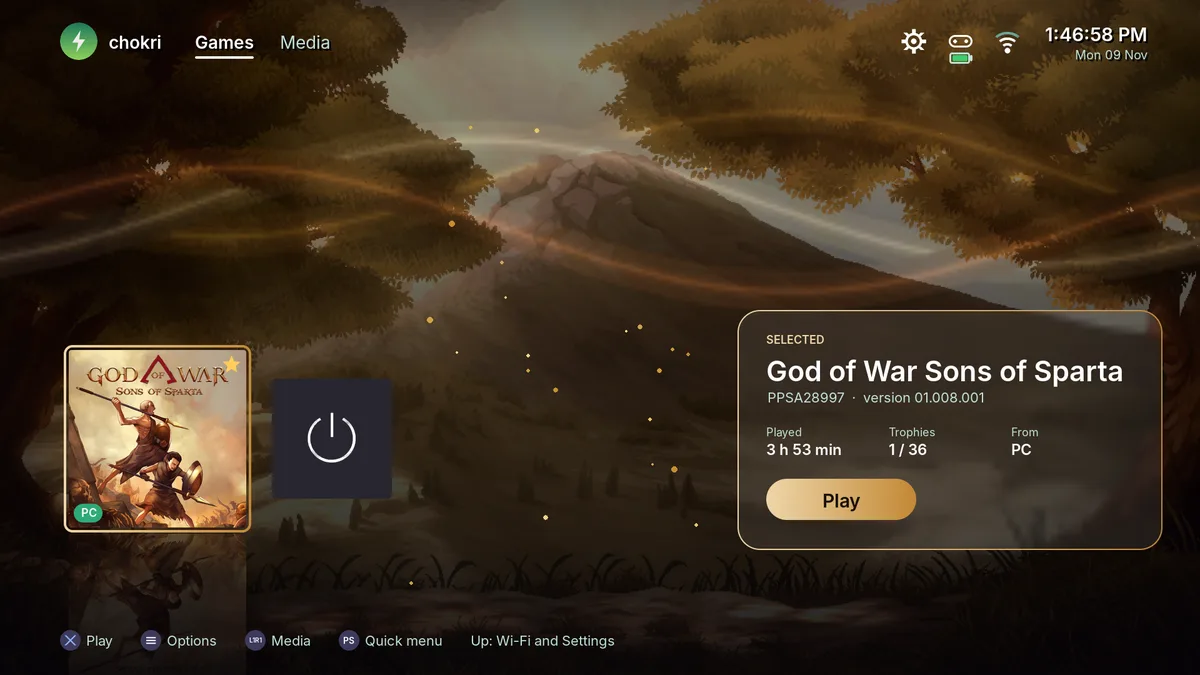
Running native PlayStation 5 game code directly on aging PlayStation 4 silicon sounded like pure technical fiction until this week. Released as an open-source research project by developer Chokri Hammedi (known as blue0x1) and updated to version 1.0.1 on Wednesday, November 11, 2026, EmuFive proves that lightweight PS5 titles can actually boot and run at playable framerates on a jailbroken PS4 Pro.
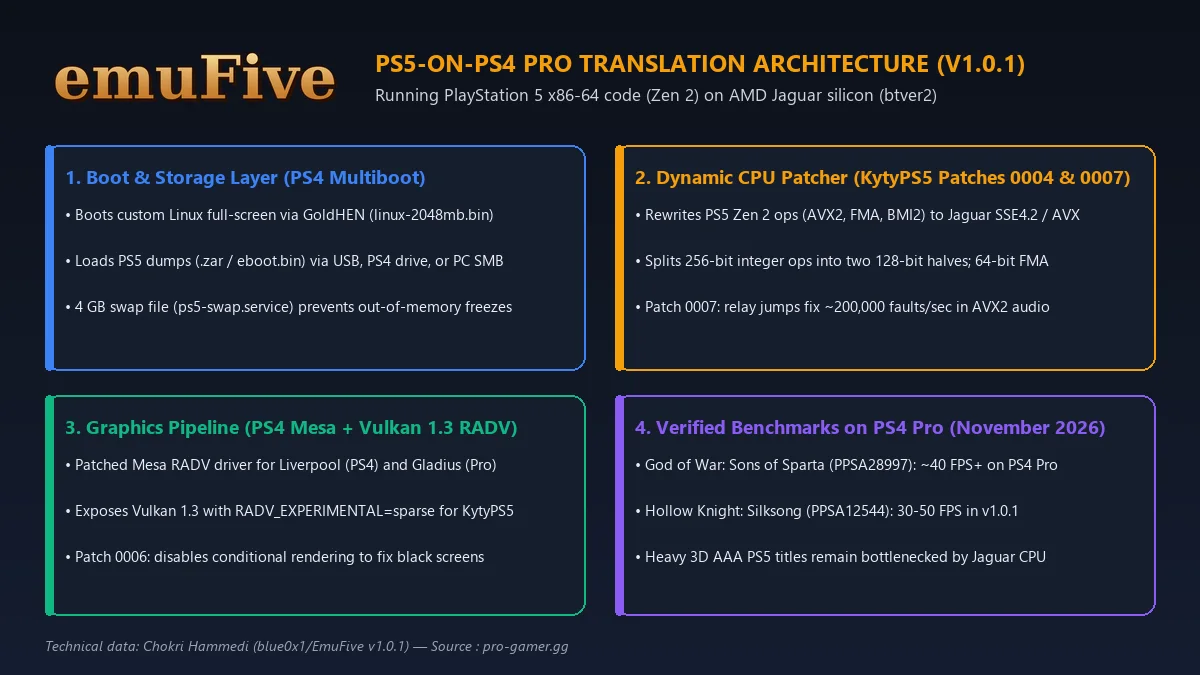
Published under the GPL-2.0 license on the official EmuFive GitHub repository, the software does not run inside Sony's standard OrbisOS environment. Instead, it relies on the developer's own PS4 Multiboot framework and a GoldHEN payload (linux-2048mb.bin) to boot a stripped-down Linux image straight into a full-screen, DualShock 4-controlled console launcher with no desktop overhead.
Rewriting PS5 Zen 2 Instructions on the Fly for the PS4's AMD Jaguar CPU
Because both Sony consoles share an x86-64 foundation, the open-source KytyPS5 emulator (derived from InoriRus's Kyty project) executes a PS5 game's native binary code directly rather than emulating a foreign CPU architecture. However, PlayStation 5 titles are compiled for AMD's Zen 2 microarchitecture and rely heavily on AVX2, FMA, and BMI2 instruction sets, none of which exist on the older AMD Jaguar (btver2) processor inside the PS4 and PS4 Pro.
While an unmodified KytyPS5 build crashes immediately with an illegal instruction fault on PS4 hardware, Chokri Hammedi's patch 0004 dynamically rewrites unsupported instructions as game modules load or the first time an instruction faults at runtime. Every AVX2, FMA, and BMI2 operation is translated into equivalent SSE4.2, AVX, and BMI1 sequences that the Jaguar cores can digest: 256-bit integer operations are split into dual 128-bit halves, cross-lane permutes are handled via AVX moves and blends, and FMA math is computed in double precision.
To verify that these binary replacements do not corrupt game logic, the repository includes an automated validation tool (jaguar-test) that executes both the original instruction and its Jaguar replacement from identical random states on a PC, comparing all registers, flags, and memory outputs. All 287 instruction forms extracted from God of War: Sons of Sparta and 227 forms from prior test binaries matched cleanly.
On the graphics side, EmuFive bundles a custom PS4 Mesa build that exposes Vulkan 1.3 to the console's Liverpool (base PS4 and Slim) and Gladius (PS4 Pro) GPUs. It uses the open-source RADV driver with experimental sparse resource support enabled, building on the same Linux graphics ecosystem as recent Mesa 26.2.6 RADV driver fixes for the KytyPS5 emulator on Linux.
God of War: Sons of Sparta at 40 FPS and Hollow Knight: Silksong Fixed in Version 1.0.1
This low-level translation layer is already delivering tangible results on 2D games compiled natively for the PlayStation 5. Running on a PS4 Pro, the 2D action platformer God of War: Sons of Sparta (title ID PPSA28997) hits roughly 40 FPS and higher directly from the EmuFive home screen.

Released today, November 11, 2026, the EmuFive 1.0.1 update goes a step further by getting the native PlayStation 5 build of Hollow Knight: Silksong (PPSA12544) running at 30 to 50 FPS on a PS4 Pro through two targeted patches:
- Patch 0006 (GPU black-screen hang fix): KytyPS5 previously relied on conditional rendering, which permanently hung the PS4's GPU while booting certain titles and left the TV with no signal until a hard reboot. Conditional rendering is now disabled on PS4 GPUs in favor of reading image data back directly.
- Patch 0007 (relay jumps for tight AVX2 audio loops): Games that execute short AVX2 instructions inside a tight loop, such as Hollow Knight: Silksong's sound mixer, lacked the byte space for a direct jump to their replacement code and triggered roughly 200,000 hardware faults per second. Routing those short instructions through a relay jump eliminates the audio crackling and restores playable framerates.
An Impressive Homebrew Milestone Bounded by 2013 Silicon
To prevent the PS4's 8 GB of unified GDDR5 memory from locking up the console under heavy loads, EmuFive automatically provisions a 4 GB swap file on the system disk and gracefully closes a game back to the launcher with an error notice if both RAM and swap are exhausted. The interface supports up to eight user profiles with separate saves, trophies, and playtime tracking, offers eight menu languages, and can load decrypted game folders (eboot.bin) or ZArchive (.zar) dumps from an exFAT USB drive, the internal PS4 drive in read-only mode, or a shared Windows or Linux PC folder over the local network via Samba.
While this cross-generational experiment shares the same DIY spirit as turning a jailbroken PS5 into a Linux gaming machine with Bazzite, Chokri Hammedi is upfront about the hardware ceiling. The PS4's aging Jaguar cores are vastly slower than the PS5's Zen 2 processor, and dynamic AVX2-to-SSE4.2 translation adds further CPU overhead, keeping heavy 3D AAA PS5 exclusives out of reach.
Sony PlayStation 5 Slim (Disc & Digital Edition)
- 8-core AMD Zen 2 CPU with native AVX2, FMA, and BMI2 instruction sets
- 36-CU RDNA 2 GPU and ultra-fast 1TB custom NVMe SSD
- DualSense wireless controller with haptic feedback and adaptive triggers
Check PlayStation 5 Slim Availability on Amazon→
My Field Notes
Going through Chokri Hammedi's commits from my desk in Quebec City tonight, EmuFive captures everything that makes the console homebrew scene so compelling: taking a hardware wall everyone assumed was absolute and building a clean software bridge to run 2026 PS5 binaries on 2013 silicon. Even though practical playability will stay limited to 2D releases and lightweight indie games, packaging the whole stack into a controller-first PS4 Multiboot appliance with SMB network shares and built-in OTA updates is a remarkable piece of engineering.
Arthur "Heimdall" on the silicon gap: From a pure architecture standpoint, splitting 256-bit AVX2 vectors into dual 128-bit SSE4.2/AVX passes while eliminating 200,000 faults per second in Silksong's audio mixer via relay jumps is top-tier x86 assembly work. Still, physics always wins in the end: with roughly a third of Zen 2's IPC, half the memory bandwidth, and no hardware Kraken decompression block on the PS4 Pro drive, no amount of instruction patching will ever make a heavy 3D PS5 open-world blockbuster playable on Jaguar cores.

Originally from Lyon, France, gaming journalist Bastien "Orion" relocated nearly a decade ago to Quebec City's Saint-Roch district, right in the heart of eastern Canada's development studio hub. Before crossing the Atlantic, he honed his versatile reporting style across classic French gaming web portals and specialist television outlets in the 2000s and 2010s, notably with JeuxVideo.fr and JeuxNews. Equally passionate about AAA blockbusters, North American studio culture, retro preservation, and community modding projects, he anchors Pro-Gamer's transatlantic desk and real-time coverage of US and Japanese industry announcements.