In-Game Overlay on Wayland, Fedora 44, and Native Rust Client: Discord Demos New Linux App With Full Windows Feature Parity
Linux PC gamers will soon no longer have to settle for a stripped-down chat experience compared to their teammates on Windows. Just days after confirming that Discord is ditching Electron for a native Rust and GPUI desktop app, Discord co-founder and Chief Technical Officer (CTO) Stanislav Vishnevskiy shared a 4K video demonstration of the upcoming Linux client in action. For the first time, the Linux build achieves full feature parity with Windows, including a native, customizable in-game overlay running on Wayland.
A Modular In-Game Overlay Running Natively on Wayland
Historically, Discord's desktop client across Windows, macOS, and Linux has been built on Electron, wrapping a web app inside bundled Chromium and Node.js processes. On modern Linux desktops, this legacy architecture clashed with the strict security and window isolation model of the Wayland display server protocol. While Discord eventually addressed Wayland screen sharing with hardware-accelerated encoding and global Push-to-Talk keybinds via xdg-desktop-portal, the in-game overlay remained either completely unavailable or broken without third-party workarounds.
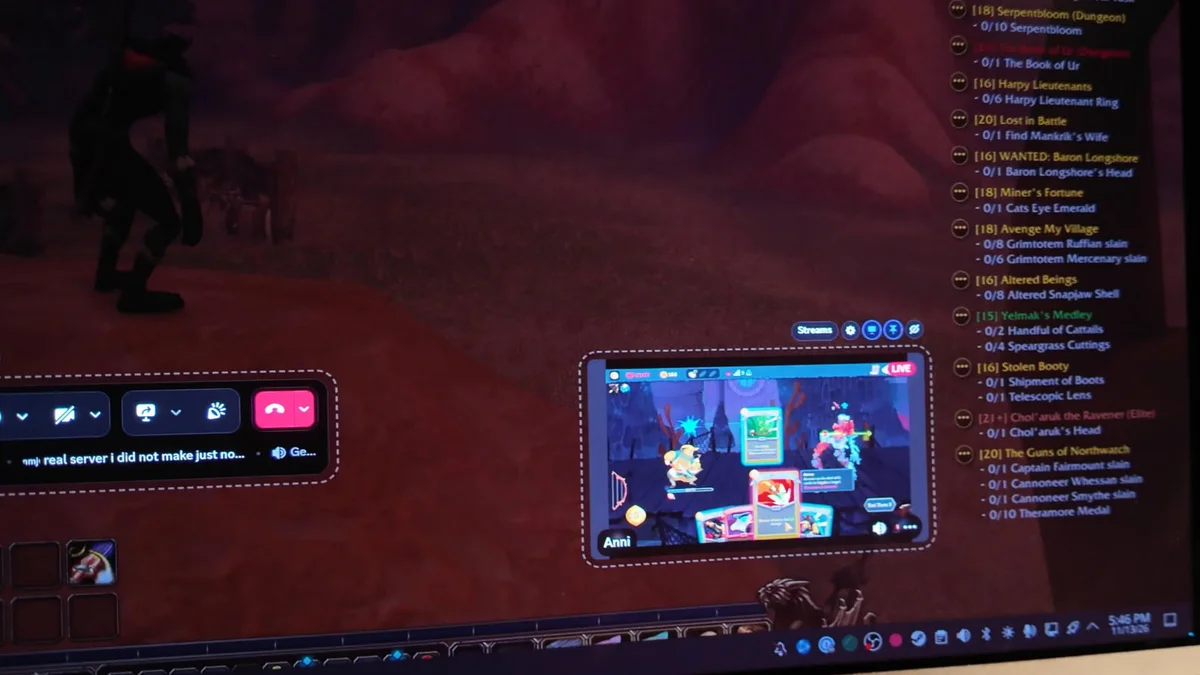
In the 23-second gameplay clip shared by Stanislav Vishnevskiy, that long-standing barrier is gone. While playing World of Warcraft in fullscreen inside The Barrens, the CTO toggles Discord's redesigned modular overlay directly over the game window. The overlay responds instantaneously and showcases the full suite of widgets recently introduced to Windows users:
- Voice and Notification Widgets: Pinned to the top-left corner, displaying four active voice channel members alongside their server tags, microphone/deafen indicators, and incoming message alerts.
- Quick Action Control Bar: Positioned on the lower left, giving instant access to mic mute, deafen, screen sharing, and Discord Activities without alt-tabbing out of the game.
- Picture-in-Picture (PiP) Stream Viewer: Anchored in the bottom-right corner directly over the MMORPG interface, rendering a smooth live screen share of a friend playing Slay the Spire with independent volume controls and pinning toggles.
Explaining the milestone behind the demonstration, Stanislav Vishnevskiy stated: "The new Rust client's architecture allows us to bring more feature parity across platforms. Linux will now have overlay support as well as other features previously locked to Windows, and macOS will get them as well."
Fedora 44, KDE Plasma 6.8.2, and Ryzen AI Max+ 395: Inside the Test Rig
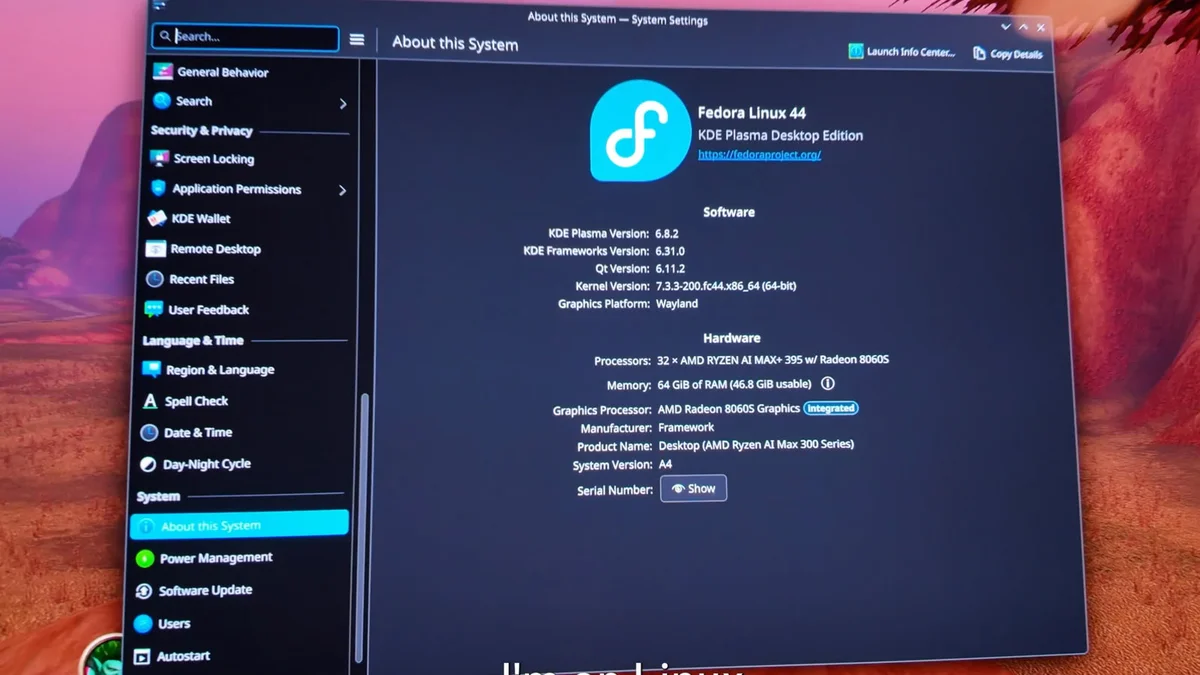
To leave no doubt about the underlying operating system, Discord's CTO pulls up the About this System panel at the end of the video and remarks, "I'm on Linux." The screen reveals the exact software and hardware stack powering the native Rust test build:
| Component | Discord Linux Rust Client Demo Specifications |
|---|---|
| Linux Distribution | Fedora Linux 44 (KDE Plasma Desktop Edition) |
| Desktop & Display Server | KDE Plasma 6.8.2 / Qt 6.11.2 / Wayland Graphics Platform |
| System Kernel | Linux Kernel 7.3.3-200.fc44.x86_64 (64-bit) |
| System & Processor | Framework Desktop (Rev. A4) with AMD Ryzen AI Max+ 395 APU (32 threads) |
| Graphics & Memory | Integrated AMD Radeon 8060S Graphics & 64 GiB RAM (46.8 GiB usable by OS) |
What This Means for SteamOS, Steam Deck, and Gaming Distros
This breakthrough builds on a steady wave of Linux quality-of-life upgrades rolled out by Discord's engineering team in recent months. Before unveiling the full Rust and GPUI rewrite, Discord ported its Rust-based auto-updater to Linux and expanded its official packaging beyond .deb and tarballs to include native .rpm packages (for Fedora and openSUSE) as well as .pkg.tar.zst builds (for Arch-based distributions).
With gaming-focused Linux distributions like CachyOS and its new Package Installer 2.0, Bazzite, and Valve's SteamOS gaining rapid traction among PC players, a native Discord client that cuts RAM usage down to roughly 290 MB while delivering a working Wayland overlay removes one of the most persistent friction points in daily Linux multiplayer gaming. The new Rust client remains in internal testing for now, with a broader public test rollout planned across Windows, macOS, and Linux once ready.

My Test Bench
Anyone who has spent serious gaming hours on a Wayland-based Linux desktop knows how frustrating the legacy Electron Discord app has been. Between the missing in-game overlay, the reliance on third-party wrappers like Vesktop or Discover Overlay just to see who is talking in voice chat, and Chromium subprocesses eating over 2 GB of RAM during 60 FPS screen shares, Linux users have felt like second-class citizens for years. Seeing Discord's own CTO daily-driving Fedora 44 with KDE Plasma and Wayland on a Framework Desktop powered by AMD's Ryzen AI Max+ 395, complete with a pinned Picture-in-Picture stream floating smoothly over World of Warcraft, is the clearest proof yet that this Rust rewrite is treating Linux as a first-class gaming platform.

PC hardware enthusiast and competitive gamer, Arthur 'Heimdall' splits his time between France and the UK working in enterprise B2B software solutions. A business school graduate passionate about component benchmarking, he has been building, modding, and tuning PCs since childhood, optimizing every thermal degree and millisecond of display latency. An avid gamer across Assassin's Creed and sandbox titles, he forged his alliance with Grimtag and Chaya during late-night World of Warcraft raids before joining Pro-Gamer.