4TB of 12,800 MT/s DDR5 on an E-ATX Footprint: ASRock Rack's Intel Diamond Rapids Motherboard Defies the RAM Crunch
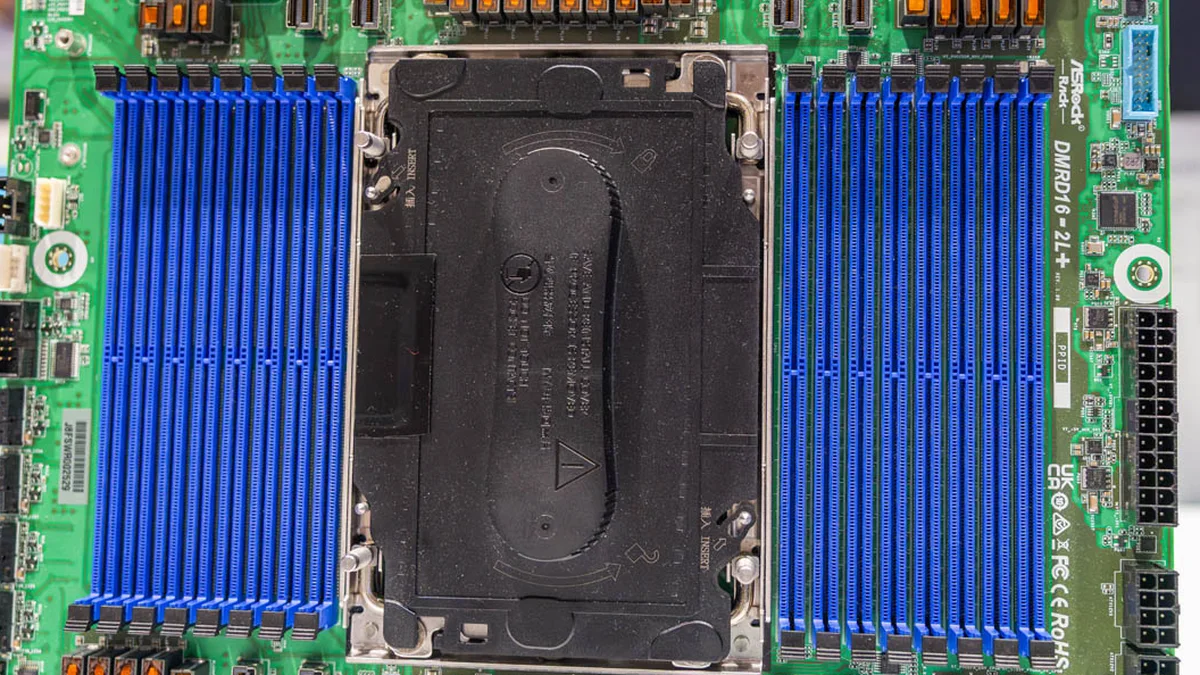
Packing 4TB of DDR5 memory running at 12,800 MT/s alongside 128 PCIe 6.0 lanes onto a circuit board no larger than an enthusiast gaming motherboard is a striking feat of hardware engineering. Built by ASRock Rack for Intel's next-generation Xeon "Diamond Rapids" server processors (the Oak Stream platform), the new DMRD16-2L+ fits inside a compact SSI EEB / E-ATX footprint (12 x 13 inches) while illustrating the stark divide splitting today's DRAM market.
LGA 9324 Socket and 16-Channel DDR5: Extreme Density on a 12 x 13-Inch Board
At the center of the green PCB sits Intel's massive LGA 9324 socket, complete with a specialized twist-to-lock protective cover. This socket is engineered to feed upcoming Intel Xeon Diamond Rapids processors scaling up to 192 P-Cores (Panther Cove architecture), with single-socket thermal design power (TDP) ratings reaching between 500W and 650W.
Flanking both sides of the CPU socket are two banks of eight blue DIMM slots, creating a full 16-channel DDR5 architecture in a 1DPC (one DIMM per channel) layout to maintain signal integrity at extreme clock speeds. According to ASRock Rack's specifications, the board supports three distinct server memory tiers:
- Standard DDR5 RDIMMs: Supports up to 128GB per module at speeds up to 8,000 MT/s, for a total capacity of 2,048GB (2TB).
- DDR5 MRDIMMs (Multiplexed Rank DIMMs): Supports up to 128GB per module running at a blistering 12,800 MT/s to double memory bandwidth for AI and HPC workloads.
- High-Density 2U DDR5 MRDIMMs: Supports 256GB modules rated at 12,800 MT/s, unlocking a staggering maximum capacity of 4,096GB (4TB) of DDR5 around a single processor socket.
Up to $50,000 in RAM on a Single Board: The Stark Contrast With PC Gaming
Looking at sixteen DIMM slots capable of swallowing 4TB of DDR5 in November 2026 puts current memory pricing into perspective. With AI data centers locking up wafer allocations from Samsung, SK hynix, and Micron, a single enterprise 256GB DDR5 RDIMM currently trades between $1,250 and $2,500 through OEM channels, while priority-allocated 256GB MRDIMM modules at 12,800 MT/s routinely command $3,000 to $4,000+ per stick. Fully populating all sixteen channels on the ASRock Rack DMRD16-2L+ translates to a memory bill ranging from $20,000 to well over $50,000 before even installing the Xeon processor.
This massive enterprise appetite for high-density silicon is the exact catalyst behind consumer PC shortages. While a single Diamond Rapids server node absorbs the DRAM equivalent of 128 gaming PCs equipped with 32GB of RAM, runaway retail pricing has triggered the first-ever PC RAM capacity decline recorded by CPU-Z, forcing mainstream builders to abandon 32GB and 64GB kits and retreat back to 16GB configurations.
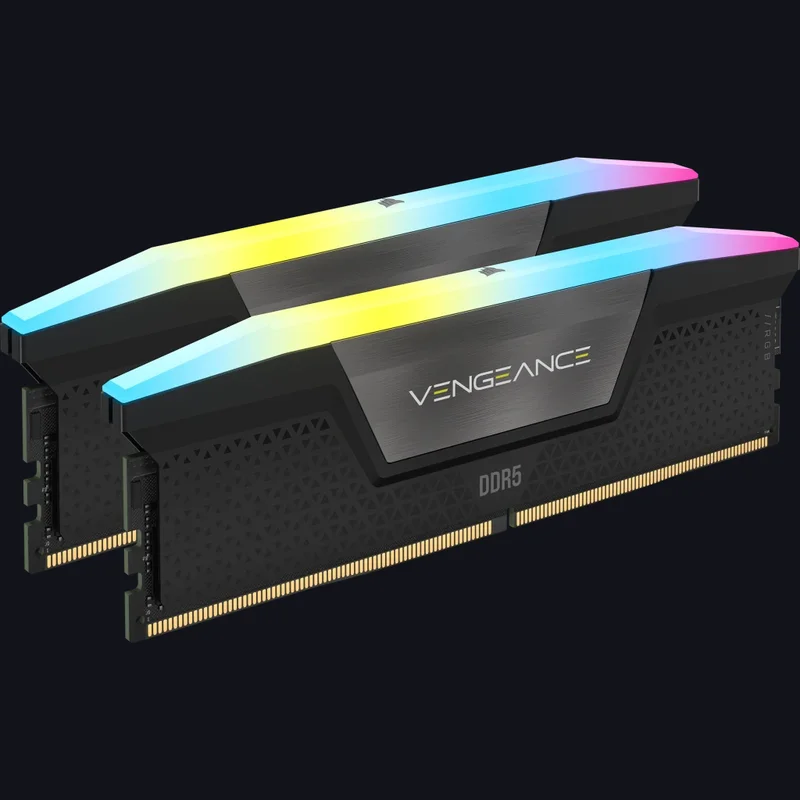
Corsair Vengeance RGB DDR5 32GB (2 x 16GB) 6000 MT/s CL30
- Dual-Channel 32GB (2 x 16GB) DDR5-6000 MT/s low-latency CL30 kit
- Certified AMD EXPO and Intel XMP 3.0 profiles with onboard PMIC voltage regulation
- Solid aluminum heatspreader with 10-zone dynamic RGB lighting
Check Availability High-Capacity DDR5 RAM Kits on Amazon→
Zero Traditional PCIe Slots: 128 PCIe 6.0 Lanes Routed Through MCIO Cables
How did ASRock Rack fit an LGA 9324 socket and sixteen DDR5 slots onto a 12 x 13-inch footprint? By eliminating traditional PCIe CEM card slots altogether. There isn't a single full-length PCIe slot on the board; instead, all high-speed expansion is handled through 16 black MCIO x8 connectors lining the top and bottom edges of the PCB.
| Specification | ASRock Rack DMRD16-2L+ Details |
|---|---|
| Platform & Socket | Intel Xeon "Diamond Rapids" (Oak Stream) / Single-Socket LGA 9324 |
| Form Factor | SSI EEB / E-ATX (12" x 13" / 305 x 330 mm) |
| Memory Architecture | 16x DDR5 DIMM slots (16-channel, 1DPC) up to 4TB (256GB 2U MRDIMM @ 12,800 MT/s) |
| PCIe 6.0 / CXL 3.0 I/O | 16x MCIO x8 connectors (128 PCIe Gen 6 lanes via cable fabric, zero CEM slots) |
| Local Storage | 1x M.2 PCIe 5.0 x4 slot (supports 2260, 2280, and 22110 drives) |
| Management & Networking | ASPEED AST2700 BMC, 1x Dedicated IPMI (Realtek RTL8211F), 2x 1GbE RJ45 (Intel I350) |
Each of those sixteen MCIO ports routes eight lanes of PCIe 6.0 or CXL 3.0 connectivity, delivering a combined 128 lanes of PCIe Gen 6 over shielded internal cables to NVMe backplanes or GPU risers. Local boot storage is handled by a single PCIe 5.0 x4 M.2 slot (up to 22110 length), while remote server management runs on an ASPEED AST2700 BMC paired with a dedicated Realtek RTL8211F IPMI port and dual 1GbE RJ45 ports driven by an Intel I350 controller.
My Take on the Spec Sheet
Inspecting the layout of the DMRD16-2L+ highlights two major hardware shifts. First, once memory hits 12,800 MT/s and PCIe 6.0 pushes 64 GT/s per lane, traditional copper PCB traces simply lose too much signal integrity over long distances: ditching bulky PCIe slots in favor of MCIO cable headers placed right next to the CPU socket is a physical necessity that will inevitably trickle down to high-end Threadripper and Xeon workstations. Second, seeing 4TB of DDR5 packed onto a 12-by-13-inch board explains why consumer RAM prices refuse to cool down: as long as every next-generation server node devours sixteen ultra-dense DDR5 modules at a time, system memory will remain the most fiercely contested silicon in PC hardware. We have not yet had a physical unit on our desk,if the manufacturer's team would like to send over a review sample so we can put it through our full real-world testing protocol, our lab doors are wide open.

PC hardware enthusiast and competitive gamer, Arthur 'Heimdall' splits his time between France and the UK working in enterprise B2B software solutions. A business school graduate passionate about component benchmarking, he has been building, modding, and tuning PCs since childhood, optimizing every thermal degree and millisecond of display latency. An avid gamer across Assassin's Creed and sandbox titles, he forged his alliance with Grimtag and Chaya during late-night World of Warcraft raids before joining Pro-Gamer.