€1,799 at European Retailers Instead of Intel's $949 MSRP: ASUS's First Intel Arc GPU Lands With a Steep Price Tag
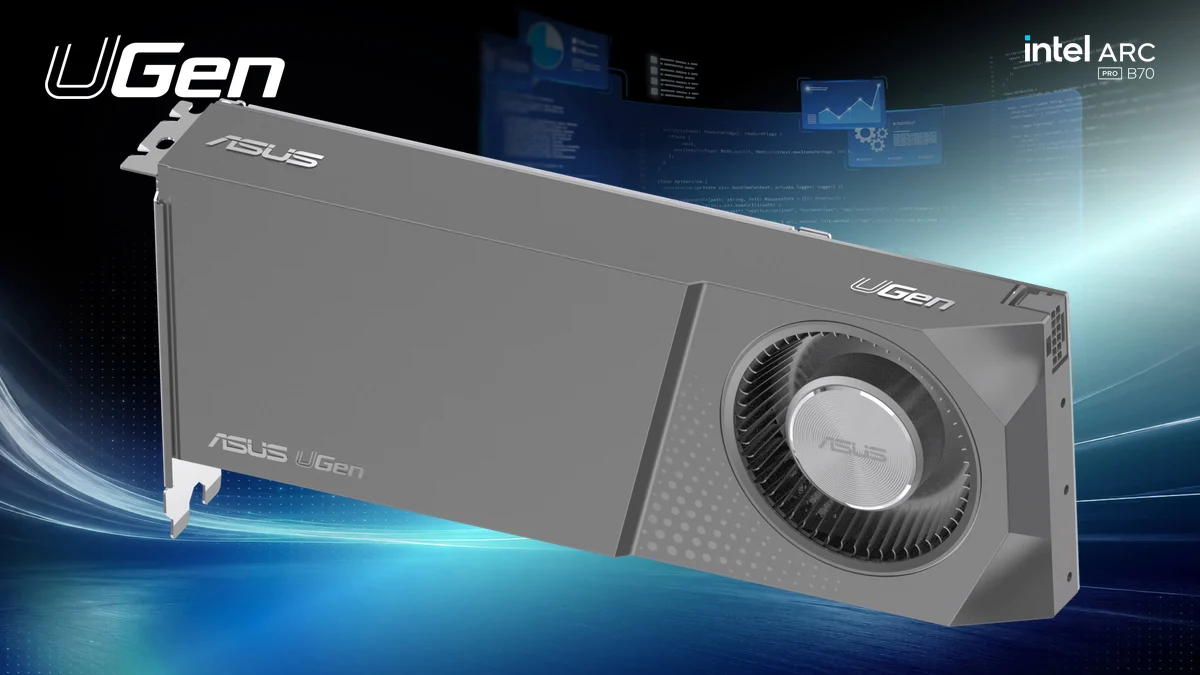
Barely ten days after ending a five-year hiatus from discrete Intel graphics, the Taiwanese hardware giant has revealed the European price tag of its return. Listed this morning across multiple European retailers and B2B distributors in Germany, Austria, Switzerland, and France (including Computeruniverse, Galaxus, and LDLC), the company's very first Intel Arc graphics card, the ASUS UGen Intel Arc Pro B70 32GB, carries a retail price of €1,799 including VAT.
That figure stands in sharp contrast to the baseline manufacturer suggested retail price originally announced by Intel at $949 before tax in the United States (which translates to roughly €1,050 to €1,100 once European VAT is factored in). Even compared to early partner boards from Sparkle and ASRock that drifted into the €1,300 to €1,500 bracket amid memory supply pressure, ASUS's workstation division has positioned its custom card nearly 70% above a direct currency conversion of the reference model.
From $949 Baseline MSRP to €1,799 in Europe: Inside the 310W ASUS UGen Custom Design
As we detailed when ASUS officially unveiled the 32GB UGen Intel Arc Pro B70 earlier this month, the manufacturer did far more than slap a sticker onto Intel's reference blower shroud. Shipped under part number 90YV0P40-M0NA00 (model UGEN-ARC-PRO-B70-32G), this custom variant raises Total Board Power (TBP) to 310W, up by 80W from Intel's 230W reference specification.
Fed through a rear-mounted 12V-2x6 power connector, that extra thermal and electrical headroom allows the flagship Battlemage BMG-G31 silicon to sustain its maximum 2,800 MHz boost clock without power-throttling during continuous multi-hour workloads. According to the official technical specifications published by ASUS, the board unlocks the full "Big Battlemage" die for workstation rendering and local AI inference.
- Graphics Processor: Full Intel Battlemage BMG-G31 silicon (Xe2 architecture)
- Compute Units: 32 Xe2 cores (4,096 stream processors), 32 Ray Tracing units, and 256 XMX matrix engines (up to 367 TOPS INT8)
- Video Memory: 32GB GDDR6 with ECC support across a 256-bit memory interface (19 Gbps effective, delivering 608 GB/s of bandwidth)
- Clock Speeds: 2,280 MHz base clock and up to 2,800 MHz boost clock
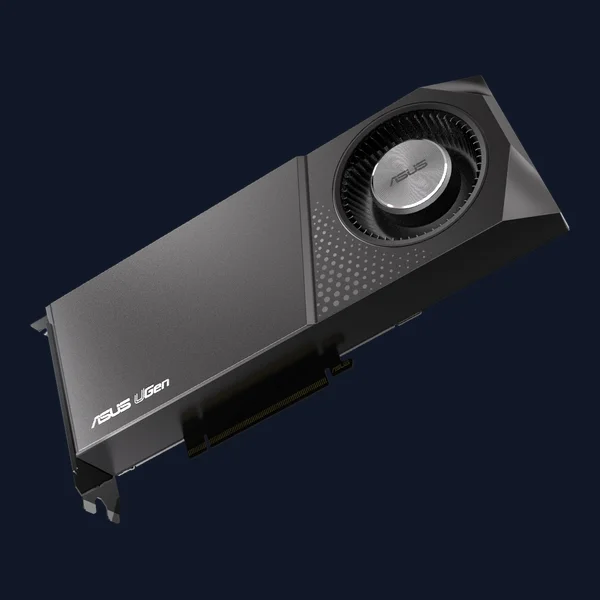
- Power and Cooling: 310W TBP via rear 12V-2x6 connector, strict 2-slot active blower fan, and phase-change GPU thermal pad
- Bus and Display Outputs: PCIe 5.0 x16 interface, three DisplayPort 2.1 (UHBR20) outputs, and one HDMI 2.1b port
- European Retail Price: €1,799 including VAT (€1,749 to €1,899 depending on local distributor tax rates)
Intel Arc Battlemage Graphics Cards (B-Series)
- Intel Xe2-HPG Battlemage architecture and XMX AI engines
- Hardware-accelerated XeSS 2 and Ray Tracing
- Dual AV1 hardware encoders and DisplayPort 2.1
Dual-Slot Blower Engineering and 128GB Multi-GPU Local AI Stacking
To justify a €1,799 outlay for development studios and enterprise workstations, ASUS engineered the UGen chassis specifically for dense multi-GPU server enclosures. The shroud maintains a strict dual-slot footprint paired with a dual-ball-bearing blower turbine that exhausts all waste heat directly out of the case through a 304 stainless steel I/O bracket.
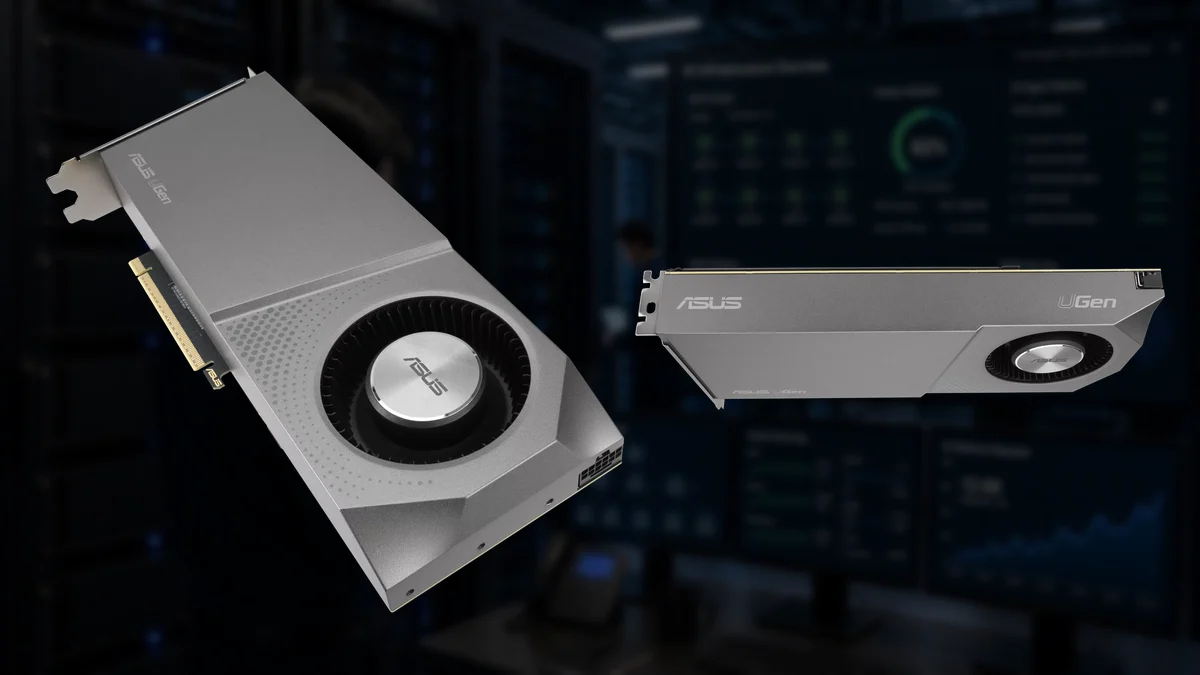
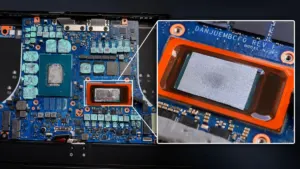
Inside the shroud, the BMG-G31 die is reinforced at all four corners with ASUS GPU Guard adhesive and topped with a phase-change thermal pad that liquefies under load to fill microscopic surface gaps without drying out over years of 24/7 operation. When four ASUS UGen Arc Pro B70 cards are stacked in a single system using the Intel SuperClaw software stack and vLLM, studios gain a unified pool of 128GB of ECC VRAM capable of running 70-billion to 120-billion parameter large language models locally.
What a €1,799 BMG-G31 Card Tells Desktop Gamers About the Missing Arc B770
Beyond the workstation market, this European retail listing explains why desktop gamers waiting for a consumer Intel Arc B770 built on the same 32-core BMG-G31 chip and 256-bit memory bus were left empty-handed. Even though enthusiasts continue squeezing impressive gaming mileage out of Xe2 hardware, as demonstrated by OptiScaler running AMD FSR 4.1.2 natively on Intel Arc XMX cores, a gaming-focused BMG-G31 card would have needed a $450 to $550 price tag to compete against the 12GB GeForce RTX 5070 and 16GB Radeon RX 9070 XT.
With ECC-grade GDDR6 memory and ABF packaging substrates commanding steep premiums across the semiconductor supply chain, selling that exact same BMG-G31 die flanked by 32GB of VRAM for €1,500 to €1,799 in the professional AI sector yields vastly higher margins for both Intel and its board partners. Even at €1,799 per card, a four-GPU workstation delivering 128GB of VRAM still undercuts a single enterprise data-center accelerator with comparable memory capacity.

My Take: From the Test Bench
When I broke down the ASUS UGen Arc Pro B70 spec sheet ten days ago, I fully expected European street prices to land well above Intel's $949 pre-tax baseline, yet seeing the counter hit €1,799 right out of the gate shows just how distorted the GPU market has become in 2026. Charging nearly €1,800 for a 32-core Battlemage BMG-G31 chip, no matter how well-built its 310W power delivery and phase-change thermal pad may be, highlights the massive tax now attached to any graphics card carrying 32GB of video memory.
As a PC builder and hardware tester, the biggest takeaway here is the bittersweet irony of ASUS's return to Intel graphics. The company has engineered the fastest, most robust desktop Battlemage card on the market, yet not a single desktop player will slot one into a rig for 4K gaming. As long as local AI developers are willing to buy these 256-bit cards in sets of four at €1,799 apiece, flagship consumer dies will keep getting redirected to the workstation aisle.

PC hardware enthusiast and competitive gamer, Arthur 'Heimdall' splits his time between France and the UK working in enterprise B2B software solutions. A business school graduate passionate about component benchmarking, he has been building, modding, and tuning PCs since childhood, optimizing every thermal degree and millisecond of display latency. An avid gamer across Assassin's Creed and sandbox titles, he forged his alliance with Grimtag and Chaya during late-night World of Warcraft raids before joining Pro-Gamer.