Why Philips Just Launched the World’s First 36-Inch 260 Hz Curved Gaming Monitor With the Evnia 36M4C5500P
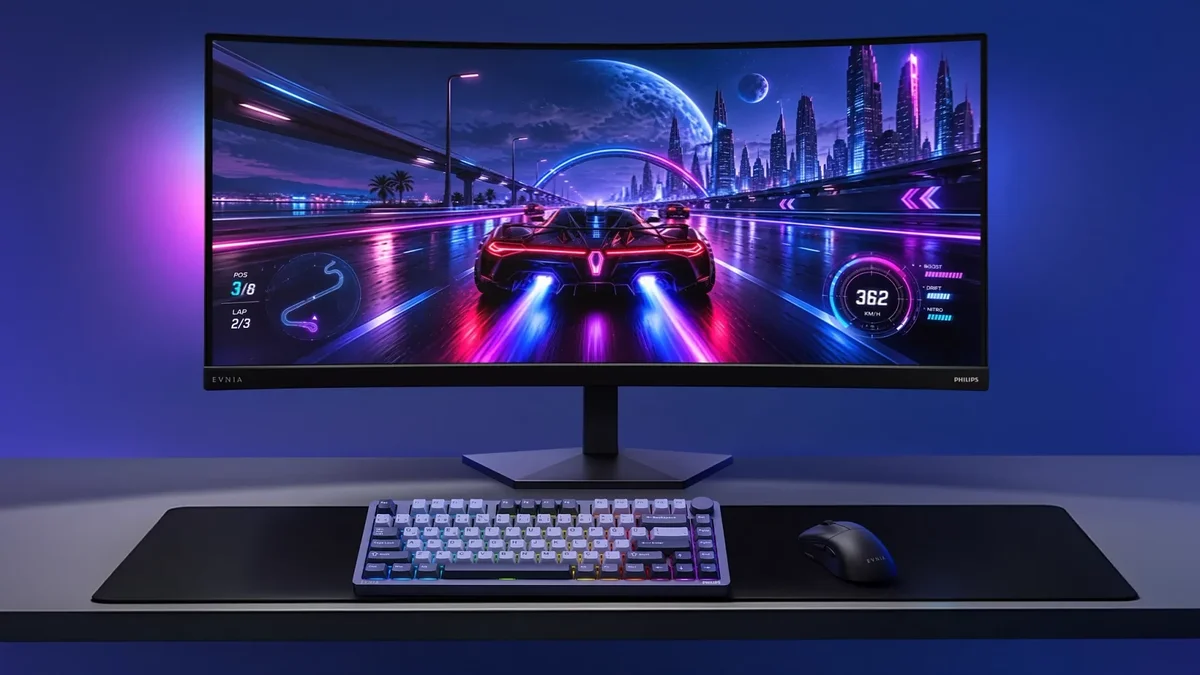
In the tightly standardized PC display market, the 21:9 ultrawide category has spent years locked around the familiar 34-inch diagonal, leaving a wide gap before jumping to much pricier 38-inch or 40-inch panels. On Thursday, October 22, 2026, Philips Monitors moved to carve out a new middle ground by officially unveiling the Evnia 36M4C5500P. Billed by the manufacturer as the world’s first 36-inch curved gaming monitor, this display aims to deliver extra physical screen real estate for sim racing enthusiasts and open-world players while pushing its refresh rate all the way up to 260 Hz.
An Unprecedented 36-Inch 1500R Curved Form Factor Running at 260 Hz
Positioned within the Evnia 5000 series (M4 lineup), a family traditionally engineered to balance high-refresh performance with accessible pricing, the Philips Evnia 36M4C5500P is built around a 21:9 Fast VA panel. Its pronounced 1500R curvature wraps naturally around the user's peripheral vision, adding two extra diagonal inches over the conventional 34-inch monitors that have dominated gaming desks for half a decade. Behind its anti-glare 3H coating, Philips pairs an UWQHD resolution of 3440 × 1440 pixels with an overclocked 260 Hz refresh rate.
On the responsiveness front, the official specification sheet rates the panel at 1 ms GtG (gray-to-gray) and drops down to 0.3 ms MPRT when engaging Philips' Smart MBR Sync motion-blur reduction system. While those numbers look brisk on paper, the broader display industry has entered an extreme speed race this year, highlighted by the arrival of 1000 Hz esports monitors and Tandem OLED panels tailored for tournament grinders. Here, Philips is clearly targeting a different balance, combining widescreen immersion with high-frame-rate fluidity.
Wide Color Gamut Coverage, Modest HDR 400, and Trimmed USB Connectivity
While Fast VA technology naturally favors high native contrast ratios over IPS panels, Philips has also focused heavily on factory color tuning. The 36M4C5500P covers 126% of the sRGB color space, 105% NTSC, 95% DCI-P3, and 91% Adobe RGB, backed by factory calibration rated at Delta E < 2. However, its high dynamic range credentials reflect its mainstream positioning: the monitor carries a basic VESA DisplayHDR 400 certification. Typical SDR brightness sits at 350 nits, stepping up to 450 nits in HDR mode with a 500-nit peak assisted by SmartImage HDR Tone Mapping. Without multi-zone Mini-LED local dimming, HDR impact will inevitably remain modest.
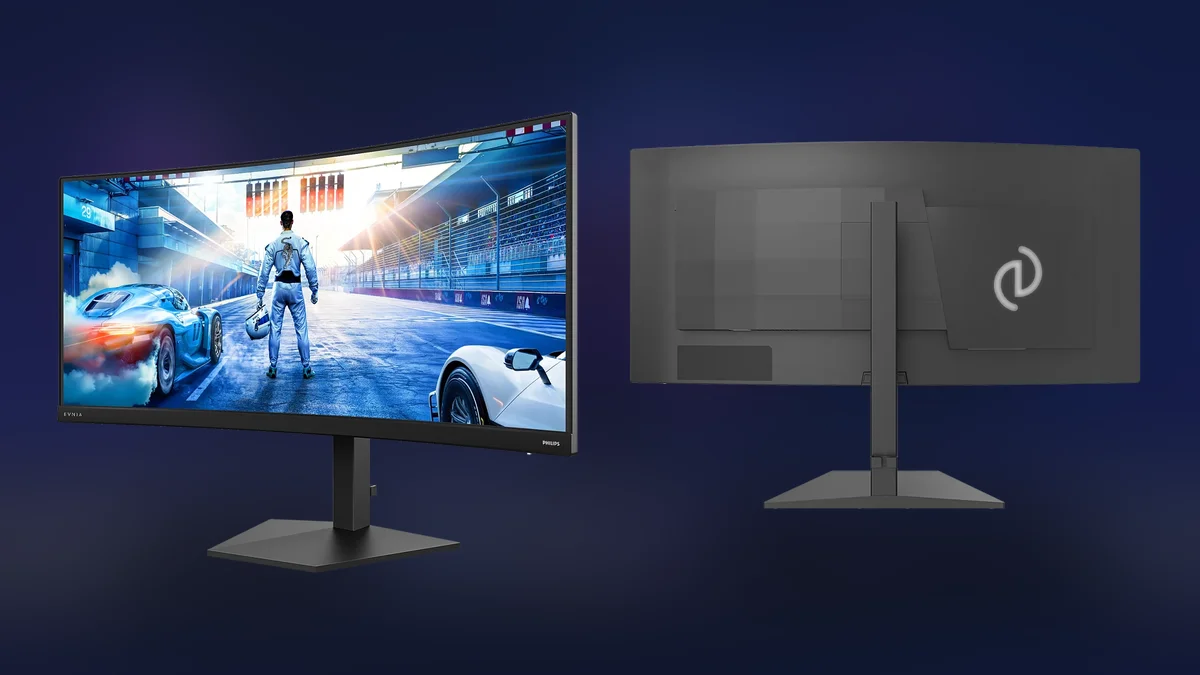
Around the back of the enclosure, the monitor features Philips' signature Iconglow customizable RGB lighting illuminating the Evnia emblem, paired with a compact ergonomic stand offering height, tilt, and swivel adjustments. Video connectivity includes two HDMI 2.1 ports, one DisplayPort 1.4 input, and a 3.5 mm headphone jack, alongside a built-in MultiView mode that lets users display two separate video sources side by side. To keep manufacturing costs down, Philips has omitted an integrated USB hub.
Check Availability Philips Evnia Gaming Monitors Availability on Amazon→
GPU Requirements and Regional Availability for the Evnia 36M4C5500P
From a PC hardware standpoint, sticking to a 3440 × 1440 pixel grid instead of jumping to 4K or 5K2K offers a clear practical upside: mid-range and high-end GPUs can realistically push frame rates close to the 260 Hz ceiling in modern titles using DLSS or FSR, especially when paired with the latest NVIDIA GeForce 621.01 WHQL driver optimized to cut shader compilation stutter. Philips also packs several gaming OSD assists into the firmware, including Stark ShadowBoost to brighten dark corners without overexposing highlights, alongside Smart Crosshair and Smart Sniper overlays.
Regarding its commercial rollout, Philips is launching the Evnia 36M4C5500P first across the Asia-Pacific (APAC) region through select retail partners. At the time of publication, the company has not yet disclosed official US or European MSRP figures or a concrete Western release window.
My Test Bench: Does a 36-Inch Fast VA Panel Make Sense Against 34-Inch QD-OLEDs?
Looking closely at the specification sheet of the Evnia 36M4C5500P, I genuinely appreciate Philips' willingness to experiment with physical panel sizing. When mounting an ultrawide display onto a sim racing rig or placing it at the back of a deep desk, standard 34-inch screens can sometimes feel slightly short vertically, and stepping up to a 36-inch 21:9 canvas provides a welcome boost in field of view without the massive footprint of a 45-inch display. That said, I have mixed feelings about stretching a 3440 × 1440 Fast VA panel across 36 inches. First, pixel density drops to roughly 103 PPI (down from nearly 110 PPI on a 34-inch monitor), which means desktop text clarity will look slightly softer during productivity work. Second, even modern Fast VA panels still have to prove they can keep dark-level transitions clean without noticeable black smearing when driven at 260 Hz. In a late-2026 market where 34-inch 175 Hz and 240 Hz QD-OLED monitors frequently go on sale with near-instantaneous pixel response and true per-pixel HDR, the Evnia 36M4C5500P will need very aggressive budget pricing below the $450 mark to truly win over PC builders.

PC hardware enthusiast and competitive gamer, Arthur 'Heimdall' splits his time between France and the UK working in enterprise B2B software solutions. A business school graduate passionate about component benchmarking, he has been building, modding, and tuning PCs since childhood, optimizing every thermal degree and millisecond of display latency. An avid gamer across Assassin's Creed and sandbox titles, he forged his alliance with Grimtag and Chaya during late-night World of Warcraft raids before joining Pro-Gamer.