0.59 ms Upscaling and Sharper Than XeSS: How OptiScaler Runs AMD FSR 4.1.2 on Intel Arc XMX Cores
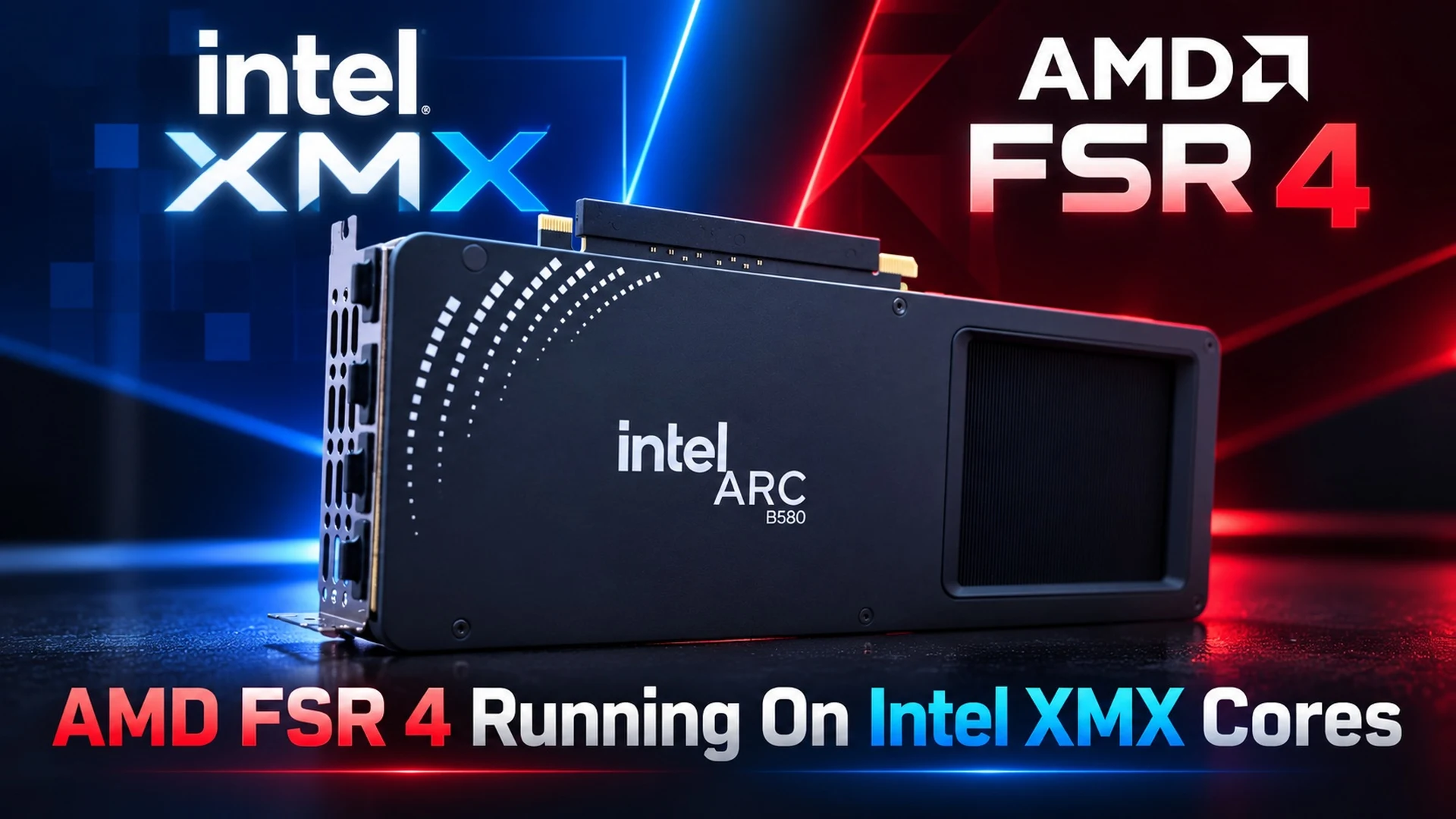
Running AMD's latest AI-powered upscaling neural network directly on the dedicated matrix engines of an Intel Arc graphics card sounded unlikely just days ago. Yet developers from the open-source OptiScaler project on GitHub have pulled off exactly that, adapting AMD FidelityFX Super Resolution 4.1.2 (FSR 4.1.2) and its streamlined FSR 4.1.2 Lite variant to run with full hardware acceleration on Intel's XMX (Xe Matrix Extensions) cores. Early benchmarks show upscaling processing times dropping as low as 0.59 ms per frame on an Intel Arc B580, matching Intel's native XeSS Super Resolution overhead while delivering noticeably cleaner image reconstruction.
From Generic DP4a Shaders to XMX Matrix Engines: Why INT8 Quantization Changes the Game
Until now, PC gamers using OptiScaler to inject FSR 4 into non-RDNA 4 graphics cards had to rely on conventional shader execution paths (DP4a). While that fallback allowed third-party GPUs to run the upscaler, bypassing dedicated matrix hardware imposed a steep frame-time penalty on every rendered image.
The breakthrough arrived following the release of the AMD Software: Adrenalin Edition 26.10.1 driver package. Shortly after AMD expanded official FSR 4.1 INT8 compute support to Radeon RX 6000 GPUs and Ryzen APUs, modders extracted the newly updated INT8 dynamic link libraries (DLLs), including the FSR 4.1.2 Lite model. Originally engineered by AMD for power-constrained mobile chips, handhelds, and integrated graphics (such as Ryzen AI and Ryzen Z-series processors), the Lite variant uses a more compact neural network that slashes compute requirements while retaining most of the visual fidelity of the full model.
By tailoring these INT8 libraries through a DirectX 12 execution path to target the dedicated XMX AI acceleration cores built into Intel Arc Alchemist (A-series) and Battlemage (B-series) GPUs, the OptiScaler community eliminated the shader bottleneck entirely. If you are looking to upgrade your rig with an XMX-capable Intel card or a native RDNA 4 GPU:
Intel Arc B580 and Arc A770 Benchmarks: FSR 4.1.2 Lite Matches or Beats Native XeSS Under 0.60 ms
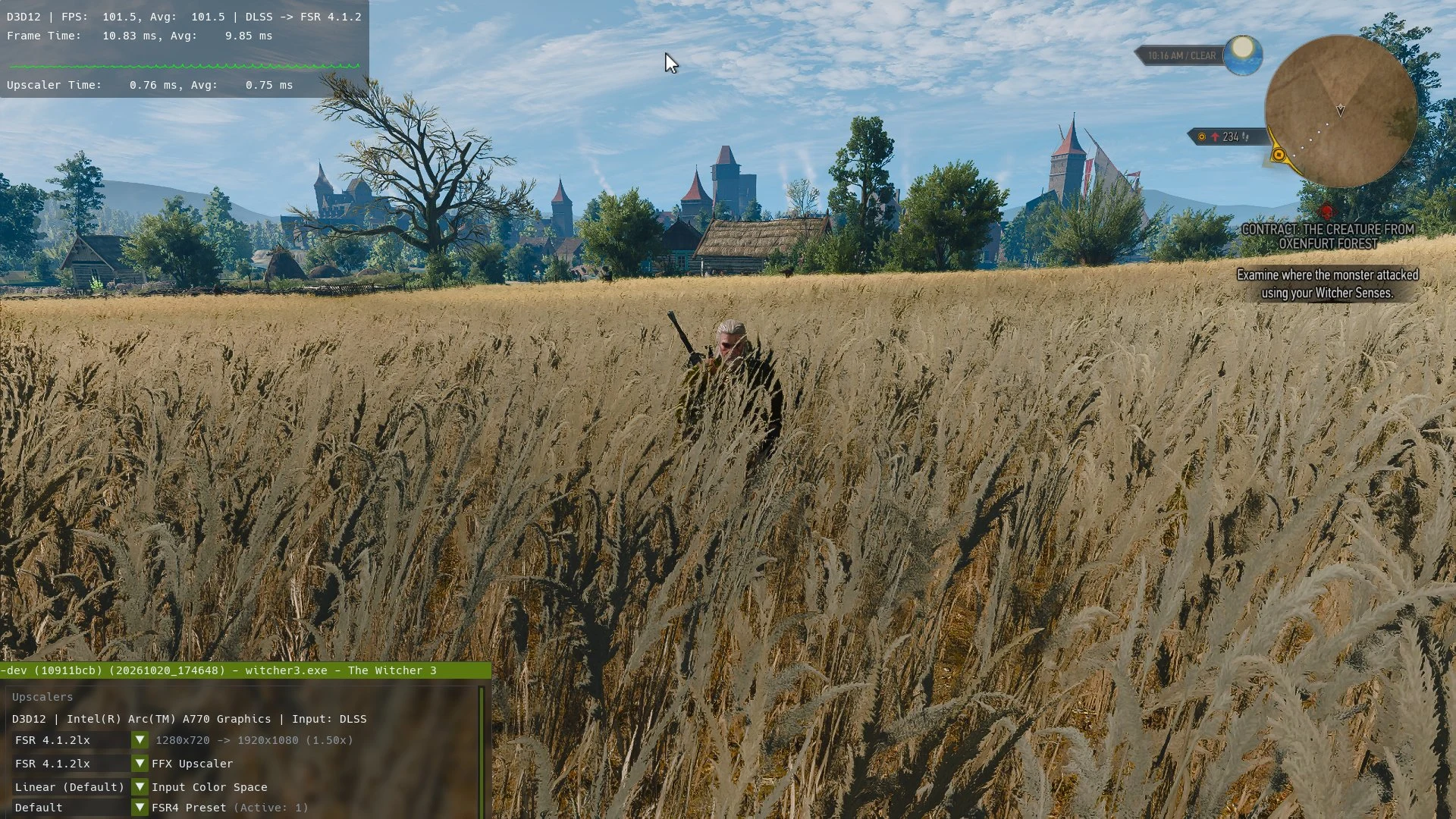
Community benchmarks shared by tester DarkerThanLpDark on the r/IntelArc forum alongside testing from the OptiScaler 0.9.0-pre9-dev branch highlight how efficiently Intel's XMX engines execute AMD's neural networks. Testing was conducted at 1080p (1280x720 internal resolution upscaled to 1920x1080 under DirectX 12) across two distinct cards: an Intel Arc B580 (Battlemage) running Clair Obscur: Expedition 33 (Balanced preset) and an Intel Arc A770 (Alchemist) running The Witcher 3: Wild Hunt , Complete Edition (Quality preset).
| Upscaler Model (XMX Execution) | Arc B580: Upscaling Time (Clair Obscur 1080p Balanced) | Arc A770: Average FPS (The Witcher 3 1080p Quality) | Arc A770: Upscaling Time (The Witcher 3 1080p Quality) |
|---|---|---|---|
| AMD FSR 4.1.2 Lite (XMX INT8) | ~0.59 ms | 101.5 FPS | 0.75 ms |
| Intel XeSS Super Resolution (Native XMX) | ~0.58 ms | 101.1 FPS | 0.84 ms |
| AMD FSR 4.1.2 Full Model (XMX INT8) | ~0.85 ms | 98.6 FPS | 1.11 ms |
| AMD FSR 4.0.2 Standard (XMX) | ~0.87 ms | 98.0 FPS | 1.17 ms |
| AMD FSR 4.0.2 Fixed / Modified (XMX) | ~0.88 ms | 97.2 FPS | 1.18 ms |
The numbers tell a remarkable story: on the Intel Arc A770 in The Witcher 3, FSR 4.1.2 Lite actually edges out Intel's own native XeSS Super Resolution, delivering 101.5 FPS versus 101.1 FPS thanks to a lower upscaling time of 0.75 ms compared to 0.84 ms. Meanwhile, on the Intel Arc B580 in Clair Obscur: Expedition 33, FSR 4.1.2 Lite requires just 0.59 ms, sitting within one-hundredth of a millisecond of native XeSS SR at 0.58 ms, while the full FSR 4.1.2 neural network takes only 0.85 ms.
Superior Image Reconstruction, 4x Frame Generation Combos, and Current Limitations
Beyond raw latency, the biggest win reported by testers is visual fidelity. Compared directly against native XeSS Super Resolution running on the exact same XMX hardware, AMD's FSR 4.1.2 and FSR 4.1.2 Lite models produce noticeably sharper image reconstruction and superior temporal stability, cutting down on foliage shimmering and fine-detail breakup in motion. Coming right after ASUS returned to Intel Arc GPUs with the 32GB Arc Pro B70, this community milestone proves just how capable Intel's matrix hardware truly is when paired with modern neural models.
Modders are already pushing hybrid combinations across multiple form factors. On an Intel-powered gaming handheld with integrated Arc graphics, testers report virtually identical frame rates between FSR 4.1.2 Lite XMX and XeSS SR, with a clear sharpness advantage for AMD's upscaler. Another Arc A770 owner paired FSR 4.1.2 XMX upscaling with Intel XeSS Frame Generation (4x mode) at 4K resolution in Assassin's Creed Odyssey, reaching 120 FPS (including generated frames).
However, a few technical caveats still apply to this early implementation:
- The XMX-accelerated FSR 4 path currently depends on a DirectX 12 pipeline, leaving Vulkan and DirectX 11 support much more limited.
- Game-by-game stability varies in this experimental build, with crashes reported in certain titles such as Crimson Desert.
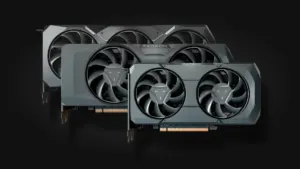
For players who prefer out-of-the-box official driver support for the full FSR 4 suite without relying on community DLL overrides, AMD's RDNA 4 desktop lineup remains the primary native option:
My Bench Take
What stands out to me most about this OptiScaler breakthrough is the sheer hardware irony: watching AMD's neural upscaler run in 0.75 ms on Intel's own XMX matrix engines and beat native XeSS in both processing speed and image clarity in The Witcher 3 is a remarkable plot twist. Intel engineered fantastic AI matrix hardware starting with Alchemist and refined it with Battlemage, yet its native XeSS Super Resolution model is starting to show its age against newer neural networks. If you own an Arc B580, an Arc A770, or an Intel Core Ultra handheld, dropping in the INT8 FSR 4.1.2 Lite profile is easily the best free visual upgrade you can give your GPU in DirectX 12 titles today.

PC hardware enthusiast and competitive gamer, Arthur 'Heimdall' splits his time between France and the UK working in enterprise B2B software solutions. A business school graduate passionate about component benchmarking, he has been building, modding, and tuning PCs since childhood, optimizing every thermal degree and millisecond of display latency. An avid gamer across Assassin's Creed and sandbox titles, he forged his alliance with Grimtag and Chaya during late-night World of Warcraft raids before joining Pro-Gamer.