1.3 PFLOPs in Just 350W: How Intel Challenges Nvidia With the D270 Crescent Island GPU and Up to 480GB of Memory
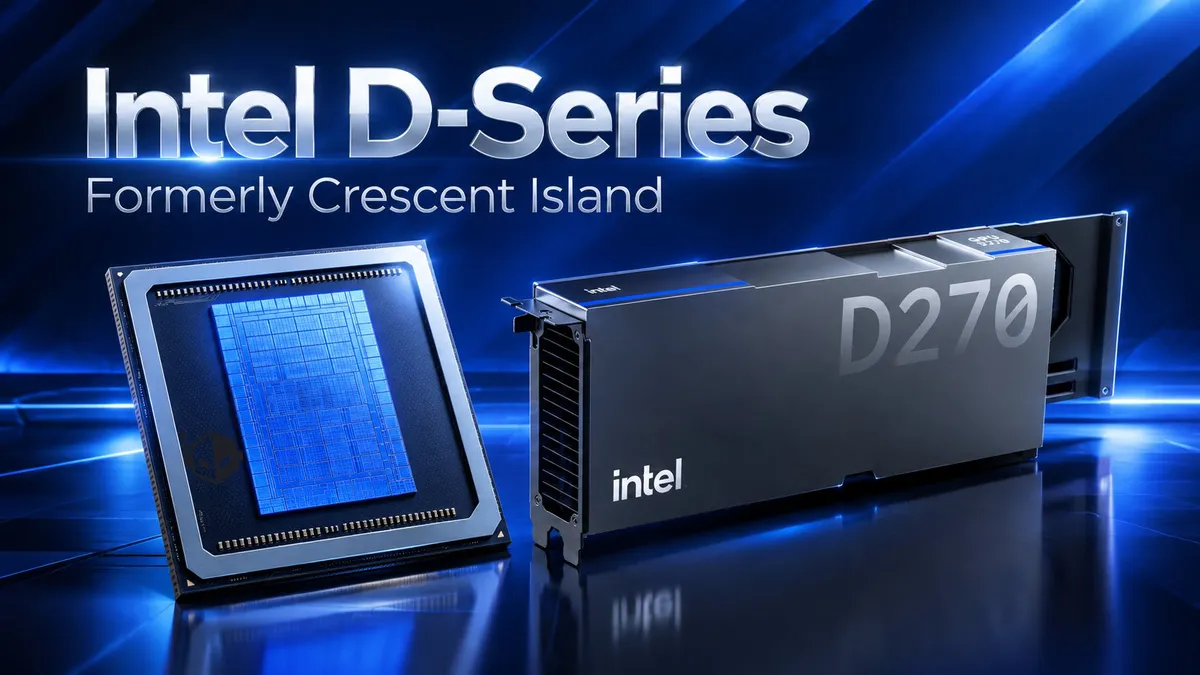
Intel took the stage at the OCP Global Summit 2026 to reveal its next-generation offensive in the data center artificial intelligence market. The Santa Clara chipmaker officially introduced its new Intel GPU D-Series accelerator family, developed under the codename Crescent Island, spearheaded by the flagship Intel GPU D270.
Intel's strategy addresses a critical industry pain point: while large model inference consumes massive amounts of power and Nvidia solutions increasingly demand costly liquid cooling plumbing, Team Blue delivers a cost- and power-optimized alternative built specifically for inference efficiency and total cost of ownership.
Xe3P Architecture: Purging 3D Rendering to Maximize Compute
At the core of the GPU D270 lies the Xe3P microarchitecture, the dedicated compute and professional implementation of Intel's 3rd Generation Xe graphics architecture. To maximize compute density on silicon, engineering teams eliminated all traditional 3D rasterization pipelines and ray-tracing hardware.
Every square millimeter of the die is dedicated to matrix and tensor mathematical throughput. The chip features 32 Xe3P cores distributed across four Compute Slices, providing a total of 256 Vector Engines and 256 deep systolic array XMX (Xe Matrix Extensions) engines.
This compute array is supported by a robust memory cache hierarchy, featuring 512 KB of dedicated L1 and Shared Local Memory (SLM) per core (totaling 16 MB) paired with a massive 32 MB unified L2 cache designed to prevent inter-core data bottlenecks.
1.3 PFLOPs at 350W with Passive Air Cooling
When it comes to raw inference throughput, the D270 delivers up to 1.3 PFLOPs of compute performance in FP8 precision, offering native hardware execution from FP4 up to FP64 for scientific simulation workloads. The technical achievement lies in achieving this density within a strict 350W thermal envelope.
Unlike competing accelerator modules pushing beyond 600W to 1,000W, the D270 uses a standard dual-slot PCIe 5.0 x16 add-in card form factor operating entirely on passive server airflow. Data center operators can slot the card into standard rack enclosures without redesigning facility infrastructure for direct-to-chip liquid cooling.
By comparison, workstation and data center cards like the Nvidia RTX PRO 5500 based on Blackwell reach around 846 TFLOPs of FP8 at a 600W thermal design point. Intel delivers higher matrix throughput while cutting overall power consumption by roughly 42%.
The LPDDR5X Strategy: Up to 480GB Without HBM Supply Bottlenecks
The most unconventional design choice of the Crescent Island platform is its memory subsystem. While Nvidia and AMD remain locked in fierce competition over high-bandwidth HBM3e and HBM4 memory (which suffer from severe packaging constraints and sky-high costs), Intel opted for high-density LPDDR5X memory.
The reference Intel-branded PCIe accelerator includes 160GB of LPDDR5X memory, while ODM partner configurations can scale all the way up to 480GB of memory capacity with an aggregate bandwidth of 1.5 TB/s.
This massive onboard memory pool fundamentally alters token-generation economics for long-context windows and key-value (KV) caching. A single D270 board can host and run 300-billion-parameter models locally, eliminating the need to split model weights across multiple networked GPUs.
Autonomous AI Agents and an Open Software Ecosystem
Intel specifically tailored the D-Series for multi-tenant inference services and multi-modal autonomous agents. An eight-GPU rack server configured with D270 accelerators can handle model deployments exceeding 1 trillion parameters without encountering memory exhaustion.
On the software side, Intel avoids proprietary lock-in by supporting industry-standard open frameworks out of the box. The D-Series works natively with vLLM, SGLang, llm-d, Triton, oneDNN, OpenVINO, PyTorch, and SYCL, while enabling heterogeneous orchestration alongside frameworks such as Nvidia Dynamo.
A Pragmatic Move Against Nvidia's Market Dominance
Customer sampling for the Intel GPU D270 begins in the second half of 2026. By sidestepping the extreme manufacturing bottlenecks of HBM in favor of cost-effective, high-density LPDDR5X, Intel delivers a realistic answer to the soaring infrastructure costs of modern AI deployments.
For cloud providers and enterprise infrastructure teams deploying giant inference workloads at scale, the battle is shifting from peak training speed to cost-efficient token throughput without blowing past power and cooling budgets.
My Take: Intel's Unexpected Comeback in the AI Hardware Race
We were just discussing this in the newsroom recently: with Nvidia's unchecked dominance and AMD's rapid gains in the datacenter space, many had already written Intel off, assuming the chipmaker had completely missed the AI train.
The arrival of this new AI accelerator card from Intel proves quite the opposite. Instead of running headfirst into the prohibitively expensive HBM wall to match Jensen Huang's power-hungry flagships, Intel executed a brilliant technical sidestep.
By leveraging 480 GB of high-density LPDDR5X and a passive 350-Watt PCIe form factor that drops right into existing server racks, Team Blue reminds everyone that their engineering labs still have serious firepower. Watching Intel surface back into the fight alongside AMD against Nvidia's near-monopoly is the best possible news for keeping the AI hardware market competitive.

SEO consultant for over 20 years and digital entrepreneur, Charles 'Grimtag' Ronchain is the founder of Pro-Gamer.gg, Retrocharting.com, and Gamescharting.com. A competitive gamer, streamer, and retro game collector, he has worked in the video game industry for over 15 years, notably as a consultant for leading game price comparison platforms. Passionate about real-time performance data and gaming technology, he analyzes competitive esports, gaming hardware benchmarks, and creator workflows on Pro-Gamer.gg with an authentic player perspective.