20 Cores, 5.4 GHz, and Missing from Intel ARK: Unannounced Core Ultra 7 260K Surfaces in Newegg Gaming PCs
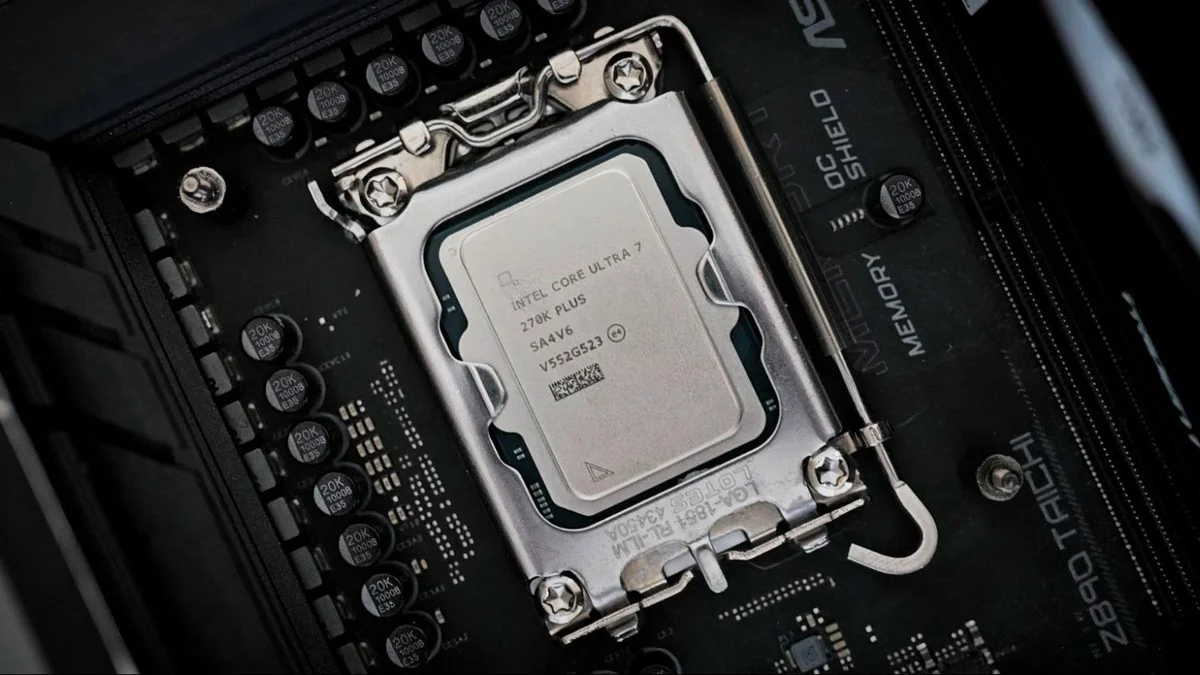
With zero press releases, no stage announcement, and not a single entry in Intel's public documentation, a brand-new desktop processor called the Intel Core Ultra 7 260K has quietly gone on sale inside prebuilt gaming desktops at US retailer Newegg. Built on the Arrow Lake-S architecture for the LGA 1851 socket, this unannounced chip is already shipping inside systems assembled by Newegg's in-house brand ABS (Advanced Battlestations), even though Intel's official ARK specification portal for Core Ultra Series 2 still lists no trace of the model.
A 20-Core Core Ultra 7 265K Trimmed by 100 MHz for System Integrators
Because Intel had not published a retail spec sheet for the processor, the technical breakdown comes directly from an official internal slide uploaded to the product image galleries of the ABS listings on Newegg. Titled Quick Reference Guide: Intel Core Ultra 7 260K and visibly captured from a Microsoft Teams presentation, the chart compares the mystery chip side by side against the mainstream Core Ultra 7 265K.
Despite the slightly lower model number, the Core Ultra 7 260K does not cut any physical cores or cache capacity. It retains the exact 20-core, 20-thread layout of the 265K, combining 8 Performance-cores (P-Cores) and 12 Efficient-cores (E-Cores), placing it well ahead of the 14-core (6P + 8E) Core Ultra 5 245K. P-Core base frequency remains locked at 3.9 GHz, backed by the same 30 MB of Intel Smart Cache (L3) and a 125W Processor Base Power (TDP) rating.
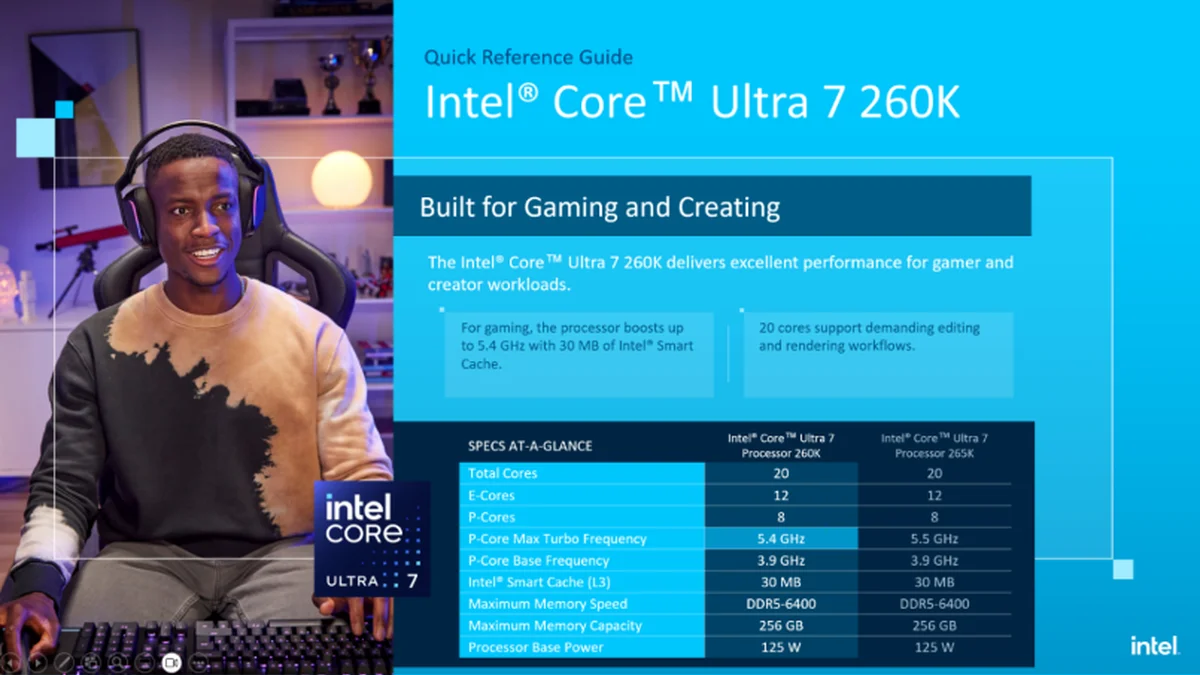
According to Intel's reference slide, the only hardware distinction is peak clock speed: the Core Ultra 7 260K reaches a 5.4 GHz P-Core Max Turbo frequency, just 100 MHz below the 5.5 GHz ceiling of the retail Core Ultra 7 265K. Another key specification confirms the 260K belongs to the original Arrow Lake-S wave rather than the newer Arrow Lake Refresh lineup (such as the Core Ultra 7 270K Plus or the recent $499 Core Ultra 5 250KF Plus bundle with a B860 motherboard and 32GB of DDR5): official memory support tops out at 256 GB of DDR5-6400, whereas Arrow Lake Refresh parts validate up to DDR5-7200 and support Intel's software-driven Intel Binary Optimization Tool (iBOT).
| Specification | Intel Core Ultra 7 260K (Newegg OEM) | Intel Core Ultra 7 265K (Retail Box) | Intel Core Ultra 7 270K Plus (Refresh) | Intel Core Ultra 5 245K (Retail Box) |
|---|---|---|---|---|
| Architecture & Socket | Arrow Lake-S (LGA 1851) | Arrow Lake-S (LGA 1851) | Arrow Lake Refresh (LGA 1851) | Arrow Lake-S (LGA 1851) |
| Cores / Threads | 20 Cores (8P + 12E) / 20T | 20 Cores (8P + 12E) / 20T | 24 Cores (8P + 16E) / 24T | 14 Cores (6P + 8E) / 14T |
| P-Core Clocks (Base / Boost) | 3.9 GHz / 5.4 GHz (5.2 GHz on listing text) | 3.9 GHz / 5.5 GHz | 3.7 GHz / 5.5 GHz | 4.2 GHz / 5.2 GHz |
| L3 Cache (Intel Smart Cache) | 30 MB | 30 MB | 36 MB | 24 MB |
| Max Official Memory Speed | DDR5-6400 (up to 256 GB) | DDR5-6400 (up to 256 GB) | DDR5-7200 (up to 256 GB) | DDR5-6400 (up to 256 GB) |
| Processor Base Power (TDP) | 125W | 125W | 125W | 125W |
| Availability | Exclusive to ABS Prebuilt PCs | Standalone Retail Box | Standalone Retail Box | Standalone Retail Box |
Following the appearance of the Newegg listings, Intel confirmed that the chip is a limited-availability SKU not offered as a standalone boxed retail processor, adding that its official specification page will go live on Intel's website within the next few days. For DIY builders assembling their own LGA 1851 rig, the standalone Core Ultra 7 265K remains the direct retail counterpart, delivering the exact same 20-core configuration and 30 MB L3 cache with a full 5.5 GHz boost clock.
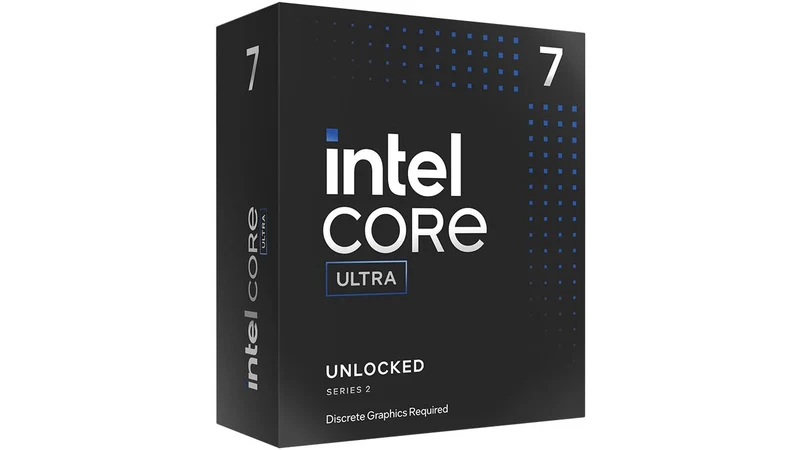
Intel Core Ultra 7 265K (20-Core, LGA 1851 Socket)
- 20 Cores (8P + 12E)
- 5.5 GHz Max Boost
- 30 MB L3 Smart Cache
- DDR5-6400
- 125W Base Power
ABS Flux II Aqua and Kaze II: RTX 5070 and RTX 5060 Prebuilts Starting at $1,699.99
Newegg has confirmed that the Core Ultra 7 260K is exclusive to the retailer and sold solely through its in-house ABS desktop configurations. Two prebuilt towers currently feature the processor, though the product pages exhibit minor labeling inconsistencies: while the main title and Intel slide refer to the chip as the 5.4 GHz Core Ultra 7 260K, the written specification bullet lists a 5.2 GHz max boost and Newegg's configuration selector labels the option as U7-260KF (indicating a variant without integrated graphics).
- ABS Flux II Aqua Gaming PC (Model F2A57N57R1): Pairs the Intel Core Ultra 7 260K (cooled by a 240mm AIO liquid cooler) with an NVIDIA GeForce RTX 5070 (12GB GDDR7, DLSS 4), 32GB of DDR5-6000 RAM, and a 1TB PCIe 4.0 NVMe SSD running Windows 11 Home. Listed on promotion between $1,799.99 and $1,999.99 (down from its $2,299.99 list price).
- ABS Kaze II Aqua White Gaming PC (Model K2A57N56R1): Combines the Intel Core Ultra 7 260K with an NVIDIA GeForce RTX 5060 (8GB), 32GB of DDR5 RAM, and a 1TB NVMe SSD inside a white chassis, discounted to $1,699.99 from $1,999.99.
Supplying retailer-exclusive silicon allows Intel and system integrators to repurpose Arrow Lake dies that fall just 100 MHz shy of the 265K's top frequency bin while keeping the appealing "20-Core Core Ultra 7" badge on prebuilt spec sheets ahead of Intel's next-generation Nova Lake desktop transition slated for CES 2027.
My Field Notes
When I spotted these two ABS listings during my late-night sweep of the US retail catalogs, I immediately pinged Arthur "Heimdall" to compare notes on the silicon binning: sitting between the 14-core Core Ultra 5 245K and the full 5.5 GHz Core Ultra 7 265K, this OEM-only 260K is a textbook example of smart wafer utilization. Dropping 100 MHz off the single-core turbo ceiling while keeping all 8 P-Cores, 12 E-Cores, and 30 MB of L3 cache will make zero real-world difference when paired with an RTX 5070 at 1440p. However, because Newegg's dropdown menu calls it a "U7-260KF" and the text mentions 5.2 GHz, buyers should assume Quick Sync integrated graphics might be disabled on their unit until Intel's ARK entry officially goes live.

Originally from Lyon, France, gaming journalist Bastien "Orion" relocated nearly a decade ago to Quebec City's Saint-Roch district, right in the heart of eastern Canada's development studio hub. Before crossing the Atlantic, he honed his versatile reporting style across classic French gaming web portals and specialist television outlets in the 2000s and 2010s, notably with JeuxVideo.fr and JeuxNews. Equally passionate about AAA blockbusters, North American studio culture, retro preservation, and community modding projects, he anchors Pro-Gamer's transatlantic desk and real-time coverage of US and Japanese industry announcements.