5K at 180 Hz or QHD at 350 Hz in One Click: Philips Unveils the Evnia 27M2D5901A 27-Inch Dual Mode Monitor with DisplayPort 2.1
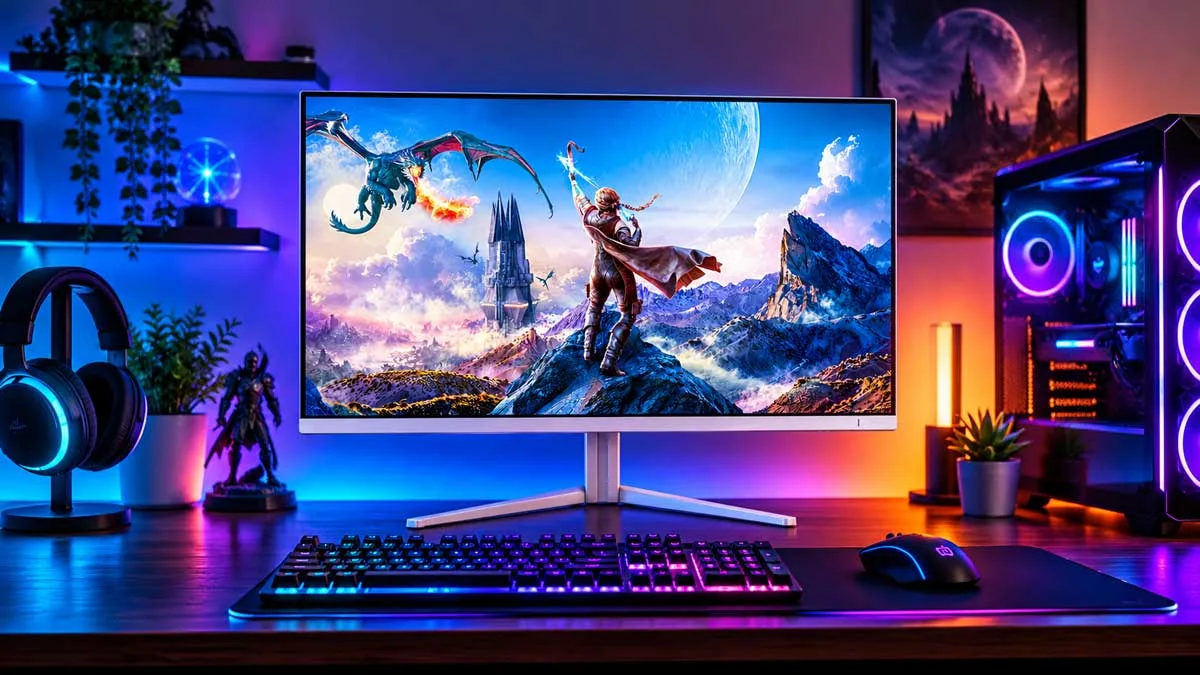
Choosing between the razor-sharp pixel density of an ultra-high-resolution display for daily productivity and the blistering refresh rate of an esports panel for competitive shooters has long forced PC builders into an awkward compromise. While first-generation dual-mode monitors mostly alternated between 4K and a somewhat coarse 1080p resolution across 27-inch or 32-inch screens, Philips Monitors and its brand license partner MMD are raising the bar within the Evnia 5000 series by officially unveiling the Philips Evnia 27M2D5901A. Built around a 27-inch Fast IPS panel, this display delivers native 5K resolution at up to 180 Hz and switches on demand to QHD 1440p at up to 350 Hz.
Dual Mode 5K at 180 Hz and QHD at 350 Hz: The Mathematical Perfection of 4:1 Integer Scaling
The standout engineering achievement of the Philips Evnia 27M2D5901A lies in the exact pixel geometry of its 27-inch (68.58 cm, 16:9) panel. In high-resolution mode, the monitor renders a crisp 5K resolution of 5120 x 2880 pixels, hitting a Retina-grade pixel density of 218 PPI (pixels per inch). In this mode, the refresh rate reaches up to 180 Hz over DisplayPort 2.1 (165 Hz native, overclockable to 180 Hz) and up to 175 Hz via HDMI 2.1.
With a quick toggle in the on-screen menu, the Dual Mode feature shifts the panel to QHD (2560 x 1440 pixels, 109 PPI) and unlocks a blistering 350 Hz refresh rate across both DisplayPort and HDMI inputs. The mathematical advantage here is crucial: 5K (5120 x 2880) is exactly twice the horizontal and vertical resolution of QHD (2560 x 1440). Unlike a 4K monitor that suffers from fractional interpolation blur when displaying a 1440p signal, the Evnia 27M2D5901A maps an exact 2x2 grid of four physical pixels to every single QHD pixel. The result is razor-sharp integer scaling at 350 Hz without dropping down to 1080p.
This push toward enthusiast display formats follows closely behind the brand's recent reveal of the Philips Evnia 36M4C5500P 36-inch 260 Hz curved gaming monitor. To keep motion clarity tight during fast flicks at 350 Hz, the Fast IPS panel is rated for a 1 ms GtG (gray-to-gray) response time and drops down to 0.5 ms using Smart MBR (Motion Blur Reduction) alongside Adaptive-Sync support.
DisplayPort 2.1, 96W USB-C Power Delivery, Smart KVM, and Factory Calibration
Thanks to its 218 PPI pixel density in 5K and factory-calibrated color accuracy, the new addition to the official Philips Evnia lineup is tailored for hybrid setups that bridge content creation, macOS or Windows workstations, and high-framerate gaming. Here is the full specification breakdown confirmed by Philips Monitors:
- Panel and Form Factor: 27-inch (68.58 cm, 16:9) Fast IPS LCD with anti-glare coating.
- Dual Mode Resolutions and Refresh Rates: 5K (5120 x 2880 at 218 PPI) up to 180 Hz via DP 2.1 (175 Hz via HDMI 2.1) or QHD (2560 x 1440 at 109 PPI) up to 350 Hz.
- Response Time: 1 ms GtG and down to 0.5 ms with Smart MBR.
- Brightness and Contrast: 500 cd/m² peak brightness, 1000:1 static contrast ratio, and VESA DisplayHDR 400 certification.
- Color Reproduction: 10-bit color depth (8-bit + FRC, 1.07 billion colors), 99.5% sRGB and approximately 95% DCI-P3 coverage, factory calibrated to a Delta E below 2.
- Video and Data Connectivity: 1x DisplayPort 2.1, 2x HDMI 2.1, 1x USB-C (DisplayPort Alt Mode with up to 96W Power Delivery), USB 3.2 Gen 1 hub (1x USB-B upstream, 2x USB-A downstream including fast charging), and a 3.5 mm audio out jack.
- Extra Features and Ergonomics: Integrated Smart KVM switch, AI-driven Ambiglow rear lighting, dual 5W stereo speakers, and an ergonomic stand with 130 mm height adjustment, tilt (-5° to +20°), swivel (-30° to +30°), and 90-degree portrait pivot.
Philips Evnia 27M2D5901A Price and Release Window
Finished in Evnia's signature textured white chassis crafted with post-consumer recycled plastics, the Philips Evnia 27M2D5901A is scheduled to hit retail shelves in late November to December 2026. Official pricing is set at €929 in Europe and £699 in the UK (roughly $899 USD equivalent).
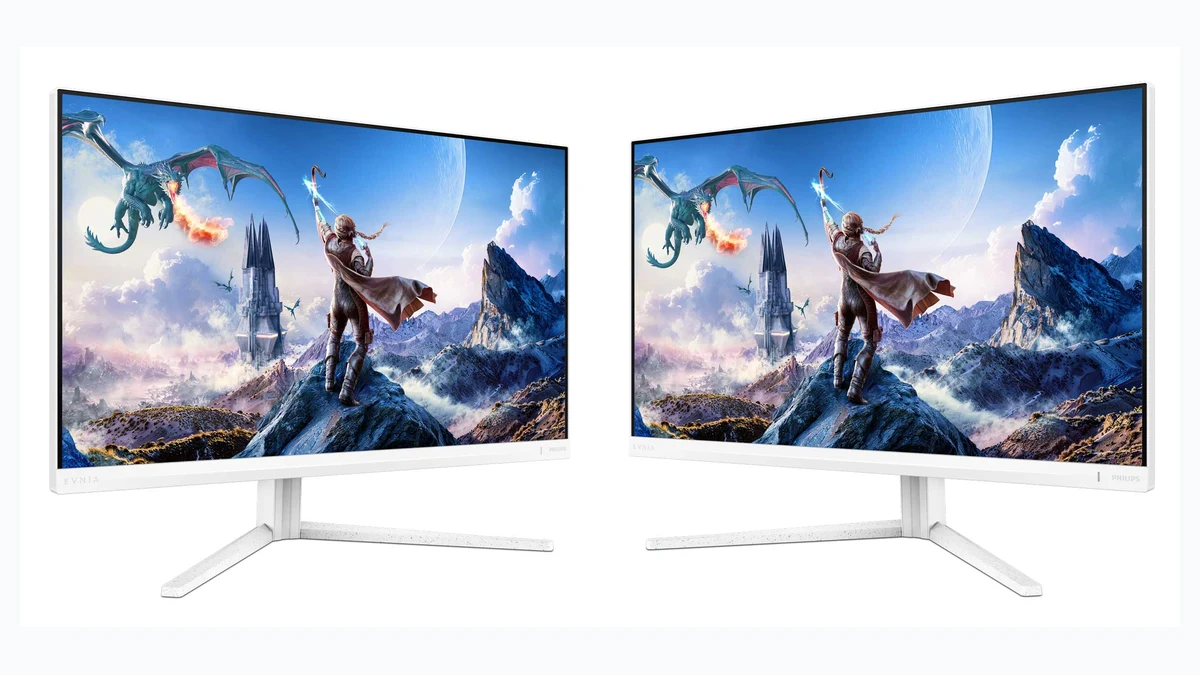
Philips Evnia 27M2D5901A (27-Inch Dual Mode 5K 180 Hz / QHD 350 Hz)
- 27-Inch Fast IPS Panel
- 5K 180 Hz and QHD 350 Hz (4:1 Integer Scaling)
- DisplayPort 2.1 and 2x HDMI 2.1
- 96W USB-C and Smart KVM
Check Availability for Philips Evnia on Amazon→
My Take on the Spec Sheet
Looking closely at the 27M2D5901A's specification sheet, Philips has finally solved my biggest gripe with first-wave dual-mode monitors. Dropping a 4K panel down to 1080p on a desk-distance 27-inch screen immediately makes text and HUD elements look blocky. By pairing 5120 x 2880 with 2560 x 1440, Philips achieves an exact 2x2 integer ratio: you get a pin-sharp 218 PPI workspace for editing and single-player titles, and a clean, non-blurry 1440p image at 350 Hz to keep frametimes locked in Counter-Strike 2 or Valorant. We have not yet had a physical unit on our desk,if the manufacturer's team would like to send over a review sample so we can put it through our full real-world testing protocol, our lab doors are wide open.
I also appreciate the inclusion of DisplayPort 2.1 alongside 96W USB-C Power Delivery and a built-in KVM switch. For anyone sharing a desk between a desktop rig powered by an RTX 5080 or RTX 5090 and a MacBook Pro that thrives on native 5K scaling, single-cable switching without an external dock is a massive quality-of-life win. My only reservation on paper is the lack of a Mini-LED backlight: at €929 (£699), a standard 1000:1 Fast IPS panel with VESA DisplayHDR 400 certification will not deliver true local-dimming HDR contrast against similarly priced OLED displays. We have not yet tested this unit with our colorimeter in the lab to measure pixel overdrive tuning at 350 Hz or the exact DisplayPort 2.1 bandwidth tier, but for dual-system productivity and high-refresh gaming, the geometry makes complete sense.

PC hardware enthusiast and competitive gamer, Arthur 'Heimdall' splits his time between France and the UK working in enterprise B2B software solutions. A business school graduate passionate about component benchmarking, he has been building, modding, and tuning PCs since childhood, optimizing every thermal degree and millisecond of display latency. An avid gamer across Assassin's Creed and sandbox titles, he forged his alliance with Grimtag and Chaya during late-night World of Warcraft raids before joining Pro-Gamer.