Hopper, Dustin, and Steve in Unity: Five 3D Character Models From Telltale's Canceled Stranger Things Game Leak Online
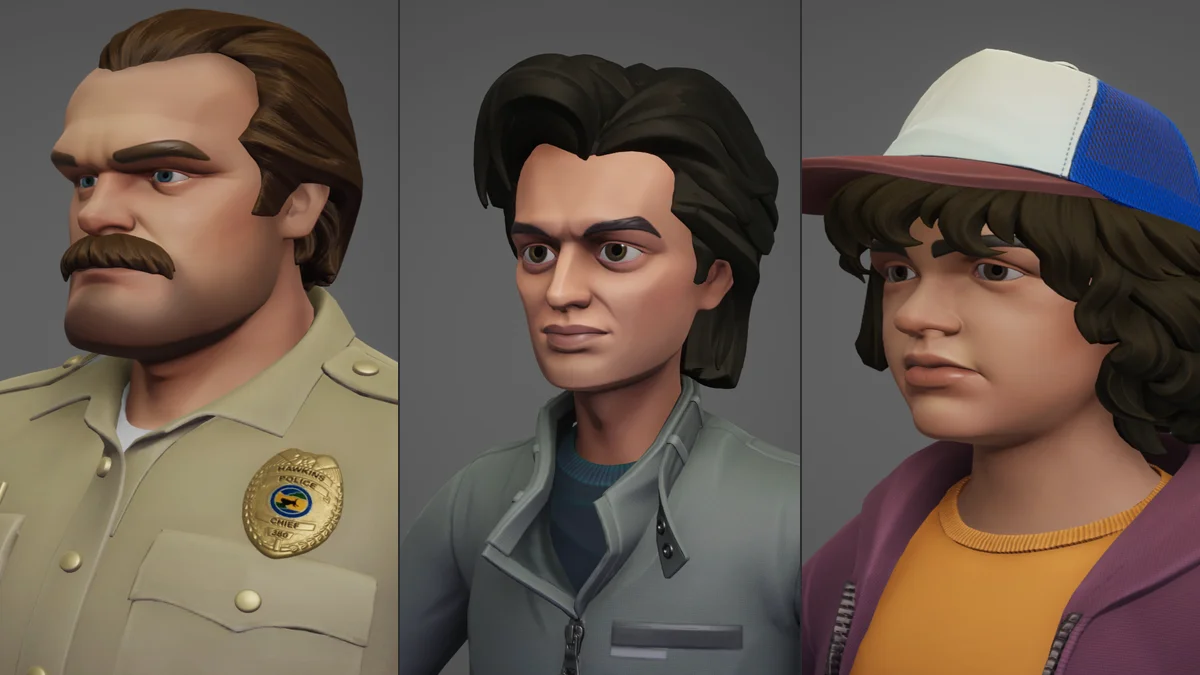
Eight years after the sudden September 2018 collapse of the original studio, the archives of Telltale Games continue to yield lost pieces of gaming history. Five high-resolution 3D character renders from the developer's canceled Stranger Things adaptation have surfaced online, offering a closer look at the stylized character assets built during the studio's ill-fated transition to the Unity engine.
Jim Hopper, Dustin Henderson, and an Early Look at Steve Harrington
Shared in crisp 2000x1125 resolution, the five leaked model sheets highlight how the San Rafael team aimed to translate the Netflix phenomenon into its signature comic-inflected art style. The most polished asset of the batch is Hawkins Police Chief Jim Hopper, featuring a heavily stylized square jaw, thick mustache, and tan uniform complete with his nameplate and a detailed "Hawkins Police Chief 380" badge.
Alongside Hopper, Dustin Henderson is shown wearing his trademark red, white, and blue trucker cap, curly brown hair, and a burgundy zip-up hoodie over a yellow-orange shirt. By contrast, the model for Steve Harrington, dressed in a gray high-collared jacket over a teal sweater, betrays just how early in pre-alpha the build was when production halted: with overly glossy skin shaders and a wide-eyed stare, the asset clearly lacked final lighting and texture passes.

Progressive Battle Damage and Torn Clothing From the Upside Down
Beyond the trio of fan-favorite leads, the leak includes two additional character sheets that shed light on the episodic progression planned by the development team. One close-up depicts a weary, dark-circled man with heavy stubble and an orange plaid shirt, while a full-body comparison sheet lines up three distinct A-pose states for a bearded older man wearing a brown sweater vest, white dress shirt, and coral tie.
That three-stage character sheet demonstrates progressive physical wear across chapters: the character first appears with his glasses resting on his nose, then with the frames tucked into his vest pocket, and finally in a battered third state with his right sleeve ripped open and his trousers shredded at the knees and ankles. It is a classic visual storytelling device used by Telltale to reflect survival encounters against creatures from the Upside Down.
Check Availability for The Walking Dead Definitive Series on Amazon→
From a 2016 Executive Rejection to the Unity and Night School Studio Collapse
The fate of Telltale's Stranger Things remains one of modern gaming's most fascinating behind-the-scenes casualties, echoing stories like Vivendi's secret cancellation of The Chronicles of Riddick at Starbreeze. Originally pitched in mid-2016 right after Season 1 debuted, the concept was repeatedly turned down by former Telltale executives who dismissed the show as "just a bunch of kids on bikes" before new leadership finally greenlit the Netflix partnership in 2017 and announced it in June 2018.
Slated for a 2019 launch to bridge the gap between Season 2 and Season 3 over spring break, the main game cast Will Byers as the playable protagonist, blending house exploration around his birthday TRS-80 computer with tense first-person Demogorgon stealth sequences. Crucially, it was set to be the first Telltale project built in Unity rather than the aging in-house Telltale Tool, while Oxenfree developer Night School Studio secretly worked on a companion game code-named Kids Next Door whose walkie-talkie choices would carry over via save files.
When Telltale collapsed in September 2018 after missing three funding payments to Night School Studio and laying off more than 250 employees, both interconnected projects were wiped out overnight. Even as the revived publisher recently celebrated the launch of The Wolf Among Us Remastered with five playable deleted scenes, these unearthed 3D models remain a vivid time capsule of a studio caught mid-transformation.
My Field Notes
Looking closely at these five renders side by side shows just how turbulent Telltale's summer of 2018 really was behind closed doors. While Jim Hopper's bust already captures the sharp, expressive caricature that made The Wolf Among Us so memorable, Steve Harrington's unfinished, glossy shader work reveals an art team still wrestling with a brand-new Unity rendering pipeline after more than a decade on the proprietary Telltale Tool. More than the main episodic season itself, the real loss here was the cross-save experiment with Night School Studio's Kids Next Door companion project, which could have finally pushed Telltale's branching narrative formula into genuinely fresh territory.
Originally from Lyon, France, gaming journalist Bastien "Orion" relocated nearly a decade ago to Quebec City's Saint-Roch district, right in the heart of eastern Canada's development studio hub. Before crossing the Atlantic, he honed his versatile reporting style across classic French gaming web portals and specialist television outlets in the 2000s and 2010s, notably with JeuxVideo.fr and JeuxNews. Equally passionate about AAA blockbusters, North American studio culture, retro preservation, and community modding projects, he anchors Pro-Gamer's transatlantic desk and real-time coverage of US and Japanese industry announcements.