With Next-Gen Consoles Nearing $1,000, Sony Patents a GPU AI That Cuts Holes in Frames to Slash Cloud Gaming Lag

As skyrocketing GDDR7 memory and NAND flash contract prices threaten to push the upcoming PlayStation 6 and Xbox Project Helix toward a steep $1,000 price tag, cloud streaming is rapidly shifting from a secondary perk to a vital entry point for next-generation gaming. Yet for cloud gaming to feel indistinguishable from local hardware on fluctuating home broadband connections, platform holders must overcome the twin bottlenecks of video bitrate and network latency. That exact challenge is at the heart of patent publication US 2026/0340791 A1, filed on April 20, 2026 by Sony Interactive Entertainment Europe Limited and officially published on October 29, 2026 by the United States Patent and Trademark Office (USPTO).
Two Matched Neural Networks That Strip Frame Data Before Video Encoding
Titled "Techniques for reducing data content in an image" and authored by London-based engineers Andrew James Bigos and Matthew William Sanders (US classification 382/100, spanning 20 formal claims), the filing arrives just as Sony leadership holds back on locking in a PlayStation 6 release date and price amid the global RAM crisis. Rather than feeding a full rasterized frame into a conventional video encoder that degrades the entire screen into blocky macroblocks whenever bandwidth drops, Sony's architecture splits the streaming pipeline across two jointly trained machine learning models:
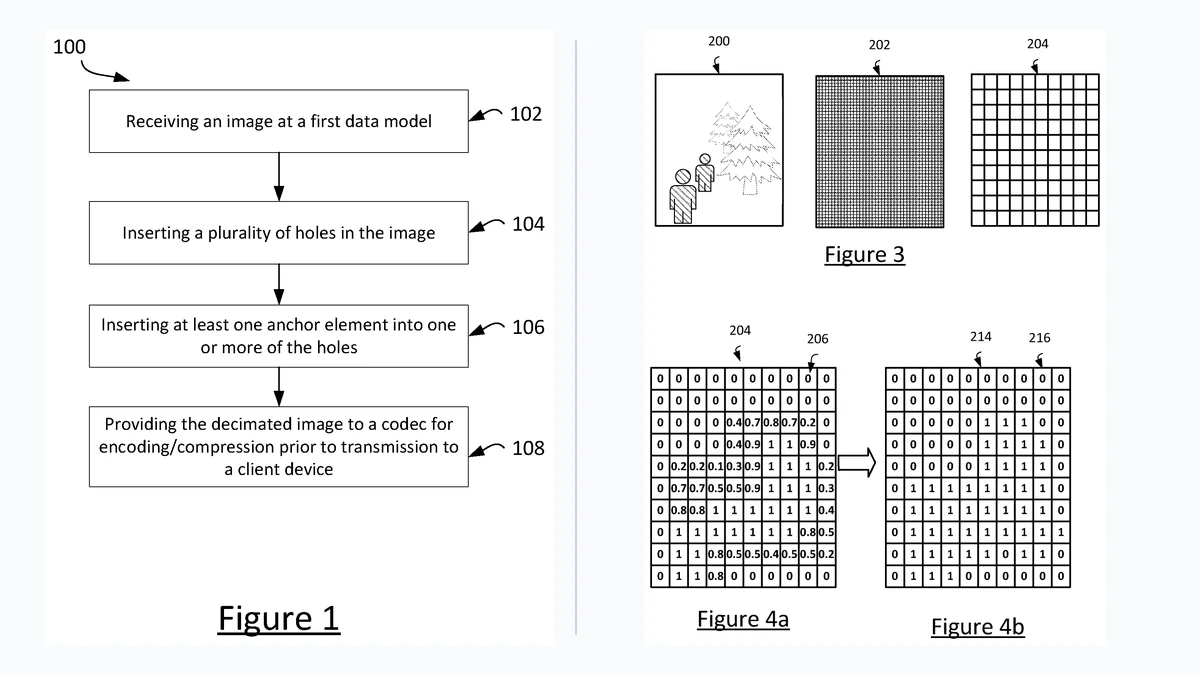
- A Server-Side Decimation Network (First Data Model): Running immediately after GPU rendering on the cloud server, this network inspects each frame and deliberately removes multiple low-priority image portions to punch a "plurality of holes" into the picture before handing it over to the video codec for compression (Step 108 in Figure 1).
- A Client-Side Reconstruction Network (Second Data Model): Running locally on the receiving hardware (whether a PlayStation console, a PlayStation Portal handheld, or an extended reality VR / XR headset explicitly named in the claims), this companion model decodes the stripped stream and reconstructs the missing regions right before display.
The 0.4 Importance Grid and "Anchor Pixels" Designed to Stop AI Hallucinations
Drawing sheets 3, 4a, and 4b of the USPTO document illustrate exactly how the sender decides which pixels can be discarded without the player noticing. When a rendered game frame (labeled 200 in Figure 3, depicting characters standing near pine trees) enters the first data model, the system generates an Importance Map (206) that assigns every cell in the spatial grid a numerical score ranging from 0 to 1.
In the patent's worked example (Figure 4a), the cutoff threshold is set at 0.4. Every grid cell scoring strictly below 0.4 (such as 0, 0.1, 0.2, or 0.3 across broad patches of sky or uniform ground) is zeroed out to 0 in a binary mask (Figure 4b) and stripped from the frame. Conversely, high-salience regions containing character silhouettes and tree foliage, which score between 0.4 and 1.0, are flagged as 1 in the mask and preserved at full fidelity.
| Pipeline Stage (US 2026/0340791 A1) | Hardware Execution Side | Neural Operation & Key Technical Parameters |
|---|---|---|
| 1. Importance Mapping (Figs. 3 & 4a) | Cloud Server / Host PS5 | Divides the frame into a grid (204) and scores each cell from 0.0 to 1.0 based on visual salience |
| 2. Decimation Network (Figs. 1 & 4b) | Cloud Server (Step 104) | Zeros out and removes image portions below threshold (e.g., < 0.4) scaled by target compression level |
| 3. Anchor Insertion (Fig. 2, 106a/b) | Cloud Server Pre-Codec | Places representative anchor elements inside larger holes to ground client-side reconstruction |
| 4. Reconstruction Network (Fig. 6) | Client (Console, Portal, XR Headset) | Decodes stream (404) and runs AI inpainting (406/408) guided by the embedded anchor pixels |
| 5. Joint Training Loop (Fig. 7) | Sony R&D Cluster (Blocks 510-520) | Dual-criteria loss function balancing stripped frame compactness against final visual accuracy |
Cutting large chunks out of a video frame creates a well-known hazard in generative image processing: when an AI inpainting model is asked to fill a blank void blindly, it tends to hallucinate details that were never present in the original game scene. To prevent false visual artifacts, Steps 106a and 106b in Figure 2 introduce anchor elements (anchor pixels). Before the decimated image is passed to the codec, the server network selects a sparse set of genuine hint pixels from a candidate grid and drops them back inside the empty holes, particularly within cavities exceeding a set area threshold.
When the frame reaches the player's device (Figure 6, Steps 402 to 408), the local reconstruction network uses those anchor elements as ground-truth color and texture guideposts to rebuild the missing background faithfully. Furthermore, Step 103 allows the system to take a desired compression level or target image quality as a live input: if a user's Wi-Fi signal dips, the decimation network dynamically bores larger holes and adjusts anchor density on the fly. This cloud transmission pipeline complements Sony's Generation Super Sampling patent that reads DualSense controller inputs to predict upcoming frames.
Check Availability for PlayStation Portal and PS5 Accessories on Amazon→
Built for PlayStation Portal Remote Play, XR Headsets, and the PlayStation 6 Era
By zeroing out low-priority spatial blocks before the frame ever hits the hardware encoder (H.265/HEVC or AV1), those empty regions require virtually zero bits to transmit over the wire. For Sony Interactive Entertainment, that efficiency reduces PlayStation Plus Premium data center egress costs while keeping Remote Play and direct Cloud Streaming responsive on the PlayStation Portal and future low-power handhelds or mixed-reality headsets.
My Take on the Spec Sheet
On paper, punching zeroed-out cavities into low-entropy regions of a rendered frame before feeding it to the video encoder targets the single biggest bottleneck in cloud gaming: packet serialization and transit queuing over congested home networks. By replacing thousands of sky, asphalt, or distant fog pixels with binary zeros and a handful of anchor pixels, instantaneous bitrate drops sharply, preventing frames from stalling in router buffers. We have not yet had a physical unit on our desk, so if the manufacturer's team would like to send over a review sample so we can put it through our full real-world testing protocol, our lab doors are wide open.
Still, two hard engineering constraints will determine whether this patent survives real-world silicon deployment. First, a 60 FPS frame budget leaves just 16.67 milliseconds from start to finish: for this pipeline to yield a net latency reduction, the server-side decimation pass plus the client-side reconstruction pass on a handheld NPU must complete in under 1.5 to 2 milliseconds combined, otherwise the compute overhead will eat up the network transit savings. Second, temporal stability across consecutive frames is unforgiving: if the holes cut below the 0.4 threshold shift slightly from frame to frame, even minor color variance in the reconstructed patches will cause peripheral shimmering. For narrative single-player games streamed to a 1080p PlayStation Portal screen, this hybrid anchor-pixel approach makes a lot of architectural sense, even if fast-twitch competitive shooters will always demand uncompressed local rendering.

PC hardware enthusiast and competitive gamer, Arthur 'Heimdall' splits his time between France and the UK working in enterprise B2B software solutions. A business school graduate passionate about component benchmarking, he has been building, modding, and tuning PCs since childhood, optimizing every thermal degree and millisecond of display latency. An avid gamer across Assassin's Creed and sandbox titles, he forged his alliance with Grimtag and Chaya during late-night World of Warcraft raids before joining Pro-Gamer.