38.7 Million French Gamers, 62% Women in Gen Z, and 65% Backing Physical Games: Key Findings from the 2026 SELL Study

Alongside the Paris Games Week 2026 trade show, the French video game publishers' union (SELL) and research institute Médiamétrie have released the 2026 edition of their flagship annual report, Les Français et le jeu vidéo (The French and Video Games). Conducted across a representative sample of 4,002 residents aged 10 to 80, this comprehensive snapshot of one of Europe's largest gaming markets counts 38.7 million players in France, representing 69% of the population playing at least occasionally. Beneath that headline figure lie striking demographic and commercial shifts, from a female majority among Gen Z players to fierce consumer loyalty toward boxed physical editions.
38.7 Million Players and an Average Age of 40: Explaining the Slight Year-Over-Year Dip
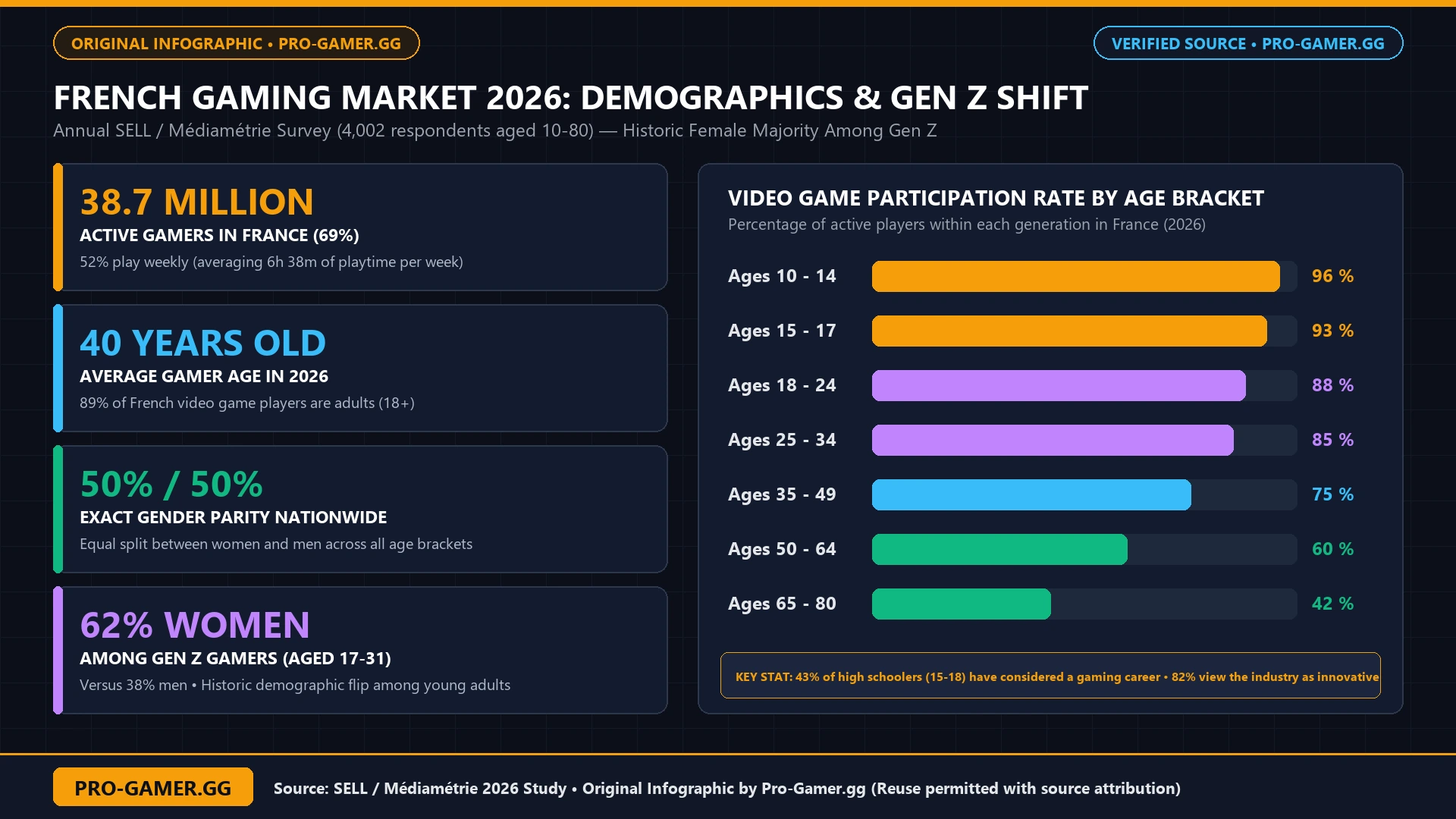
While nearly seven out of ten French citizens continue to play video games, the total headcount marks a modest pullback from the all-time high of 40.2 million recorded in 2025. Average weekly playtime followed a similar curve, settling at 5 hours and 23 minutes per week across all respondents (down from 6 hours and 23 minutes a year ago), while reaching 6 hours and 38 minutes among regular players,defined as the 52% of French citizens who play at least once a week.
In its editorial commentary, SELL notes that these numbers should be viewed in light of the specific timing of Médiamétrie's fieldwork, which ran from June 2 to June 24, 2026, coinciding with both a severe summer heatwave and the FIFA World Cup. Structurally, gaming remains deeply rooted in adult life: 89% of French players are adults (aged 18 and over), and the average player age stands at 40 years old. Participation peaks among younger cohorts (96% of 10-14 year-olds, 93% of 15-17 year-olds, 88% of 18-24 year-olds, and 85% of 25-34 year-olds), but holds remarkably strong across older brackets, including 75% of 35-49 year-olds, 60% of 50-64 year-olds, and 42% of seniors aged 65 to 80.
Exact Gender Parity Overall and a Historic 62% Female Majority in Gen Z
The standout demographic finding of the 2026 edition centers on gender distribution. Nationwide, gaming in France has reached an exact 50% female and 50% male split. Breaking the numbers down by generation, however, reveals a major reversal within Generation Z (defined in the study as ages 17 to 31), where women now account for 62% of players compared to 38% men. Conversely, men remain the majority among senior players at 63%.
| Metric (2026 SELL / Médiamétrie Study) | Key Figure in France | Notable Breakdown |
|---|---|---|
| Total Gaming Population (Ages 10-80) | 38.7 million (69%) | 52% of the population plays weekly (averaging 6h38m) |
| Demographics & Gender Split | 40 years average age (50% / 50%) | 62% women in Gen Z (ages 17-31); 89% of all players are adults |
| Preferred Platforms (2.1 per player) | Console (57%) & Smartphone (57%) | Ahead of PC (36%); 28% combine console and smartphone play |
| Purchase Preference (Physical vs Digital) | 65% prefer boxed physical games | 59% bought physical over the past year (collecting 51%, resale 37%) |
| Annual Spend & Subscriptions | €117 per year on game purchases | 42% subscribe to gaming services (€18/mo); €39/yr on in-game items |
SELL points out that this parity among players has yet to translate into equal representation across studio development teams and executive leadership roles. Meanwhile, SELL President Bénédicte Germain highlighted the stark contrast between ongoing studio restructurings across the industry and the sector's enduring appeal among teenagers: 43% of 15-18 year-olds say they have considered working in the video game industry, while 82% of French citizens view gaming as an innovative sector and 78% regard game developers as true artists.
Consoles and Smartphones Tied at 57%: Multiplatform Play Becomes the Norm
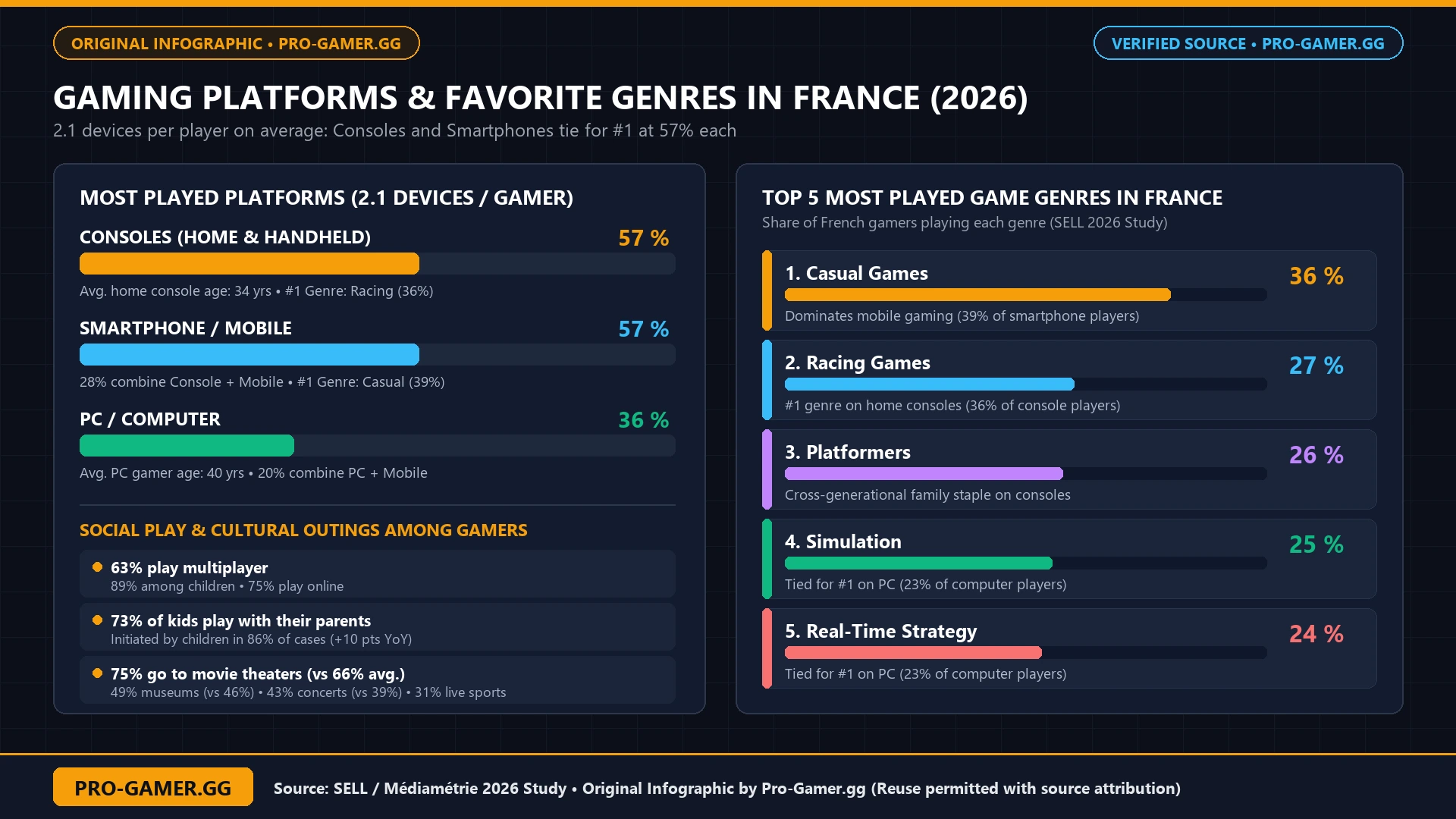
When it comes to hardware, French players use an average of 2.1 different devices. Home and handheld consoles are tied for first place with smartphones, each used by 57% of players, while PCs are used by 36% of respondents. Cross-device habits are widespread, with 28% of players combining a console and a smartphone, and 20% pairing a PC with a mobile phone. Player age also varies by hardware: home console players average 34 years old, compared to 40 years old for PC gamers.
Across all platforms, casual games lead genre preferences at 36%, followed by racing games (27%), platformers (26%), simulation titles (25%), and real-time strategy (24%). Each device retains a distinct profile: racing games top the charts on home consoles (36%), strategy and simulation share first place on PC (23% each), and casual titles dominate smartphones (39%).
65% of Buyers Prefer Boxed Copies: Physical Media Holds Its Ground
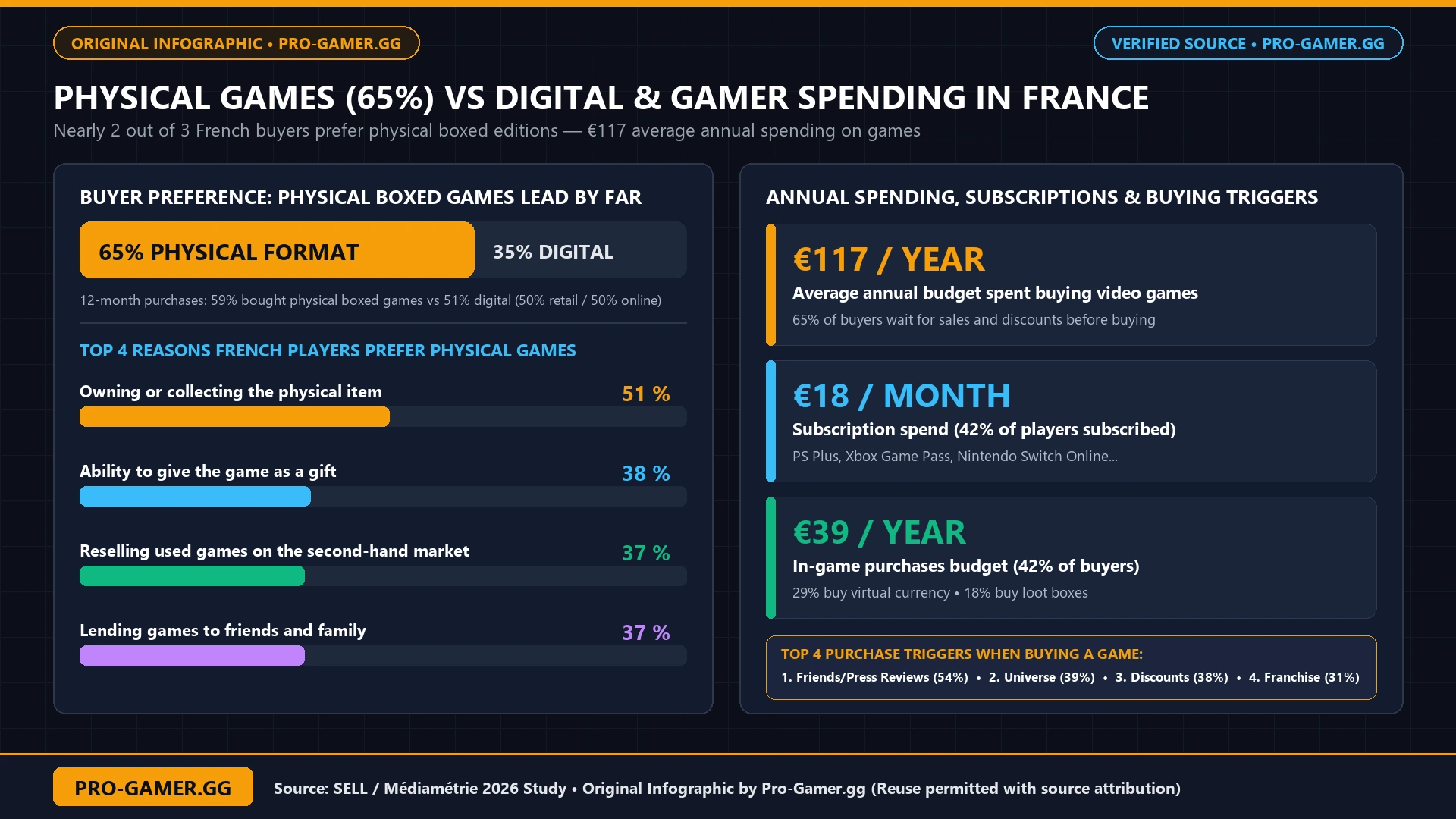
Even as broader European revenue audits factoring in mobile apps, PC digital storefronts, and microtransactions show digital revenue dominating total spend, SELL's consumer survey underscores how strongly French buyers still value physical discs and cartridges. Among the 40% of French citizens who purchased gaming content over the past twelve months (90% of whom play weekly), 65% state a preference for physical editions over digital downloads (35%).
Looking at actual purchases over the past year, 59% of buyers bought at least one boxed game while 51% bought a digital title, with retail channels split evenly between brick-and-mortar stores (50%) and online retailers (50%). For fans of physical media, the top motivation is the pleasure of owning or collecting a tangible object (51%), followed by the ability to gift a game (38%), resell it on the second-hand market (37%), or lend it to friends and family (37%).
Annual spending on game purchases has stabilized at an average of €117 per year, with 65% of buyers waiting for sales and discounts. Word-of-mouth and external reviews remain the primary purchase driver: recommendations from friends, fellow players, content creators, or the gaming press rank first (54%), ahead of a game's setting and universe (39%), promotional discounts (38%), and franchise loyalty (31%). Additionally, 42% of players subscribe to a gaming service at an average cost of €18 per month, and 42% of buyers made in-game purchases over the past twelve months (spending an average of €39 per year, including 29% buying virtual currency and 18% purchasing loot boxes).
Social Connection, Cultural Outings, and the Parental Control Gap
Far from isolating players, gaming continues to serve as a social hub: 63% of respondents play multiplayer games locally or online (rising to 89% among children), and 75% play online. Nearly one in three players report making friends through video games, a figure approaching one in two among Gen Alpha and Gen Z players (54% and 53% of whom self-identify as "gamers", compared to 36% across all age groups). Regular gamers also participate in out-of-home cultural activities at higher rates than the national average over a six-month period, including going to movie theaters (75% vs. 66% nationally), visiting museums (49% vs. 46%), attending concerts (43% vs. 39%), watching live professional sports (31% vs. 24%), and going to the theater (26% vs. 23%).
Still, the report highlights two areas of concern. First, 17% of online players witnessed threats or harassment during multiplayer sessions over the past year, prompting 55% of those affected to curtail their playtime and 51% to alter or conceal their online identity. Second, while 73% of children play video games with their parents (initiated by the children in 86% of cases, up 10 points year-over-year), technical safeguards remain underused: although 96% of parents of young gamers are aware of parental control tools, only 43% actually enable them, and just 11% actively monitor playtime,even as PEGI updated its rating criteria in 2026 to account for paid random items, in-game purchases, and daily login incentives.
My Take: A 65% Preference for Physical Games Is a Warning Shot Console Makers Cannot Ignore
What stands out most to me in this 2026 SELL and Médiamétrie report is the sheer disconnect between corporate digital-only strategies and what console buyers actually want. Industry earnings calls constantly frame an all-digital future as inevitable, yet when you ask French buyers what they prefer, 65% still want a physical box on their shelf and 59% actively buy them. With launch prices climbing higher and nearly two-thirds of buyers relying on sales, the ability to resell or lend a disc or cartridge,cited by 37% of buyers,remains the ultimate consumer safety net. Stripping disc drives out of future console hardware as a default move risks alienating nearly two-thirds of the paying audience in one of Europe's flagship gaming markets.

SEO consultant for over 20 years and digital entrepreneur, Charles "Grimtag" is the founder of Pro-Gamer.gg, Retrocharting.com, and Gamescharting.com. A competitive gamer, streamer, and retro game collector, he has worked in the video game industry for over 15 years, notably as a consultant for leading game price comparison platforms. Passionate about real-time performance data and gaming technology, he analyzes competitive esports, gaming hardware benchmarks, and creator workflows on Pro-Gamer.gg with an authentic player perspective.