PlayStation 6 Storage Architecture: Why Sony May Keep Standard PCIe 4.0 M.2 NVMe SSD Support Alongside PCIe 5.0
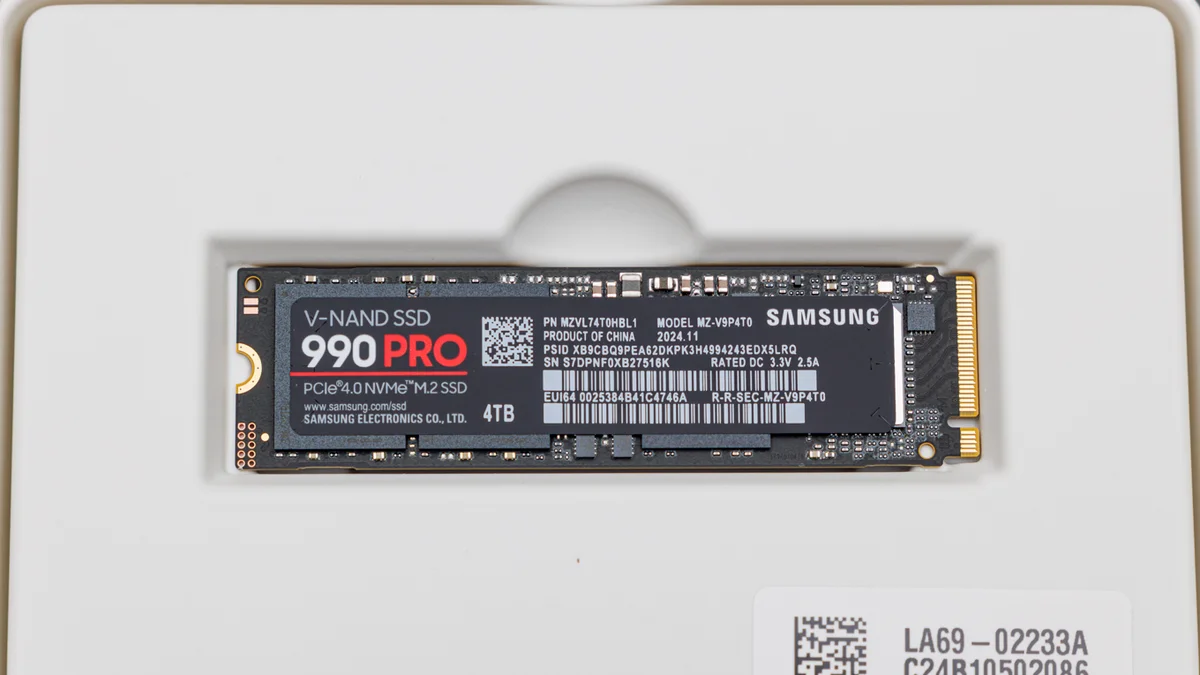
New architectural details surrounding Sony's next-generation home console continue to surface as silicon partners prepare for a late-decade production ramp. While hardware leaks from industry insiders KeplerL2 and Moore's Law Is Dead indicate that the PlayStation 6 will transition its primary internal storage bus to a high-speed PCIe 5.0 x4 interface, a crucial engineering detail brings welcome news for current console owners: the motherboard's standard M.2 2280 expansion bay is expected to retain full physical and logical backward compatibility with existing PCIe 4.0 M.2 NVMe SSDs.
From PCIe 4.0 to PCIe 5.0 x4: Scaling Up to 14,900 MB/s Alongside AMD's Orion APU
Under the hood, the PlayStation 6 hardware blueprint centers on the custom AMD Orion APU manufactured on TSMC's 3nm process node. As we analyzed in our technical breakdown of the taped-out PS6 and Xbox Helix APU specifications, Sony's chip pairs next-generation Zen 6 CPU cores with an RDNA 5 graphics engine targeting over 40 TFLOPS of compute performance, backed by a 160-bit GDDR7 memory bus and dedicated PSSR neural upscaling accelerators.
To feed that graphics pipeline without I/O bottlenecks, platform engineers are moving the storage subsystem to the PCIe 5.0 x4 NVMe protocol. Where the PlayStation 5 and PS5 Pro mandate a minimum sequential read speed of 5,500 MB/s over PCIe 4.0, modern PCIe 5.0 x4 drives scale up to 14,900 MB/s in sequential reads and 14,000 MB/s in sequential writes. Nearly tripling the baseline PS5 bandwidth target allows engines to stream dense geometry and high-resolution ray-traced assets into unified memory virtually instantaneously.
| Storage Specification | PlayStation 5 / PS5 Pro | PlayStation 6 (Target Architecture) |
|---|---|---|
| Expansion Slot Interface | PCIe Gen 4.0 x4 NVMe | PCIe Gen 5.0 x4 NVMe (Backward compatible with Gen 4.0) |
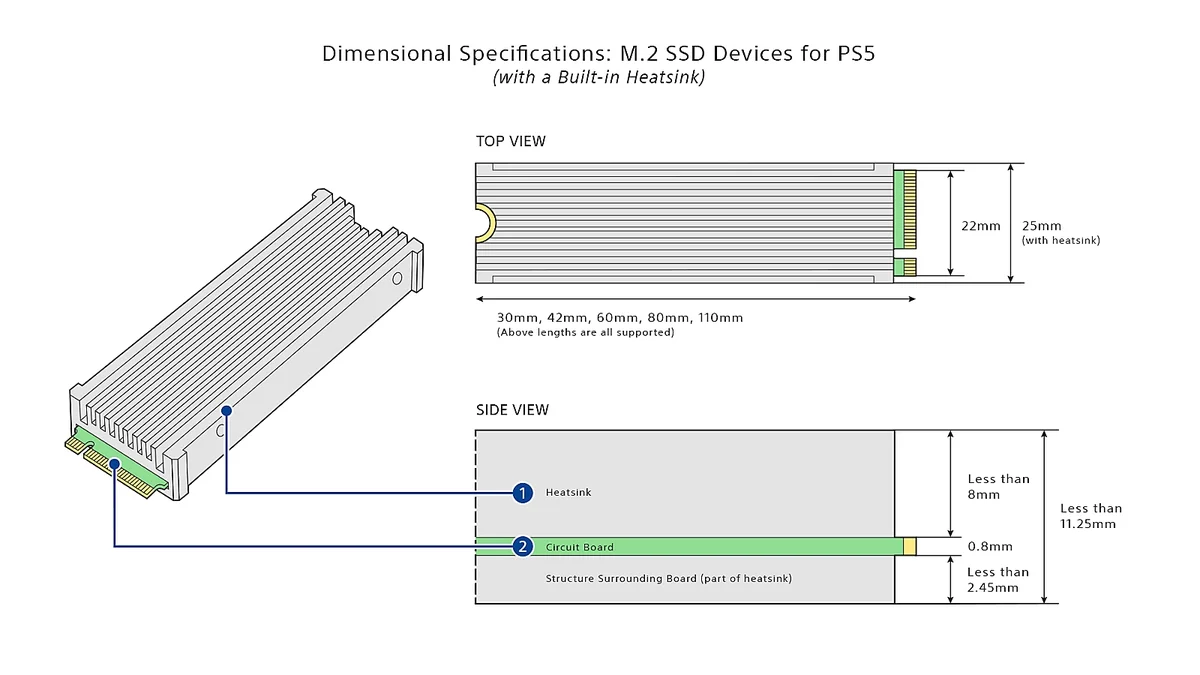
| Physical Form Factor | M.2 2230 to 22110 (2280 standard) | Standard M.2 2280 with low-profile heatsink |
| Sequential Read Throughput | 5,500 MB/s min (up to 7,450 MB/s peak) | Up to 14,900 MB/s (Gen 5) / 7,450 MB/s (Gen 4) |
| Expected Internal Baseline | 825 GB / 1 TB (Slim) / 2 TB (Pro) | 1 TB PCIe 5.0 + Neural Texture Compression |
| Supported M.2 Capacities | 250 GB to 8 TB | 1 TB, 2 TB, 4 TB, and 8 TB (PCIe 4.0 & PCIe 5.0) |
Why PCIe 4.0 M.2 Backward Compatibility Matters Amid Rising NAND Flash Costs
By preserving physical and logical continuity across the standard M.2 2280 Key M connector defined by the PCI-SIG specification, Sony ensures that its PCIe 5.0 x4 slot can seamlessly negotiate four PCIe 4.0 lanes when a previous-generation drive is inserted. Players who have already invested in high-capacity 1 TB, 2 TB, 4 TB, or 8 TB PCIe 4.0 SSDs for their PS5 (such as the Samsung 990 PRO, WD Black SN850X, or Lexar NM790) will be able to migrate those drives directly into the PlayStation 6 at launch.
That backward compatibility is especially critical given the severe supply pressure across the semiconductor market heading into 2027. As highlighted in our report on Samsung's record Q3 2026 earnings and how the HBM4 boom keeps NVMe SSD supply tight, hyperscale AI data centers are absorbing silicon wafer capacity and driving up prices for both GDDR7 memory and high-speed NAND flash arrays.
To keep the console's bill of materials (BOM) in check, industry leaks suggest Sony is evaluating a baseline 1 TB internal PCIe 5.0 SSD paired with SDK-level Neural Texture Compression (NTC) to shrink game install footprints. Allowing users to drop in an existing 2 TB or 4 TB PCIe 4.0 M.2 drive on day one removes the need to buy an expensive Gen 5 module immediately at launch.
Check Availability for M.2 NVMe PCIe 4.0 Heatsink SSDs on Amazon→
Modular Storage Continuity Built on the PS5 Slim and PS5 Pro Design
Unlike Microsoft's proprietary storage expansion cards on Xbox Series X|S, Sony's embrace of standard off-the-shelf M.2 PC hardware has proven to be one of the most consumer-friendly hardware decisions of the current generation. The tool-friendly expansion bay layout refined on the CFI-2000 (Slim) and CFI-7000 (Pro) chassis illustrates how straightforward M.2 installation remains across the PlayStation hardware ecosystem:
My Take
Every time we benchmark a high-end PCIe 5.0 NVMe review sample on our test bench, the thermal reality tells the exact same story: hitting 14,500 MB/s in CrystalDiskMark looks impressive on a box, but early Gen 5 controllers pull up to 11 watts under sustained load and quickly hit thermal throttling inside enclosed compartments without direct airflow. Until next-generation 5nm and 6nm DRAM-less PCIe 5.0 controllers become cooler and significantly cheaper, forcing console players to buy Gen 5 drives just to expand their storage would be a costly mistake. If storage manufacturers want to send over a review unit of their newest low-power Gen 5 controllers to put through our full thermal protocol, our lab doors are wide open.
In real-world game engines, raw sequential read bandwidth on massive contiguous files is rarely the true bottleneck. What actually eliminates loading screens and asset pop-in is random 4K IOPS latency combined with Sony's dedicated hardware decompression blocks (Kraken and Oodle today, reinforced by neural texture decompression tomorrow). Top-tier PCIe 4.0 drives running between 7,000 MB/s and 7,450 MB/s already deliver massive headroom while running far cooler inside a console bay. Retaining support for standard PCIe 4.0 M.2 2280 drives on the PlayStation 6 is a smart, pro-consumer engineering move that protects players' existing hardware investments.

PC hardware enthusiast and competitive gamer, Arthur 'Heimdall' splits his time between France and the UK working in enterprise B2B software solutions. A business school graduate passionate about component benchmarking, he has been building, modding, and tuning PCs since childhood, optimizing every thermal degree and millisecond of display latency. An avid gamer across Assassin's Creed and sandbox titles, he forged his alliance with Grimtag and Chaya during late-night World of Warcraft raids before joining Pro-Gamer.