Orbiting ESA Satellite Launches DOOM via Voice Command After 27 MB Onboard AI Decodes Amateur Radio on 7th Attempt
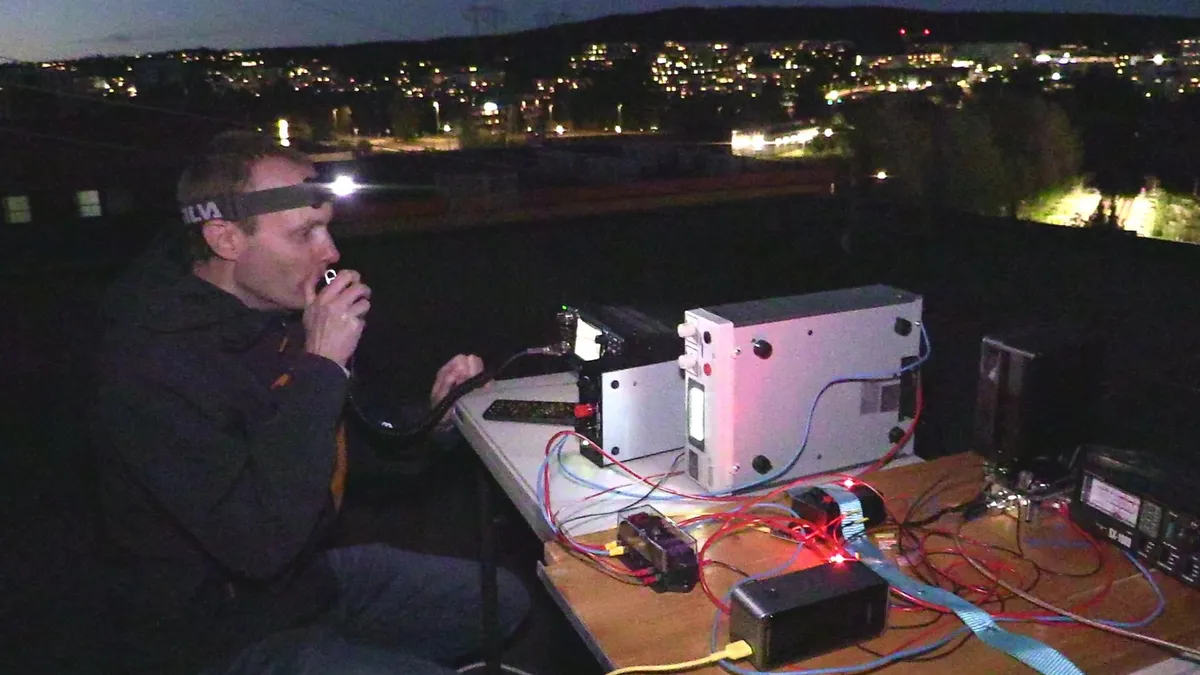
Running DOOM on ATMs, DSLR cameras, and oscilloscopes has long been computing's favorite engineering sport. Commanding id Software's 1993 shooter to boot up by speaking into a handheld microphone from an Oslo rooftop toward a spacecraft in low Earth orbit takes that tradition into uncharted operational territory. In an in-orbit demonstration dubbed PRETTY DOOMed, Norwegian amateur radio operators and Estonian space-AI company Tanagra Space successfully prompted the European Space Agency (ESA) experimental CubeSat OPS-SAT PRETTY to recognize a spoken human voice command and autonomously launch the game more than 520 km above Earth on the seventh attempt.
From 2023's Scripted Orbit Run to the First Voice-Commanded Spacecraft
This is not the Doom Slayer's first trip into space. Back in December 2023 and March 2024, Iceland-born, Norway-based developer Ólafur Waage and principal investigator Georges Labrèche famously ran the game aboard ESA's OPS-SAT-1 spacecraft (logged as entry #1042 in the official Can it run Doom registry). However, that earlier milestone relied on an internal scheduled trigger and conventional binary telecommands.
Under normal spaceflight protocols, satellites only respond to structured binary packets uplinked under strict frameworks such as the CCSDS Space Data Link Protocol and the European Packet Utilisation Standard (PUS). Built by an Austrian consortium comprising Beyond Gravity Austria, Graz University of Technology (TU Graz), and Seibersdorf Laboratories under ESA's OPS-SAT Space Lab program, the 3U CubeSat OPS-SAT PRETTY (Passive REfleTometry and DosimeTrY) added a critical hardware link: an onboard AD9361 software-defined radio (SDR) coupled directly to its reconfigurable ARM32 SEPP (Satellite Experimental Processing Platform) flight computer. For the first time in spaceflight history, a satellite could listen to amateur radio waves, isolate human speech from orbital noise, and execute an onboard program with zero ground cloud computing or human intervention in the loop.
80 Watts on an Oslo Rooftop, 170 kHz of Static, and Seven Runs
Turning spoken radio waves into a deterministic spacecraft trigger required months of volunteer radio engineering. Following four initial link tests (Runs 1 through 4) transmitted between April and June 2026 by amateur radio operators in Legnica, Poland (call signs SQ6RDP and SQ6QV), ground operations shifted to Oslo club station LA4O (Oslogruppen av NRRL, part of the Norwegian Radio Relay League). Operating from their rooftop station at Nedre Rommen (160 meters above sea level in northeastern Oslo), operators LB6AJ, LB9BJ, LA7IJ, and LB5SK spent 59 days building a 23 cm band (1296.000 MHz) narrowband FM uplink station on a total club budget of roughly 7,200 NOK (around $770, pizza included).
Their setup paired an Icom IC-9700 transceiver with a 75W PE1RKI XRF286S LDMOS power amplifier pushing roughly 80 W of indicated output (an estimated 1.45 to 2.04 kW effective isotropic radiated power), cooled by a desktop CPU tower heatsink hose-clamped to an old wooden shelf board, and fed into a hand-aimed 15.1 dBi Wimo Helix23-2 right-hand circularly polarized antenna guided by chalk bearings drawn on the roof.
During the fifth attempt (Run 5, an instrumented listening pass recording raw in-phase and quadrature I/Q samples), the spacecraft clearly heard LA4O's carrier, yet the demodulated audio output was almost pure static. Analyzing the downlinked I/Q captures offline with NumPy and SciPy, operator LB6AJ pinpointed the flaw: the spacecraft's original receive chain fed a wide 170 kHz channel into the FM discriminator even though the narrowband FM voice signal occupied only about ±5 kHz, burying the speech under broadband noise.
Within a week, Georges Labrèche reproduced and integrated a C++17 and GNU Radio software fix into the project's open-source flight pipeline on GitHub: the onboard SDR now searches for the carrier peak within a ±100 kHz Doppler window, shifts it to baseband, applies a tight ±10 kHz low-pass channel filter, and decimates the signal to 25 kSPS before FM demodulation, while stripping out a redundant second audio filter.
How a 27 MB Quantized AI Model Launched DOOM in Orbit
With the RF signal narrowed, the audio still had to be decoded entirely on the satellite's resource-constrained ARM processor. The team deployed an int8-quantized English speech-to-text transducer model, Sherpa-ONNX Zipformer (sherpa-onnx-zipformer-small-en-2023-06-26), weighing just 27 MB. To survive low carrier-to-noise ratios (9 to 12 dB CNR), LB6AJ screened 29 synthetic Piper TTS voices against a simulated FM impairment chain and inserted 100 to 200 ms digital silence gaps between repeated trigger words so the transducer would not blur them into a single mangled token.
After resolving a last-minute rooftop crisis on the morning of the pass - the WAV files had accidentally been exported at 48 kHz instead of the strict 16 kHz required by the Icom IC-9700 SD card player - two consecutive passes sealed the milestone:
- Run 6 (Morning Pass): The Oslo team transmitted a looped synthetic voice keyer file. Three of the satellite's six two-second captures detected the command via the tolerant fuzzy matcher (accepting noisy transcripts such as "PLAY DOON") and launched DOOM in orbit.
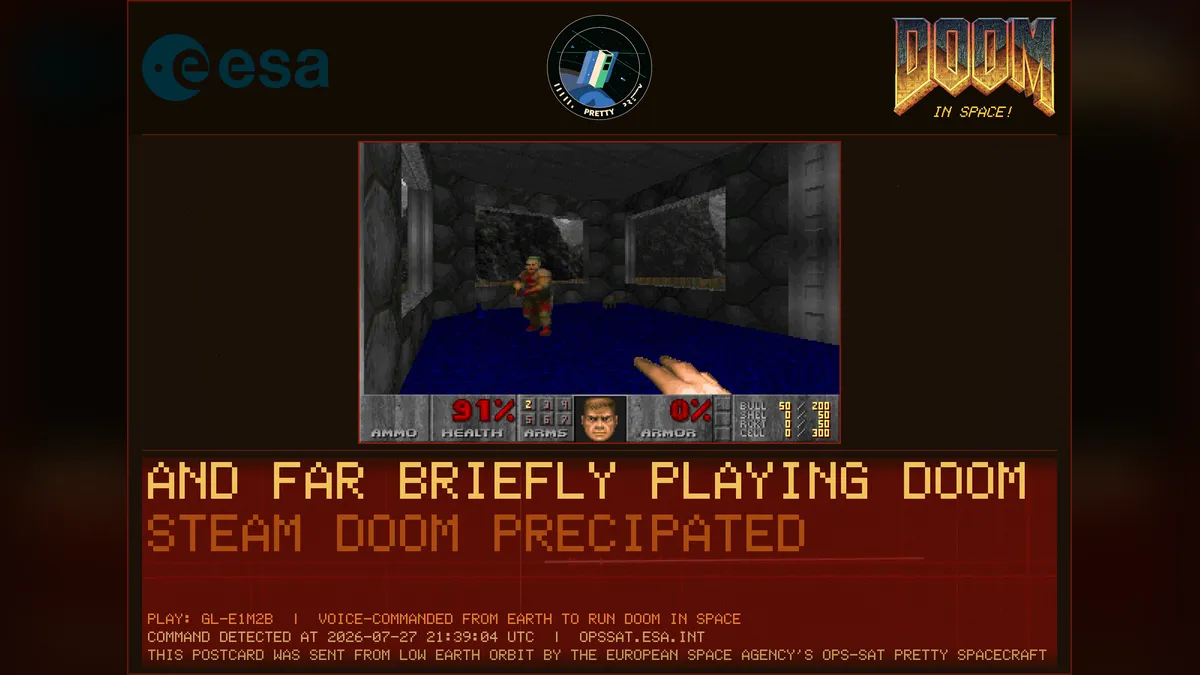
- Run 7 (Evening Pass, 7th Attempt): Replacing the keyer with a live human voice, operator LB9BJ spoke directly into the handheld microphone: "LIMA ALFA FOUR OSCAR, PRETTY PLAY DOOM DOOM DOOM, PRETTY PLAY DOOM DOOM DOOM." Even though the spacecraft's attitude control had not been enabled (leaving its antenna unpointed), one of the five usable captures isolated the live voice from space noise, transcribed "AND FAR BRIEFLY PLAYING DOOM STEAM DOOM PRECIPATED" with two exact matches of the word DOOM, and booted the game.

Because the CubeSat has no display screen, OPS-SAT PRETTY executed a headless build of the 1993 engine that plays back a demo file, captures rendered frames from memory, and composites them into a diagnostic "postcard" downlinked to Earth. While id Software's storied DOOM legacy continues to make headlines decades after the debut of the classic DOOM 1+2 bundle, the experiment proves that an SDR-equipped satellite running a tiny onboard AI model can monitor radio bands and autonomously detect spoken distress calls like "Mayday" from remote regions on Earth.
My Perspective
Having tracked dozens of bizarre hardware ports for my Can it run Doom archives, from digital cameras to custom silicon, watching this seventh run succeed over Oslo hits differently. What stands out to me is the sheer contrast between grassroots amateur radio ingenuity on the ground - an LDMOS amplifier screwed onto a scrap wooden shelf with a hose-clamped PC CPU cooler and chalk marks on a rooftop - and the pinpoint accuracy of the orbital DSP fix. Seeing a tiny 27 MB quantized Zipformer model pull two exact "DOOM" tokens out of Doppler-shifted space static 520 kilometers up also made me think immediately of Chaya "Chayane": while tech giants pour gigawatts into massive terrestrial data centers, this team just proved that a razor-sharp 27 MB speech model is enough to command a spacecraft by voice.

Based on the outskirts of New York City, Chaya 'Chayane' spent five years studying software engineering in Montreal before returning to her home state. A Full-Stack developer and Deep Learning AI architecture researcher, she explores neural networks and algorithmic optimization while engineering data pipelines for Retrocharting and Gamescharting alongside Grimtag. A gamer for over 20 years and an avid collector of Nintendo history and The Legend of Zelda, she explored World of Warcraft's Azeroth before bringing her deep technical background to video game analysis.