Multistreaming in 2026: How to Stream to Twitch, YouTube, Kick, and TikTok for Free
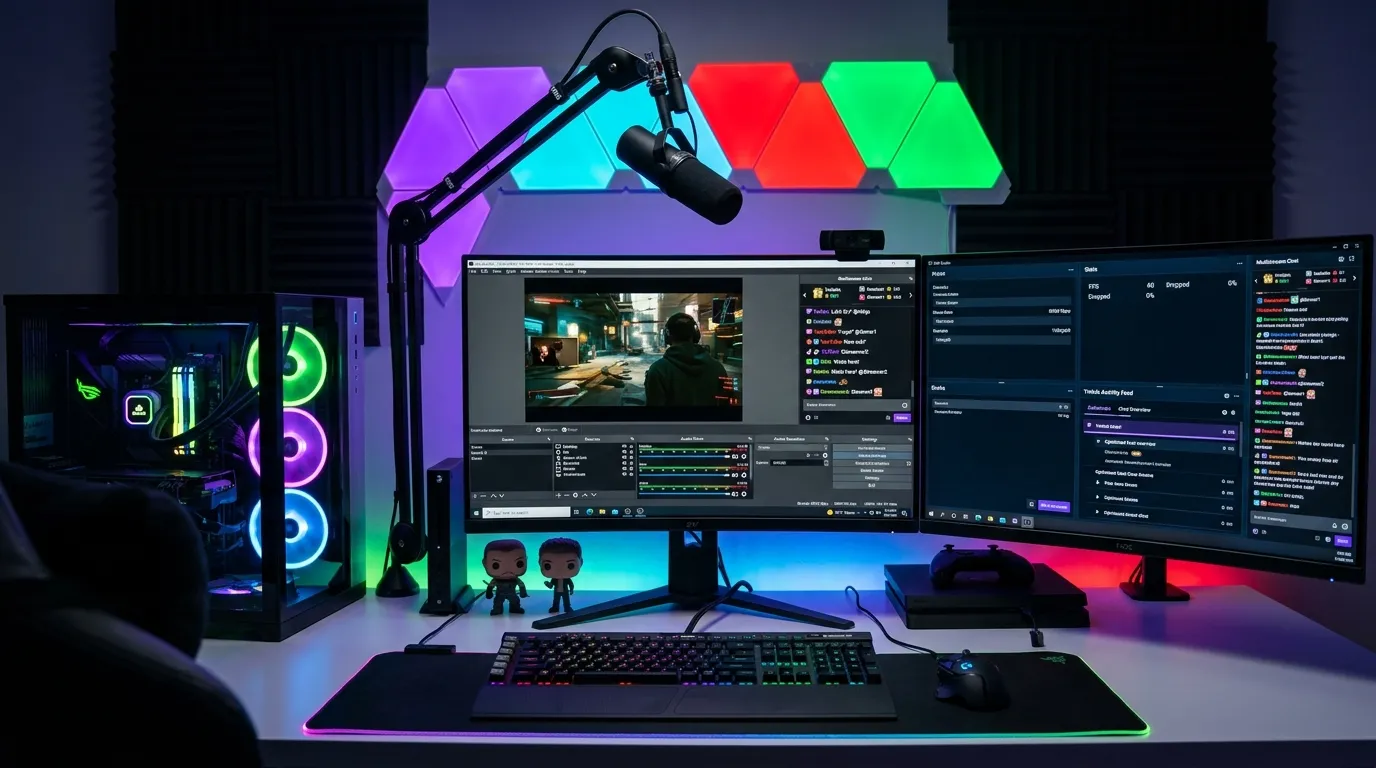
Streaming for hours in front of two viewers and your own moderation bot is a reality that thousands of creators face daily. For years, rigid exclusivity rules kept smaller broadcasters completely invisible.
That paradigm shifted in 2026. Twitch officially removed exclusivity restrictions for affiliates and partners, authorizing simultaneous multi-platform broadcasting.
Streaming your gameplay to multiple platforms at once is now the fastest way to maximize discovery across different gaming audiences.
The End of Twitch Exclusivity: Why Single-Platform Streaming Limits Your Growth
For nearly a decade, streaming contracts prevented affiliates from broadcasting anywhere else while live on Twitch. This policy locked emerging creators into a closed system where organic growth had become practically impossible.
That barrier has been dismantled. Twitch now explicitly permits simulcasting to all major video services, allowing streamers to broadcast on YouTube, Kick, TikTok, and X simultaneously without risking their channel standing.
Broadcasting to multiple platforms allows you to leverage different algorithms at once. As we analyzed in our breakdown of Twitch monetization, relying solely on a single platform creates significant financial vulnerabilities for growing channels.
The Cloud Subscription Myth: Why You Do Not Need Restream in 2026
Many creators still believe multistreaming requires paid cloud relays like Restream.io or Castr. These platforms charge 20 to 40 dollars monthly simply to forward your video feed.
Paying monthly subscriptions when building a channel is unnecessary overhead. Your computer and OBS Studio handle multi-platform distribution entirely on their own.
Cloud relays merely redistribute your feed. Utilizing free open-source plugins directly inside OBS eliminates middleman fees, preserving your budget for hardware.
Installing the Free Multiple RTMP Outputs Plugin in OBS Studio
The most dependable solution is Multiple RTMP outputs, a free plugin built by Sorayuki. Another popular option is Aitum Multistream.
Installation takes two minutes:
- Download the installer from the official GitHub repository for Sorayuki obs-multi-rtmp or the OBS Project forums.
- Close OBS Studio completely before launching the Windows installer.
- Relaunch OBS Studio. A new panel titled Multiple RTMP Outputs docks on your interface.
- If the dock does not appear, enable it under Docks by checking Multiple RTMP Outputs.
This dock acts as your command center to start and monitor auxiliary streams independently.
Step-by-Step Configuration for YouTube, Kick, and TikTok
Your primary platform remains configured in standard OBS Settings, while additional destinations are handled by the plugin.
Under OBS Settings and Stream, keep your primary platform configured, such as Twitch with your stream key.
Next, use the Multiple RTMP dock to configure your secondary targets:
- Kick: Click Add new target. Name it Kick, input the RTMP server URL from your Kick dashboard, and paste your stream key. Broadcasters are increasingly drawn to this option, as explored in our guide on Kick monetization and its creator-friendly revenue splits.
- YouTube Live: Add a new target labeled YouTube. Copy the primary RTMP ingestion server URL and your YouTube Studio live event stream key.
- TikTok Live: If you have PC RTMP streaming access, enter your TikTok server URL and stream key. For console players streaming from the living room, check out our guide on how to stream on TikTok from a gaming console using a capture card.
The Video Encoding Secret: Cloning NVENC Without Overloading Your GPU
This setting is the most critical factor for hardware stability. Inside each target settings window in the plugin, locate the Video Encoder section.
Always select Get from OBS (or use main encoder). This instructs OBS to clone the already encoded video frames generated by your graphics card rather than processing a separate encode for each platform.
If you mistakenly set each target to encode independently using separate NVENC sessions, your GPU will render multiple video streams simultaneously. This will severely degrade your gaming framerates.
Cloning the main stream ensures that broadcasting to three or four destinations requires zero additional graphics card processing power.
Bandwidth Requirements: How to Calculate Your Real Upload Bitrate
While cloned encoding protects your GPU, your internet connection must handle the cumulative upload. Every target transmits a complete stream over your home network.
Here is the realistic bandwidth math you must account for:
- A standard 1080p60 stream at 6,000 kbps uses roughly 7 Mbps of real upload including audio bitrate and network overhead.
- Two streams combining Twitch at 6,000 kbps and Kick at 6,000 kbps require approximately 14 Mbps of continuous upload.
- Three streams combining Twitch at 6,000 kbps, Kick at 6,000 kbps, and YouTube at 9,000 kbps demand roughly 23 Mbps of stable upload.
To prevent in-game latency spikes during competitive matches, maintain a 50 percent headroom margin above your total broadcast bitrate.
A reliable fiber optic connection with at least 40 to 50 Mbps upload speed is strongly recommended before broadcasting three streams simultaneously.
Unified Chat Overlays: Reading Twitch, Kick, and YouTube in One OBS Dock
Broadcasting to multiple platforms is pointless if you cannot interact with your community in real time. Juggling four separate browser tabs for chat kills stream pacing during intense moments.
The premier free utility in 2026 is Social Stream Ninja, an open-source tool developed by Steve Seguin. It merges incoming chats from Twitch, Kick, YouTube, and TikTok into a single unified stream.
Each message clearly highlights the platform origin icon, allowing you to instantly address viewers regardless of where they are watching. You can dock the unified feed directly inside OBS Studio using a Custom Browser Dock.
Alternative tools like Botrix and Chatty also provide dependable chat aggregation widgets for creators who prefer quick setup.
Editorial Take: Turning Multistreaming into Real Audience Growth
The era of sitting alone in a Twitch directory waiting for discovery is over. In 2026, audience building requires a multi-platform presence where discovery on TikTok, YouTube Shorts, and Kick channels viewers back to your live stream.
Leveraging free local OBS multistreaming gives you the exact broadcast capabilities used by major esports talent without spending a dime on recurring subscription platforms.
Set up your stream keys, verify your upload bandwidth, and stop limiting your broadcast to a single audience.

SEO consultant for over 20 years and digital entrepreneur, Charles "Grimtag" is the founder of Pro-Gamer.gg, Retrocharting.com, and Gamescharting.com. A competitive gamer, streamer, and retro game collector, he has worked in the video game industry for over 15 years, notably as a consultant for leading game price comparison platforms. Passionate about real-time performance data and gaming technology, he analyzes competitive esports, gaming hardware benchmarks, and creator workflows on Pro-Gamer.gg with an authentic player perspective.