Minecraft Dungeons 1 vs 2 for Couch Co-op: Prices, Mixed Co-op, Switch Edition, and Which One to Buy
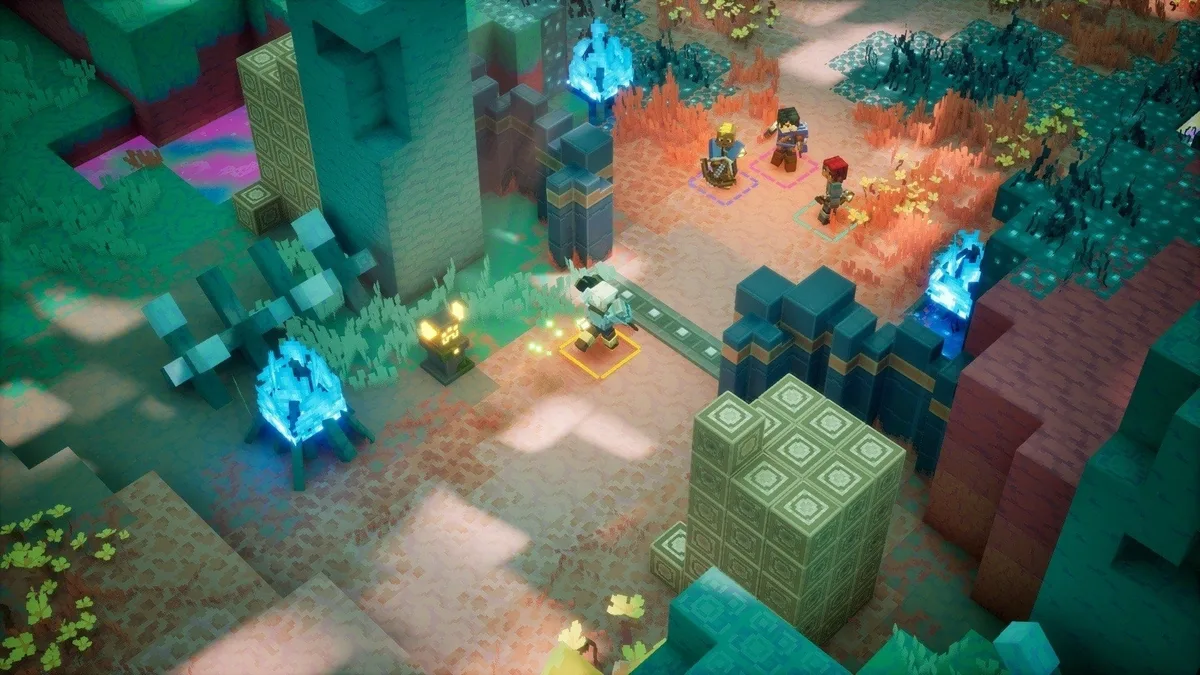
Sharing a single television screen with up to four players on the same couch, one controller in each hand, remains one of the most rewarding ways to experience an action-RPG with family or friends. Now that Minecraft Dungeons II stands alongside the original 2020 Minecraft Dungeons on digital storefronts and retail shelves, buyers face a practical dilemma: should you save ten dollars by picking up the original game and its finished catalog of expansions, or jump straight into the modernized sequel crafted by Mojang Studios and Double Eleven? From interconnected world design and mixed local-online lobbies to the Nintendo Switch 1 physical cartridge arriving on November 10, 2026, here is the complete breakdown to help you choose the right entry for your living room.
Four-Player Shared Screen and the Mixed Co-op Upgrade
At their core, both games champion the same accessible dungeon-crawling foundation: up to four players can team up on a single console or PC, sharing one screen with one controller per person. Neither the original Minecraft Dungeons nor its sequel uses split-screen views. Every member of the party stays within the same camera frame, requiring the squad to stick together when wading through waves of mobs. Furthermore, neither title requires a paid online subscription (such as Nintendo Switch Online) when playing strictly in local couch co-op.
Where Minecraft Dungeons II pulls ahead is in how it bridges the living room sofa with the rest of the internet. In the original game, couch co-op was strictly locked to offline play: if two people were sitting together on the couch, they could not invite a third friend online into that same session. As Stefan Annell, Technical Director on Minecraft Dungeons II at Mojang Studios, explains, the sequel was engineered around a "one-click crossplay" philosophy that introduces full Mixed Co-op.
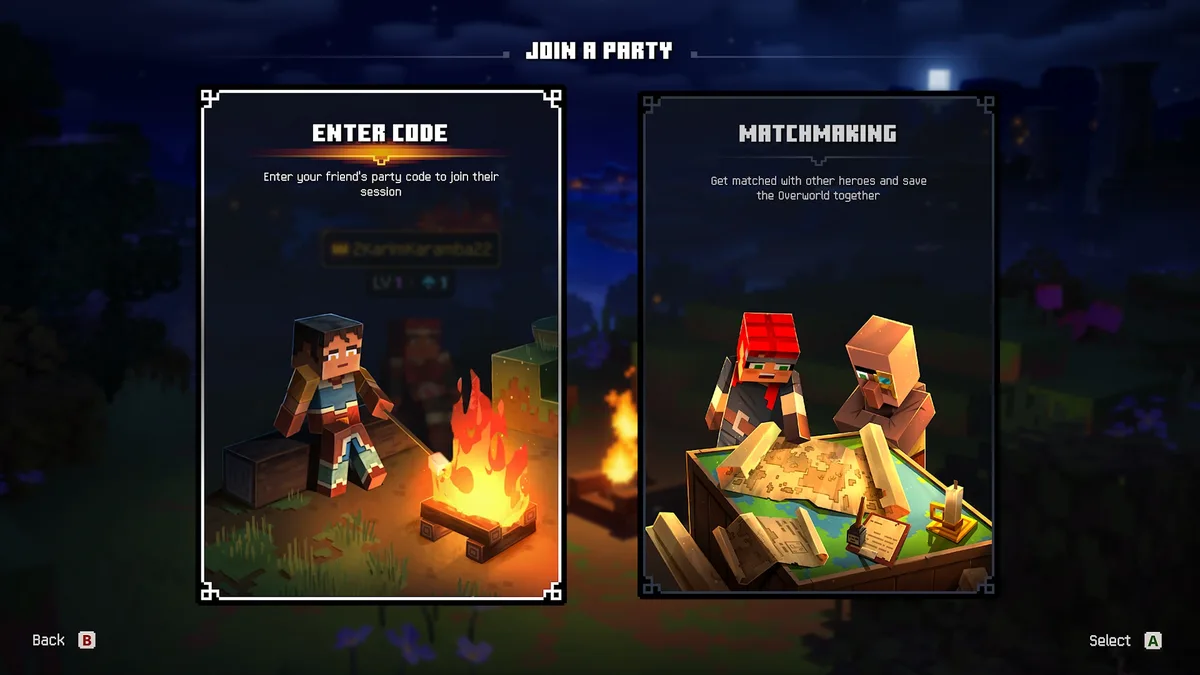
In practice, two players sharing a sofa can now take their local session online and let remote friends join the remaining slots across PC, PlayStation 5, Xbox Series X|S, Nintendo Switch, and Nintendo Switch 2. Behind the scenes, Mojang also overhauled several multiplayer pillars that directly benefit co-op groups:
- Cloud-Saved Guest Heroes on a Friend's Console: because character data is stored on Mojang's online backend rather than locked to a single machine, a friend visiting your house can sign in with their own platform account (or linked Microsoft account) on your device, play with their personal hero, and keep all earned loot and XP when they return home.
- Eight-Character Party Codes and Drop-In Matchmaking: alongside the in-game friends list, an eight-character alphanumeric party code lets friends join a lobby or an active dungeon regardless of platform. A new matchmaking system can also fill open party slots mid-session by evaluating core quest progress, region, and power level.
- Dedicated Servers and Steam Remote Play Together: whereas the first game relied on peer-to-peer hosting tied to the party leader's hardware and internet connection, Minecraft Dungeons II runs on dedicated servers automatically selected based on each player's ping. On PC, the sequel also supports Steam's Remote Play Together, allowing a friend to join your local game over the internet without owning a copy, while Nintendo Switch 1 and Switch 2 add 1-to-4 player local wireless play.
Linear Mission Select vs. Seamless Connected World, Jumping, and The Sift
Beyond multiplayer plumbing, the two games structure their campaigns very differently. The original Minecraft Dungeons uses a classic hub-and-mission layout: you pick a self-contained level from the camp map, battle through a linear path with a clear beginning and end, and return home. Rated PEGI 7 and having surpassed 25 million players before its final 1.17 update in November 2022, that straightforward arcade loop remains ideal for younger children or casual newcomers who just want to mash buttons and grab loot without navigating an expansive map.
By contrast, as we covered during the worldwide launch of Minecraft Dungeons II and its overhauled gameplay systems, the sequel replaces the mission-select screen with one seamless, interconnected world with zero loading screens between regions. Players traverse the landscape using Minecart Stations and Teleport Statues as they battle the new Illager High Council (led by the Grand Illusioner, Supreme Evoker, and Prime Enchanter) across the Overworld and into a corrupted new dimension known as The Sift.
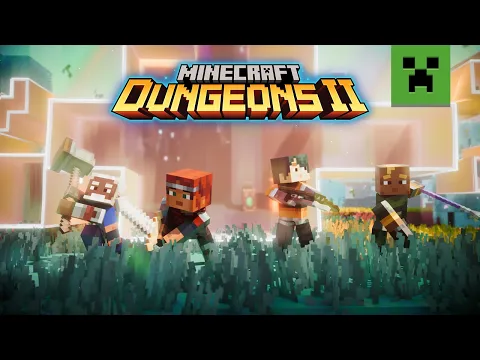
Moment-to-moment combat and RPG progression also go noticeably deeper in the sequel. First, Minecraft Dungeons II finally introduces a dedicated jump mechanic, adding verticality and aerial dodging that the grounded original lacked. Second, character builds expand from a single armor piece into four separate armor slots alongside three talisman slots that grant passive bonuses on top of your weapon, armor, and artifacts, earning the sequel a spot among our best co-op and multiplayer games to play with friends in 2026.
Prices, Complete Editions, and Nintendo Switch Physical Releases
When budget is the deciding factor, the first game holds a clear price advantage. Across the Nintendo eShop, Steam, and console stores, the original Minecraft Dungeons retails for $19.99, while the Minecraft Dungeons Ultimate Edition costs $39.99. Because development on the first game is complete, buying the Ultimate Edition immediately unlocks all six major DLC expansions right out of the box: Jungle Awakens, Creeping Winter, Howling Peaks, Flames of the Nether, Hidden Depths, and Echoing Void.
Meanwhile, Minecraft Dungeons II is priced at $29.99 for the standard edition ($10 more than the original's base game) and $49.99 for the Deluxe Edition, which bundles four hero skins, the Soul cape, the Blub pet, and access to DLC 1 and DLC 2 as they release in the future. However, subscribers to Xbox Game Pass on PC or Xbox Series X|S can play Minecraft Dungeons II at no extra cost.
For households playing on Nintendo hardware, platform compatibility and physical cartridge availability also differ between the two titles:
| Comparison Feature | Minecraft Dungeons (2020) | Minecraft Dungeons II (2026) |
|---|---|---|
| Base / Complete Edition Price | $19.99 (Base) / $39.99 (Ultimate with all 6 DLCs included) | $29.99 (Base, on Game Pass) / $49.99 (Deluxe + 2 upcoming DLCs) |
| Couch Co-op Support | 1 to 4 players on one shared screen (offline local only) | 1 to 4 players on one shared screen + Mixed Co-op (sofa + online) |
| Local Guest Progression | Tied to the host device during local play | Sign in with personal platform account for Cloud-saved heroes |
| World Structure | Hub camp with linear mission-select levels | Seamless interconnected open world + The Sift dimension |
| Movement & RPG Builds | No jumping, 1 armor slot + artifacts | Full jumping mechanic, 4 armor slots + 3 passive talisman slots |
| Switch 1 & Switch 2 Versions | Switch 1 version runs on Switch 2 via backward compatibility | Native Switch 1 (6.8 GB) and Switch 2 (6.1 GB) editions |
If you prefer a physical game card on Nintendo consoles, the Nintendo Switch 2 retail box for Minecraft Dungeons II is already on store shelves, while Nintendo has scheduled the physical Nintendo Switch 1 edition for November 10, 2026. Digitally, the sequel requires a lightweight 6.8 GB download on the original Switch and 6.1 GB on Switch 2.
My Perspective
If your primary goal is entertaining a younger child on the living room sofa without spending much, the original Minecraft Dungeons still does the job admirably. Its bite-sized, linear stages keep kids focused from start to finish, and the $39.99 Ultimate Edition hands you six finished expansions for just ten dollars more than the sequel's base game. And if you already own the first game, you certainly do not need to buy the sequel solely to play four-player local co-op on one screen.
However, if you are buying into the series for the first time or want to mix couch co-op sessions with online friends, paying the extra $10 for Minecraft Dungeons II is an easy call. Adding a jump button, expanding gear customization to four armor pieces and three talismans, linking the world without loading screens, and letting local players bring their cloud-saved heroes into dedicated-server Mixed Co-op fixes nearly every limitation of the 2020 original. With active post-launch DLC on the horizon and day-one Game Pass access, the sequel is the clear winner for long-term co-op nights.
Minecraft
Explore official trailers, technical specs and all latest coverage for Minecraft.
Based on the outskirts of New York City, Chaya 'Chayane' spent five years studying software engineering in Montreal before returning to her home state. A Full-Stack developer and Deep Learning AI architecture researcher, she explores neural networks and algorithmic optimization while engineering data pipelines for Retrocharting and Gamescharting alongside Grimtag. A gamer for over 20 years and an avid collector of Nintendo history and The Legend of Zelda, she explored World of Warcraft's Azeroth before bringing her deep technical background to video game analysis.