A RISC-V Microcontroller Under Every Key: How Modder Nathan Alspaugh Built Keybytes, the Open-Source Modular Magnetic Keyboard That Snaps Together Like Lego
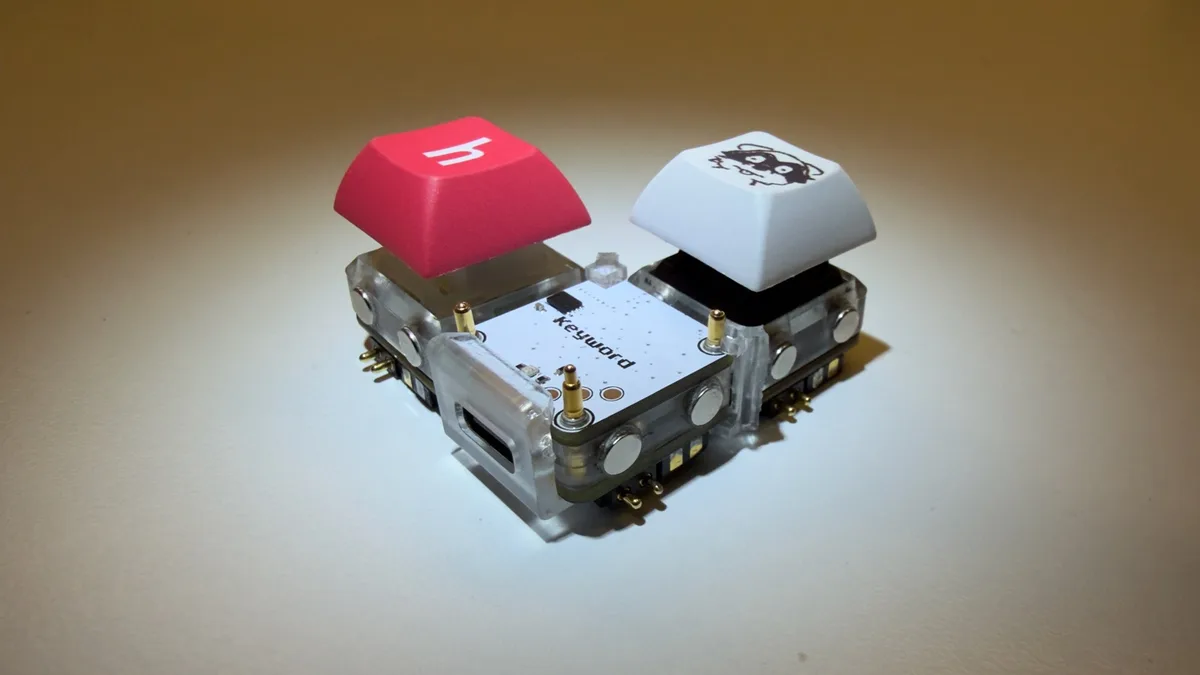
In the custom mechanical keyboard scene, one hardware constraint has long seemed set in epoxy: no matter how exotic the case or keycap profile, every build ultimately relies on a fixed printed circuit board (PCB) that locks the physical layout in place at the factory. Hardware engineer and maker Nathan Alspaugh, known across the open-source community as notaroomba, has shattered that limitation with Keybytes. His engineering premise is as radical as it is playful: eliminate the traditional mainboard entirely and turn every single key into an autonomous magnetic building block that snaps together and reconfigures on the fly like Lego bricks.
Keybits and Keyword: A Dedicated RISC-V Microcontroller Under Every Finger
Whereas a conventional keyboard routes rows and columns of dumb switches back to a single master processor, the Keybytes architecture distributes computing power directly into every single-unit (1u) key module. Dubbed Keybits, these standalone blocks each house their own miniature PCB (a rigid board in revision v1, evolving into a cross-shaped two-layer flexible PCB with FR4 stiffeners folded into the housing in revision v2), Mill-Max 3305 hot-swap sockets for any Cherry MX-style mechanical switch, an addressable WS2812 RGB LED, and a dedicated RISC-V microcontroller (a WCH CH32V003 in v1, upgraded to a BLE-capable CH592F in v2). In practice, every key sitting on your desk operates as a tiny independent computer.
To coordinate the array and communicate with a host PC, the keys snap onto a central master hub called the Keyword. Built around an STM32WB55 wireless microcontroller in the original prototype (and a unified CH592F flex board in v2), the Keyword manages wired USB-C connectivity (with USBLC6 ESD protection), wireless Bluetooth pairing, power delivery, and LiPo battery charging through a BQ25185 controller. Even firmware deployment is cable-free at the key level: four surface-mount pogo pins on top of the Keyword (GND, TIO, TCK, and 3V3) align with contact pads underneath each Keybit, allowing builders to flash a new key simply by pressing it against the hub before switching to over-the-air (OTA) updates.
Spring-Loaded Pogo Pins, Orientation-Free Rotation, and Hall Effect Modules
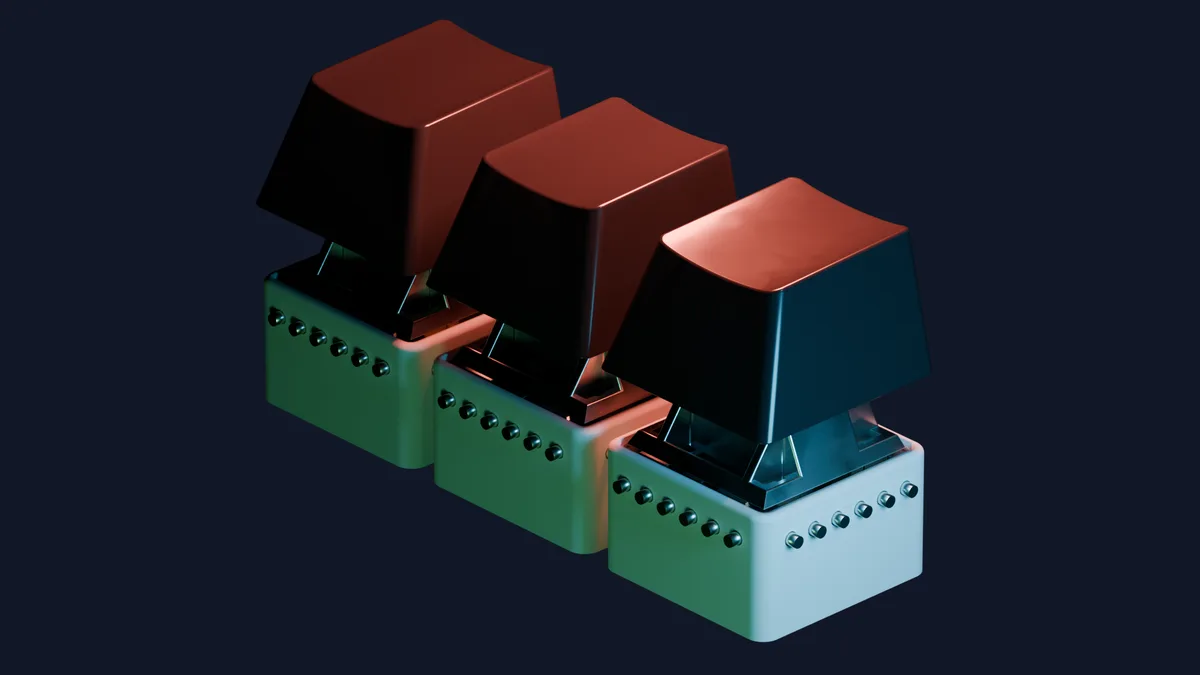
Passing both electrical power and data cleanly across dozens of detachable blocks without exposed wiring required clever interconnect design. Along all four edges, each Keybit combines N52 neodymium magnets with spring-loaded pogo pins,refined in v2 into six conductive contact magnets spaced on a 2.38mm grid with alternating nets. As soon as two Keybits snap together, power and I2C communication signals hop from neighbor to neighbor back to the Keyword hub. Because each edge incorporates a tiny FET bridge that automatically sorts out VBUS and ground polarity, keys are completely orientation-independent and can be rotated 90, 180, or 270 degrees without shorting the bus.

That 2.38mm magnetic pitch also unlocks customizable physical offsets, supporting 0%, 25%, 50%, or 75% row and column stagger. Players can shift from a strict ortholinear grid to an angled ergonomic cluster in seconds, or bridge intentional gaps using passive flex spacers (1u, 0.75u, and 0.5u) that carry power across open space. At a time when compact magnetic-switch keypads like the Keychron F4 HE 8K are carving out a dedicated spot on gaming desks, Nathan Alspaugh has also engineered a Hall Effect variant using a 3-axis TMAG3001 sensor that lets the exact same Keybit PCB function as an analog trigger key, a rotary encoder knob, or a miniature thumb joystick.
100% Open-Source Hardware Built for Custom Gaming Pads and Accessibility
True to the open-source hardware ethos, every KiCad schematic, Onshape 3D CAD enclosure, JLCPCB panelized production file, and firmware repository has been released free of charge under an MIT license on Nathan Alspaugh's official notaroomba/Keybytes GitHub repository. While populating a full 100-key board with individual microcontrollers and magnetic pogo arrays would be pricey compared to picking up ready-to-play hot-swap mechanical keyboards like the 8BitDo Retro 87, Keybytes shines as a custom gaming pad platform. Whether assembling an asymmetric left-hand FPS cluster tailored to your exact finger reach, a dedicated macro array, or an adaptive controller for players with limited mobility, this modular architecture turns hardware layout into a living canvas.
My Field Notes
Tucking a dedicated RISC-V microcontroller and an automatic FET polarity bridge underneath every single 1u keycap is the exact kind of glorious hardware over-engineering that makes late-night tech watch so rewarding. Nobody needs a hundred individual microcontrollers just to type up office spreadsheets, but for PC gaming ergonomics, the possibilities are wild. I can already picture the asymmetric left-hand clusters Kaelen would snap together at a 25% stagger for her raid keybinds, or the Hall-sensor telemetry rigs Heimdall would immediately wire up on his test bench. By publishing every KiCad schematic and pre-panelized PCB file under an open-source MIT license, Nathan Alspaugh has handed the modding community a genuinely brilliant building block.

Originally from Lyon, France, gaming journalist Bastien "Orion" relocated nearly a decade ago to Quebec City's Saint-Roch district, right in the heart of eastern Canada's development studio hub. Before crossing the Atlantic, he honed his versatile reporting style across classic French gaming web portals and specialist television outlets in the 2000s and 2010s, notably with JeuxVideo.fr and JeuxNews. Equally passionate about AAA blockbusters, North American studio culture, retro preservation, and community modding projects, he anchors Pro-Gamer's transatlantic desk and real-time coverage of US and Japanese industry announcements.