Dolby Vision, 12-Bit Color, and 12.15 TFLOPS: Why GTA 6 on Xbox Series X Challenges PS5 HDR10
Nine days ahead of its worldwide launch on November 19, 2026 from Rockstar Games, the technical showdown surrounding Grand Theft Auto VI extends well beyond raw frame rate targets. While Sony holds the official marketing partnership, technical capability tags within the Xbox ecosystem and retail Xbox Series X|S packaging details shared by community tracker @videotech confirm a visual feature absent from PlayStation hardware: native Dolby Vision support paired with Dolby Atmos spatial audio.
12-Bit Dynamic Metadata vs 10-Bit Static HDR10
Both the base PlayStation 5 and the PlayStation 5 Pro share a permanent architectural omission: neither console supports Dolby Vision Gaming. While Sony includes the proprietary format from Dolby Laboratories on select Bravia televisions and standalone UHD Blu-ray players, its gaming consoles rely strictly on open-standard HDR10 for interactive rendering.
The pipeline gap between these two high dynamic range standards directly affects Rockstar Games' RAGE 9 engine. Standard HDR10 on PS5 uses static metadata encoded at 10-bit color depth (1.07 billion colors). In practice, the console transmits a single Maximum Content Light Level (MaxCLL) and a single Maximum Frame-Average Light Level (MaxFALL) value that remain locked across the entire gameplay session.
Conversely, Dolby Vision for Gaming on Xbox Series X and Series S (supported up to 4K at 120 Hz over HDMI 2.1) processes dynamic metadata on a scene-by-scene and frame-by-frame basis within a container supporting up to 12-bit color depth (up to 68.7 billion theoretical shades).

Vice City Neon and Leonida Sunlight: How Dynamic Tone Mapping Changes the Image
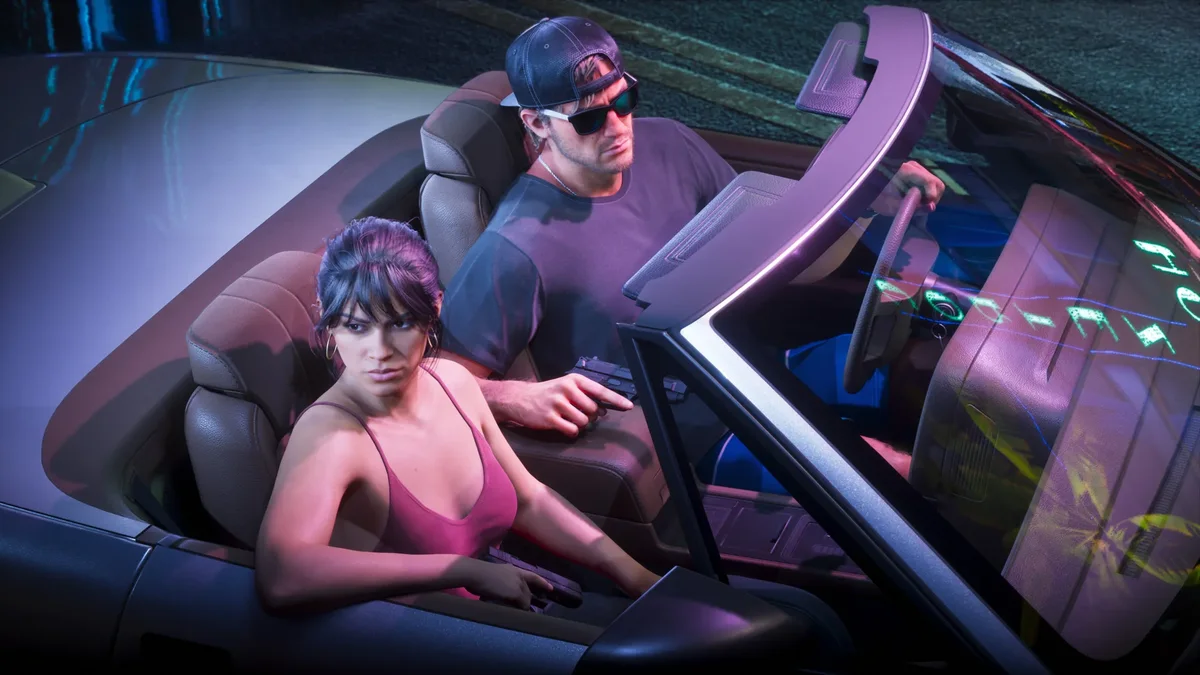
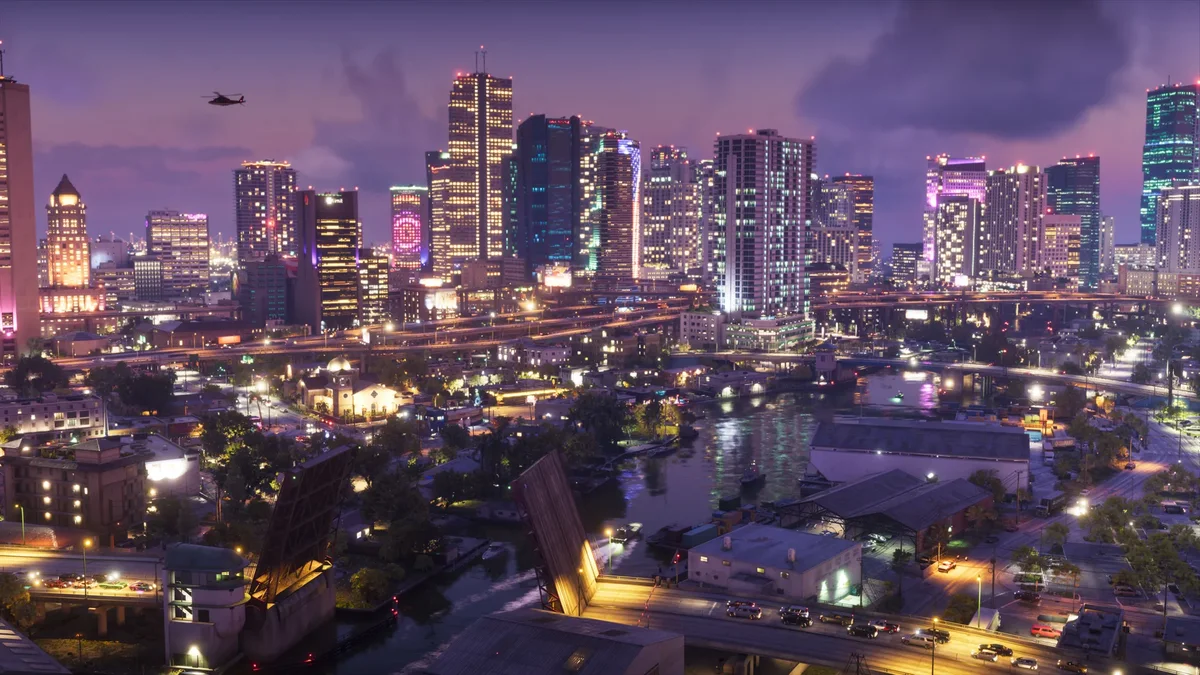
In an open world built around extreme luminance contrasts like the state of Leonida, real-time adjustments to the Electro-Optical Transfer Function (EOTF) curve provide a measurable advantage. When Jason and Lucia drive from a shadowed back alley straight onto an Ocean Drive strip saturated with pink and cyan neon signs reflecting off wet asphalt, a static HDR10 feed forces the display into a fixed tone-mapping compromise.
With Dolby Vision active on Xbox Series X, dynamic tone mapping recalibrates highlight roll-off and shadow floor parameters across every weather shift and time-of-day transition. Halogen headlights, police strobes, and midday glare over Vice Beach retain specular detail without clipping whites, while night patrols through the Grassrivers wetlands preserve shadow separation without crushing blacks or introducing color banding across twilight skies. PlayStation players must manually configure a strict HGiG calibration profile within the PS5 and PS5 Pro video and audio settings to prevent double tone-mapping artifacts.
Dolby Atmos, 12.15 TFLOPS, and PSSR 13.60: Full Console Spec Comparison
Alongside the Dolby Vision badge, the Xbox Series X retail box and Microsoft Store listing confirm Dolby Atmos spatial audio, 4K Ultra HD, HDR10, VRR (Variable Refresh Rate), and Quick Resume. On the audio front, the gap with Sony has largely closed: while Xbox Series X handles object-based Dolby Atmos natively at the system level, PS5 firmware updates now allow Sony's proprietary Tempest 3D AudioTech engine to output an encapsulated Dolby Atmos bitstream to compatible HDMI eARC soundbars and AV receivers.
Evaluating the broader hardware balance across all three current-generation systems available in November 2026 reveals two distinct matchups. Compared against the standard PS5 Slim (10.28 TFLOPS, priced at $649.99 for the Disc Edition), the Xbox Series X (12.15 TFLOPS across 52 RDNA 2 compute units, retailing at $799.99) pairs an 18% raw compute advantage with Dolby Vision dynamic range. However, when matched against the PS5 Pro ($899.99), Microsoft's flagship lacks a dedicated hardware counterpart to the PSSR 13.60 AI upscaler and 3.85 GHz CPU boost uncovered in the GTA 6 PlayStation manifest:
| Technical Specification | Xbox Series X ($799.99) | PS5 Standard Slim ($649.99) | PS5 Pro ($899.99) |
|---|---|---|---|
| GPU Compute & Architecture | 12.15 TFLOPS (52 CU RDNA 2 at 1.825 GHz) | 10.28 TFLOPS (36 CU RDNA 2 at 2.23 GHz) | 16.7 TFLOPS (60 CU hybrid RDNA + 300 TOPS NPU) |
| CPU Clock (8-Core Zen 2) | 3.80 GHz (3.66 GHz with SMT enabled) | 3.50 GHz (variable frequency) | Up to 3.85 GHz (High CPU Frequency Mode bit 22) |
| High Dynamic Range (HDR) | Dolby Vision Gaming (12-bit dynamic) & HDR10 | Static HDR10 (10-bit) & HGiG | Static HDR10 (10-bit) & HGiG |
| 4K Upscaling Pipeline | RAGE 9 temporal reconstruction / FSR | RAGE 9 temporal reconstruction / FSR | PSSR revision 13.60 neural AI (MFSR) |
| 3D Spatial Audio | Native Dolby Atmos, DTS:X & Windows Sonic | Tempest 3D AudioTech (Dolby Atmos HDMI output) | Tempest 3D AudioTech (Dolby Atmos HDMI output) |
| Platform Features | Quick Resume, HDMI 2.1 VRR & ALLM | DualSense haptic feedback & adaptive triggers | 120 Hz display container, Wi-Fi 7 & 2 TB SSD |
My Take on the Spec Sheet
We need to separate two very different console matchups before November 19 arrives. If you are comparing the two baseline machines on a modern OLED television (such as an LG C-Series or G-Series panel capable of low-latency 120 Hz Dolby Vision), the Xbox Series X holds a genuine visual edge over the standard PS5: its 52 compute units sustain a higher internal dynamic resolution ceiling, and 12-bit scene-by-scene tone mapping keeps Vice City's nighttime neon highlights from clipping while preserving deep shadow detail. Against a PS5 Pro, however, Dolby Vision alone cannot offset the spatial clarity delivered by Sony's PSSR 13.60 neural upscaler and the frame-time stability of the 3.85 GHz CPU boost mode. On a properly calibrated HGiG display, the PS5 Pro's 4K image reconstruction will outweigh dynamic HDR metadata in side-by-side play.

Grand Theft Auto 6 (GTA 6)
Explore official trailers, technical specs and all latest coverage for Grand Theft Auto 6 (GTA 6).

PC hardware enthusiast and competitive gamer, Arthur 'Heimdall' splits his time between France and the UK working in enterprise B2B software solutions. A business school graduate passionate about component benchmarking, he has been building, modding, and tuning PCs since childhood, optimizing every thermal degree and millisecond of display latency. An avid gamer across Assassin's Creed and sandbox titles, he forged his alliance with Grimtag and Chaya during late-night World of Warcraft raids before joining Pro-Gamer.