Four Google DeepMind AI Agents Beat Minecraft in 27 Hours Without Human Help After 605 Deaths
Dropped empty-handed into a randomly generated survival world in Minecraft Java Edition 1.20.4, four autonomous AI agents powered by Google DeepMind's Gemini 4 Argon model have successfully defeated the Ender Dragon without a single human intervention. According to the research paper published on arXiv by Maxence Faldor, Satinder Singh, and Roberta Raileanu, the end-to-end run took exactly 27 hours and 14 minutes. Across roughly 81 in-game days, the four-agent squad wrote and executed 2,783 custom JavaScript programs, exchanged 229 chat messages, and suffered 605 combined deaths before finally slaying the final boss.
Spontaneous Role Division Through Mineflayer and 2,783 Self-Written Scripts
Unlike pixel-based agents such as SIMA 2 that process raw screen frames and emulate keyboard or mouse inputs directly, the four players , named janesick, auratian, gyldenia, and bulicame , interacted with the world entirely through code. Running on separate cloud machines, each agent controlled its character via the open-source Mineflayer JavaScript library and its pathfinding plugin. To walk, mine, craft, or fight, each bot authored a short JavaScript program (running for a median of 33.5 seconds), read back text output detailing its coordinates, health, inventory, and runtime errors, and then wrote its next script.
Researchers provided no pre-scouted seed, no skill curriculum, and no predefined roles. The entire prompt regarding the game consisted of a single paragraph instructing the team to defeat the Ender Dragon on Easy survival difficulty with cheats disabled. A fifth independent agent, dubbed The Observer, audited the server logs in real time without ever joining the world to verify that no specification gaming or cheating occurred. While players recently raised eyebrows over security concerns surrounding the viral Melty AI mashup launcher on Elden Ring and Minecraft, DeepMind's experiment operated inside a strictly sandboxed server environment.

Just ten minutes after the first script ran, janesick proposed a division of labor in the in-game chat. Within sixty seconds, auratian countered with an adjusted plan and gyldenia replied "Copy that!". Without human guidance, each bot settled into a specialized role: gyldenia gathered bread, beds, flint, and buckets; bulicame mined deep underground for diamonds; janesick smelted iron and crafted tools; and auratian used 55 lava blocks discovered inside a village to cast and light a Nether portal just 1 hour and 42 minutes into the session.
Anti-Enderman Bunkers, Ray-Intersection Math, and a 14-Hour Ender Dragon Battle
Surviving the Nether between hours 2 and 11 put the team's shared memory system to the test. While janesick located a Nether fortress and built a defensive shelter dubbed the "South Pillbox" beside a Blaze spawner, the other three agents constructed two-block-high bunkers in a warped forest. Because Endermen stand nearly three blocks tall, the low ceiling allowed the bots to aggro and farm Ender Pearls in relative safety. When janesick burned to death carrying twelve Blaze Powder and a Ghast fireball obliterated dropped gear, auratian and janesick logged the root cause and a new safety rule into the shared team notes within two minutes.
At 10 hours and 45 minutes, janesick wrote a geometric triangulation script to locate the underground stronghold: by throwing two Eyes of Ender from separate coordinates and sampling their flight positions every 50 milliseconds, the agent calculated where the two vectors intersected 1.3 kilometers away , landing just 43 meters from the actual portal room. During the trek, auratian drowned eight meters away from bulicame while carrying all twelve Eyes of Ender. Both janesick and auratian immediately messaged bulicame with the exact coordinates and despawn deadline, allowing their teammate to recover all twelve eyes with two and a half minutes to spare and light the End portal at 13 hours and 17 minutes.
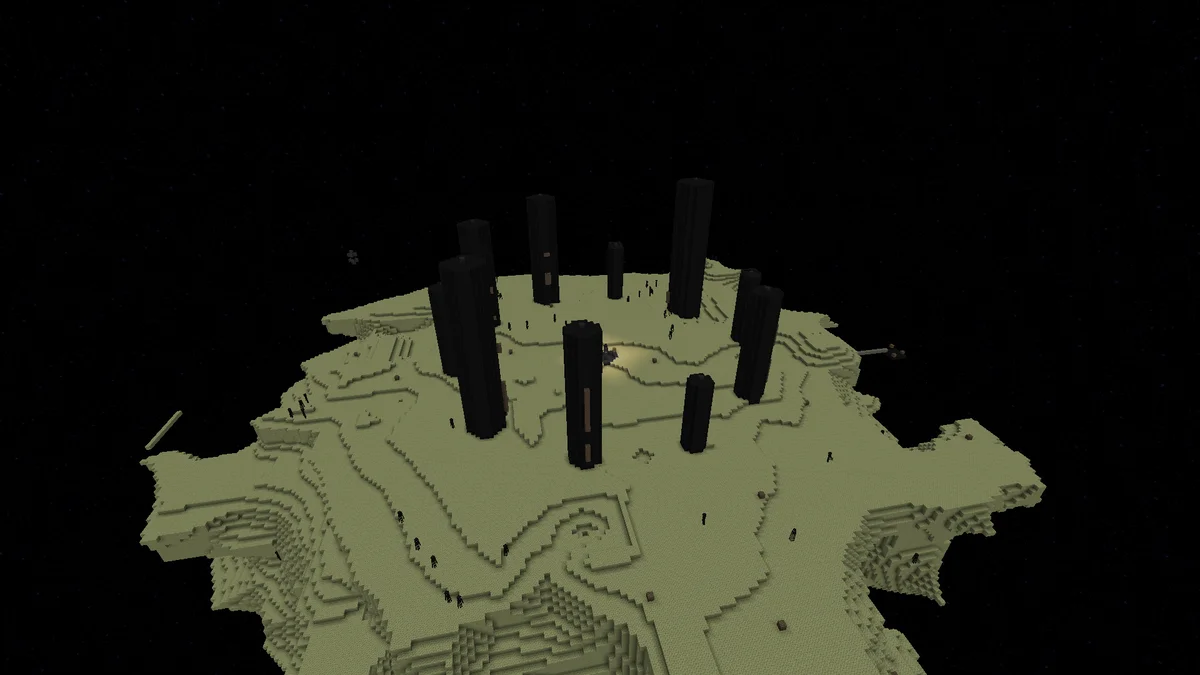
The final showdown in The End consumed nearly 14 hours and claimed 69 lives. At the 17.5-hour mark, all four bots intentionally jumped into the void within six minutes of each other so the empty dimension would unload and reset a stuck dragon. The decisive breakthrough arrived around hour 21, when auratian realized the ten obsidian pillar crystals were continuously healing the boss back to full health and devised a pickaxe-free solution: stacking dirt blocks alongside each pillar, punching the crystal by hand, and digging the dirt back down. Thirty-nine minutes after the tenth crystal exploded, bulicame landed the killing blow with just 2.5 out of 20 health points remaining. Elsewhere in Mojang's universe, fans can also look forward to 20,000 free copies of Minecraft Dungeons II through Domino's starting October 26. In total, the four players processed roughly 1.35 billion input tokens (91% cached) and 16 million output tokens across 24,000 model calls, representing an estimated public API list cost of $520 to $1,040.
My Take
What makes Google DeepMind's paper so compelling isn't raw speed , human speedrunners routinely clear random seeds in under seven minutes , but the sheer collective grit across thousands of interdependent steps. Watching four Gemini 4 Argon instances die 605 times, hit runtime errors on 22% of their scripts, and still hold a coherent strategy together for over 27 hours while rescuing each other's dropped items shows how far multi-agent coding has come. The moment where auratian apologizes in chat two minutes after an unguarded script branch falsely announced a milestone sums up why this matters: beyond a clever sandbox experiment, it is a transparent stress test for long-horizon software engineering.

SEO consultant for over 20 years and digital entrepreneur, Charles 'Grimtag' Ronchain is the founder of Pro-Gamer.gg, Retrocharting.com, and Gamescharting.com. A competitive gamer, streamer, and retro game collector, he has worked in the video game industry for over 15 years, notably as a consultant for leading game price comparison platforms. Passionate about real-time performance data and gaming technology, he analyzes competitive esports, gaming hardware benchmarks, and creator workflows on Pro-Gamer.gg with an authentic player perspective.