Full 16-CU Radeon 890M Without Paying for 12 Cores: Why AMD's Ryzen AI 7 HX 455 Changes the Portable Gaming Equation
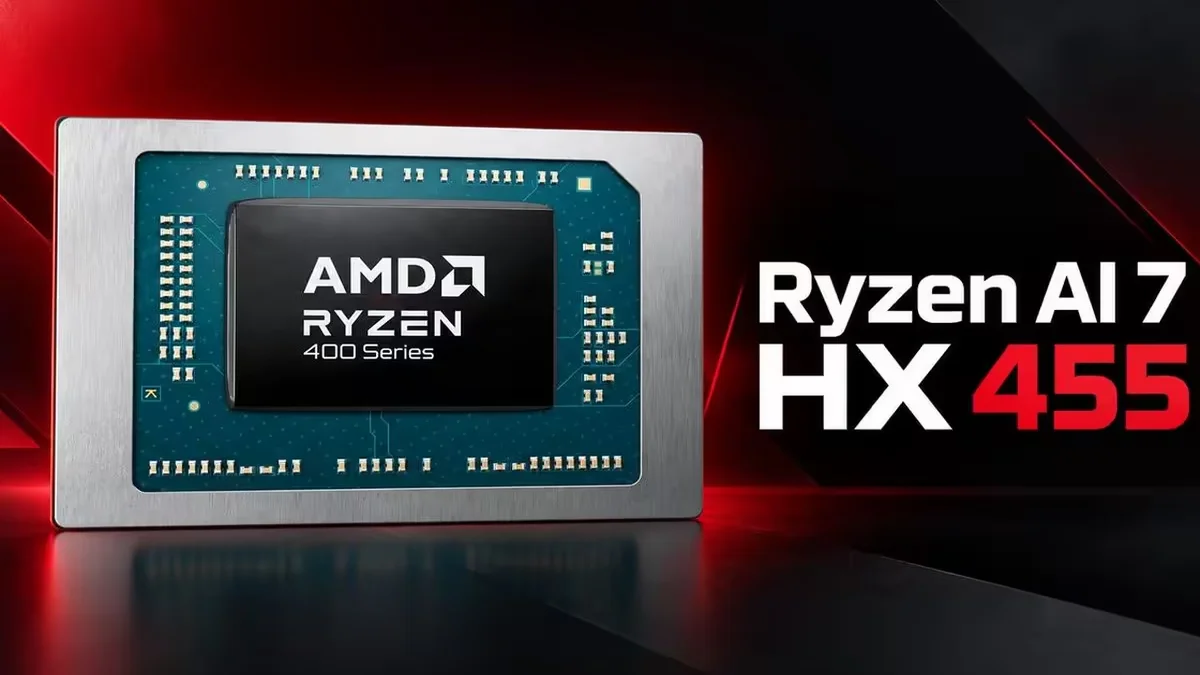
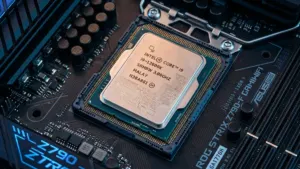
Until now, AMD’s mobile processor segmentation enforced a strict tax on portable gamers: anyone who wanted the full Radeon 890M integrated GPU with all 16 Compute Units (CUs) unlocked had to pay top dollar for a flagship 12-core Ryzen AI 9 HX chip. A newly leaked SKU from the Ryzen AI 400 “Gorgon Point” family is set to break that barrier. Revealed by hardware insider Golden Pig Upgrade on Weibo, the unannounced AMD Ryzen AI 7 HX 455 pairs an 8-core, 16-thread CPU with the full 16-CU Radeon 890M iGPU and a complete 24 MB L3 cache pool.
8 Zen 5 Cores, 24 MB L3 Cache, and 16 RDNA 3.5 CUs: Inside the Ryzen AI 7 HX 455
Across both the previous Strix Point generation and the initial Ryzen AI 400 wave, AMD reserved its HX branding exclusively for 12-core/24-thread flagships such as the Ryzen AI 9 HX 370, HX 470, and HX 475. Stepping down to an 8-core Ryzen AI 7 previously meant losing half of the graphics silicon. For instance, the standard Ryzen AI 7 450 drops L3 cache down to 16 MB and cuts the integrated GPU in half with an 8-CU Radeon 860M (512 Stream Processors).
By bringing the HX tier down to the Ryzen AI 7 family, the Ryzen AI 7 HX 455 retains the exact same 16-CU Radeon 890M (1,024 Stream Processors based on the RDNA 3.5 architecture) and the full 24 MB of L3 cache found on the 12-core flagships, while trimming the CPU complex to a balanced 8-core, 16-thread layout combining 4 full-speed Zen 5 cores with 4 dense Zen 5c cores.
| APU Model (Gorgon Point) | CPU Cores / Threads | L3 Cache | iGPU (RDNA 3.5) | Graphics Units |
|---|---|---|---|---|
| Ryzen AI 9 HX 475 / HX 470 | 12 Cores / 24 Threads | 24 MB | Radeon 890M | 16 CUs (1,024 SPs) |
| Ryzen AI 7 HX 455 (Leaked) | 8 Cores / 16 Threads | 24 MB | Radeon 890M | 16 CUs (1,024 SPs) |
| Ryzen AI 7 450 | 8 Cores / 16 Threads | 16 MB | Radeon 860M | 8 CUs (512 SPs) |
Check Availability of AMD Ryzen AI Laptops on Amazon→
Why 8 CPU Cores and 16 GPU CUs Is the Sweet Spot for Handhelds and Thin Laptops
In thin-and-light gaming notebooks and portable PC handhelds operating within a tight 15W to 30W battery power envelope (and up to 54W plugged in), every watt routed to extra CPU cores is a watt taken away from the integrated graphics clock speeds. Modern games rarely saturate more than eight CPU cores on an APU, whereas iGPU compute density and high-speed LPDDR5X-8533 memory bandwidth dictate actual frame rates. Memory throughput remains a critical pillar across AMD platforms, as recently highlighted when the Colorful iGame X870E ULTRA-S pushed 192GB of DDR5 to 6600 MT/s CL28 across four AM5 slots.

Keeping the full 24 MB of L3 cache alongside the 16-CU Radeon 890M is equally decisive: larger L3 cache buffers reduce main memory round-trips and stabilize 1% low frame times in open-world titles. Combined with growing software versatility on Radeon hardware, including community breakthroughs that unlock Ray Reconstruction and Multi Frame Generation on AMD Radeon GPUs, the Ryzen AI 7 HX 455 gives OEMs a way to build sub-$1,000 handhelds and ultrabooks without sacrificing flagship integrated graphics performance.
Check Availability of ASUS ROG Ally X on Amazon→

My Benchmark Take: Every time I have tested 12-core Strix Point APUs inside a 17W to 28W handheld power envelope, the telemetry told the exact same story: four of those twelve CPU cores sat idle in games or actively stole thermal headroom from the Radeon 890M during shader spikes. Decoupling the full 16-CU RDNA 3.5 iGPU and 24MB of L3 cache from the expensive 12-core tier fixes the single biggest frustration in AMD’s mobile lineup. If laptop and handheld makers pass those BOM savings on to players, the Ryzen AI 7 HX 455 will easily become the price-to-performance champion of the entire Gorgon Point generation.

PC hardware enthusiast and competitive gamer, Arthur 'Heimdall' splits his time between France and the UK working in enterprise B2B software solutions. A business school graduate passionate about component benchmarking, he has been building, modding, and tuning PCs since childhood, optimizing every thermal degree and millisecond of display latency. An avid gamer across Assassin's Creed and sandbox titles, he forged his alliance with Grimtag and Chaya during late-night World of Warcraft raids before joining Pro-Gamer.