Bought for $4.99 in a Goodwill Keyboard Bin: Buyer Opens the Case and Uncovers the 1983 Humdinger, an 8-Bit Computer With Zero Known Survivors
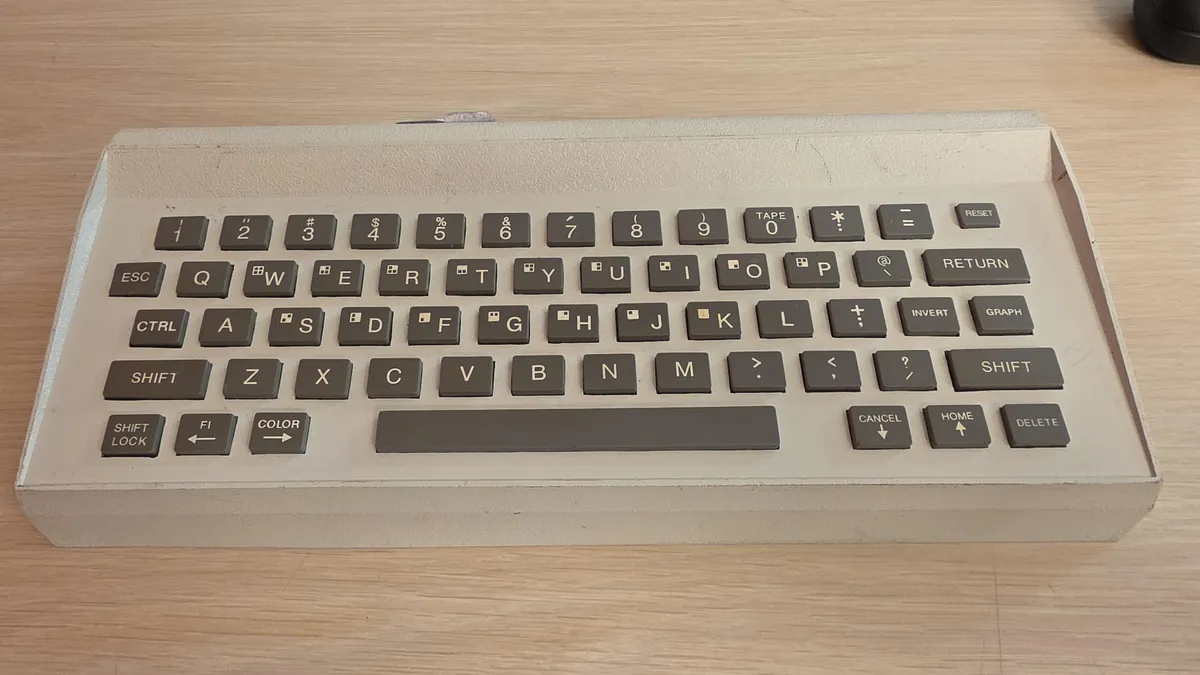
While digging through a pile of secondhand keyboards at a US Goodwill store, a thrift shopper paid $4.99 for an unusual cream-colored enclosure that looked a bit too thick to be a standard peripheral. Opening the shell at home revealed a complete 1980s motherboard and a loose internal badge featuring a hummingbird and rainbow logo: the 1983 Humdinger, an elusive 8-bit home computer with zero previously documented surviving units.
The finder, named Aarin and known as woodson600 on the r/vintagecomputing community, made the crucial decision not to plug the unit into wall power. Firing up a forty-three-year-old circuit board blind can easily blow shorted capacitors and send lethal voltage spikes straight into irreplaceable vintage silicon.
From the 1983 West Coast Computer Faire to Complete Obscurity
Before Aarin's photographs surfaced in autumn 2026, the Humdinger existed solely as a paper trail in 1983 computer magazines. Built by Cupertino-based Venture Micro, Inc. under company president Roger Pitkin, the machine debuted in March 1983 at the 8th West Coast Computer Faire in San Francisco.
Pitched right into the brutal early-1980s budget price war between the $99.95 Timex Sinclair 1000, the $160 Mattel Aquarius, and the Commodore 64, the Humdinger was advertised by Quest Electronics at $129.95 (roughly $440 adjusted for inflation in 2026). British computing writer Tim Hartnell and Artic Computing's Richard Turner even reported in the June/July 1983 issue of ZX Computing that they had placed orders at the show, though Hartnell noted two weeks later that his unit still had not arrived before Venture Micro vanished by 1984.
In an era where hardware modders build custom input architectures from scratch like Nathan Alspaugh's modular Keybytes magnetic mechanical keyboard powered by per-key RISC-V microcontrollers, spotting an intact 1983 all-in-one computer camouflaged inside a thrift store keyboard bin is a one-in-a-million stroke of luck. Its 58 dark keys, including dedicated COLOR and GRAPH legends, hid the entire logic board directly beneath the keyswitches.
Check Availability 8BitDo Retro Mechanical Keyboard Availability on Amazon→
Mostek MK3880 Silicon, 4KB of SRAM, and an Unsolved Video Memory Puzzle
Chip markings on the recovered board confirm an architecture distinct from 6809-based contemporaries like the TRS-80 Color Computer or Dragon 32. The Humdinger runs on an 8-bit Mostek MK3880 processor (a licensed Zilog Z80 family clone) paired with two 2KB Hitachi HM6116P-3 static RAM chips for a total of 4KB of onboard SRAM.
Display output relies on a Motorola MC6847 video display generator paired with an MC1372P TV modulator. That chip combination immediately exposes a hardware mystery: while 1983 advertisements promised 256×192 resolution and eight colors, a standard MC6847 256×192 bitmap framebuffer requires 6KB of video memory (and only outputs two colors in that high-resolution mode), exceeding the 4KB of SRAM physically installed on the board.
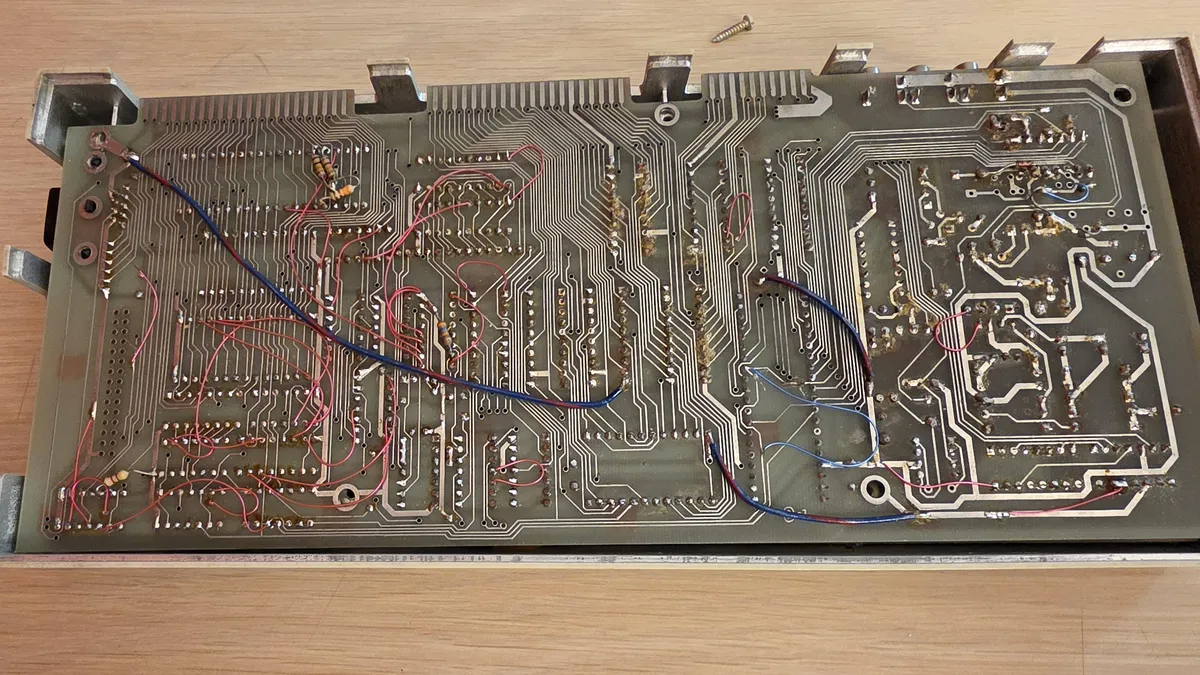
Even more tellingly, the Goodwill unit features several unpopulated IC sockets, including an empty 20-pin footprint. Despite period adverts touting an 8KB BASIC ROM and four-voice sound across five octaves, neither a firmware ROM chip nor a dedicated programmable sound generator IC has yet been identified on the circuit board.
| Subsystem / Specification | 1983 Advertised Claims (Venture Micro / Quest) | Verified Hardware on Recovered Unit (October 2026) |
|---|---|---|
| Main Processor (CPU) | Z80-compatible architecture (CP/M expansion priced separately) | Mostek MK3880 (Z80 family) confirmed via chip markings |
| System Memory (RAM) | 4KB base RAM (expandable up to 64KB) | 4KB SRAM via two 2KB Hitachi HM6116P-3 chips |
| Video Subsystem | 256×192 resolution, 8 colors | Motorola MC6847 VDG + MC1372P TV modulator (constrained by 4KB RAM) |
| Firmware & Audio | 8KB BASIC ROM, 4-voice sound over 5 octaves | No ROM or dedicated sound IC identified; empty DIP sockets present |
| I/O & PCB Assembly | Centronics, RS-232, cassette, cartridge, joystick, RF output | 3 RCA jacks, 9-pin D-sub, card-edge fingers, heavy hand wiring |
The Doppledinger Project: Open-Source Hardware Preservation Over Auction Flipping
Instead of flipping the one-of-a-kind machine on auction sites where early 1980s prototypes regularly fetch thousands of dollars, Aarin chose preservation over profit. He generously shipped the Humdinger for the cost of postage alone to British researcher Nick Taylor (known online as indigoprime), who had been tracking the machine's magazine footprint since 2020 and authored its Wikipedia entry.
After arriving on October 8, 2026, and undergoing an initial physical inspection on October 11, the computer now anchors the Doppledinger preservation and reconstruction repository on GitHub. That dedication to keeping legacy hardware alive echoes modern hardware preservation feats like Kouzex's DualStation project turning a 2004 Nintendo DS motherboard into a 60Hz HDMI home console.
Taylor's roadmap focuses on non-destructive continuity tracing to map the full schematic before eventually placing the original unit in a museum, while releasing an open-source hardware reconstruction under the CERN Open Hardware Licence v2. The team has also issued an open call for any former Venture Micro or Quest Electronics engineers who might still hold original schematics, manuals, or the missing 8KB BASIC ROM in an old storage box.
Check Vintage 1980s 8-Bit Home Computer Listings on eBay→
My Take on the Spec Sheet
Flipping this PCB over and seeing that web of hand-soldered point-to-point bodge wires across the copper traces, right alongside unpopulated ROM sockets and a Motorola MC6847 video chip starved of the 6KB framebuffer it needs for full 256×192 graphics, screams early 1983 trade-show engineering sample. The fact that Aarin resisted plugging a random power brick into the rear jacks and instead handed the board straight to Nick Taylor for continuity tracing saved a piece of Silicon Valley history from going up in magic smoke.

PC hardware enthusiast and competitive gamer, Arthur 'Heimdall' splits his time between France and the UK working in enterprise B2B software solutions. A business school graduate passionate about component benchmarking, he has been building, modding, and tuning PCs since childhood, optimizing every thermal degree and millisecond of display latency. An avid gamer across Assassin's Creed and sandbox titles, he forged his alliance with Grimtag and Chaya during late-night World of Warcraft raids before joining Pro-Gamer.