Radeon-atieclxx-SSD-Fix v2.1: How This Open-Source Tool Blocks 56 GB of Background SSD Writes Without Disabling FreeSync

AMD Radeon graphics card owners now have a clean, non-destructive way to protect their NVMe drives while waiting for AMD's official driver patch. Just days after we covered how the AMD Radeon Adrenalin driver bug hammers your SSD with constant daily writes at idle, independent developer Necandi (known as necanditool on GitHub and an active member of the German ComputerBase forum) has released version 2.1 of Radeon-atieclxx-SSD-Fix. Published under the open-source MIT license, this lightweight utility stops the atieclxx.exe self-copy loop cold without forcing PC gamers to disable AMD FreeSync, Frame Pacing, or Resizable BAR.
Why the AMD External Events Utility Drains NVMe SSD TBW Endurance
Confirmed by AMD and affecting recent driver releases including the Adrenalin 26.10.2 branch on Radeon RX 7000 and RX 9000 GPUs, the bug originates inside the Windows AMD External Events Utility service (atieclxx.exe). When the utility attempts to locate installation files for the amdkmpfd PCI filter driver tied to Smart Access Memory (Resizable BAR) and fails, it enters an endless retry loop.
Event Tracing for Windows (ETW) logs show that on affected systems, the 660 KB atieclxx.exe binary copies itself once every second from the driver store directly into the Windows system profile folder at:
C:WindowsSystem32configsystemprofileAppDataLocalAMDatieclxx.exe
At a baseline rate of 660 KB per second, this single self-copy operation writes 2.38 GB per hour, or roughly 56 GB per day, to the primary boot drive. Depending on system configuration and secondary installer logs, background write throughput can climb anywhere from 0.3 MB/s to 5 MB/s (1.08 GB to 18 GB per hour, or up to 432 GB per day), steadily burning through the rated TBW (Terabytes Written) warranty endurance of NAND flash cells even while the PC sits completely idle on the desktop.
Check Availability for PCIe 4.0 NVMe SSDs on Amazon→
How Radeon-atieclxx-SSD-Fix v2.1 Works: Targeted NTFS ACL Blocking
Until now, manual workarounds forced users into an unpleasant trade-off: either shut down the AMD External Events Utility service entirely in services.msc (which can break FreeSync, degrade Frame Pacing, and kill Adrenalin hotkeys) or disable Resizable BAR in the motherboard BIOS. Necandi's open-source tool sidesteps both compromises by applying a targeted Windows NTFS Access Control List (ACL) permission rule to the single looping file.
The full source code and portable release archive (Radeon-atieclxx-SSD-Fix.zip, with verified SHA-256 checksum) can be inspected and downloaded directly from the official Radeon-atieclxx-SSD-Fix GitHub repository and its v2.1 Releases page.
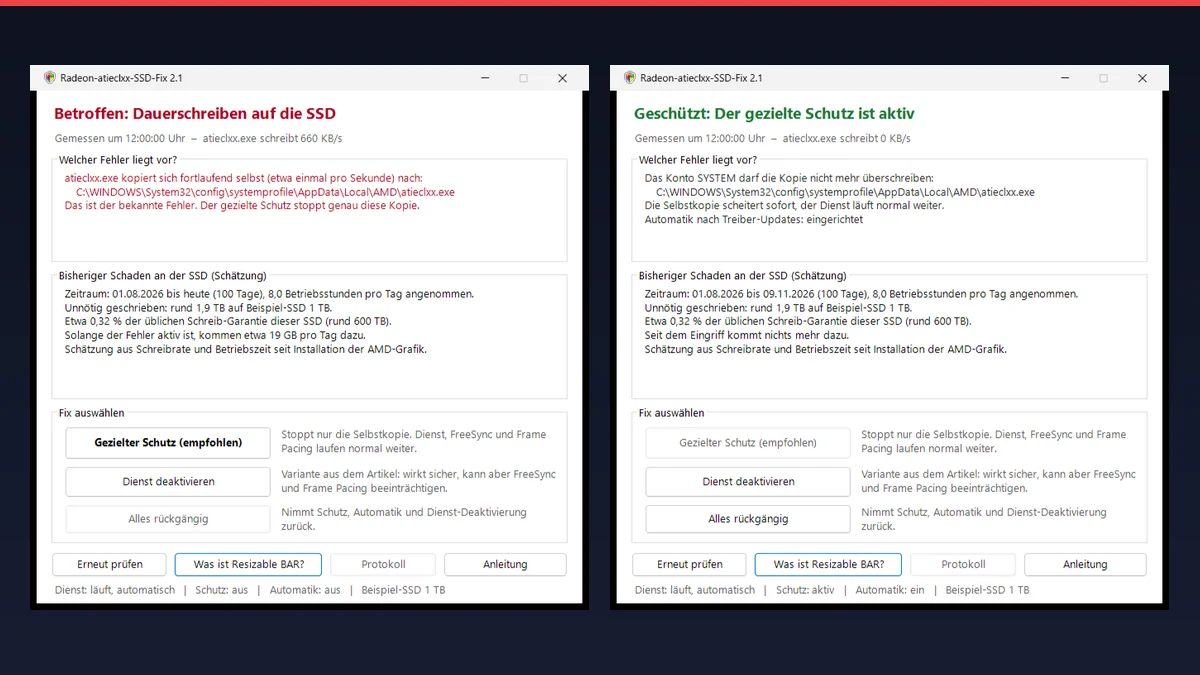
When launched via START.cmd with administrator privileges, the utility performs three core operations:
- NTFS USN Journal & ETW Diagnostics: Because the Windows
CopyFileAPI preserves the original timestamp of the source file, checking file modification dates cannot detect the loop. Instead, the tool queries the NTFS Update Sequence Number (USN) change journal over a 10-second window (with a 64 MB capped ETW trace as a fallback) to measure exact write activity fromatieclxx.exe. - Cumulative TBW Wear Estimator (Schadensschätzung): The interface calculates how many gigabytes have already been written unnecessarily to your SSD by multiplying the measured write rate by system uptime since the AMD driver installation date, displaying the percentage of typical SSD write warranty consumed.
- Targeted File Lock (Gezielter Schutz): Selecting the recommended Gezielter Schutz option executes the native Windows command
icacls <target> /deny S-1-5-18:(WD,AD,WEA,WA,DE). This strips only theSYSTEMaccount (SIDS-1-5-18) of write and delete permissions on that specific copy ofatieclxx.exeinsidesystemprofile. Every overwrite attempt fails immediately at the filesystem level before touching the NAND flash: background SSD writes drop to 0 KB/s, while the service, FreeSync, Frame Pacing, and hotkeys continue running normally.
Technical Comparison: AMD SSD Write Bug Impact vs. Workarounds
| Parameter / Method | Affected Adrenalin Driver (Unpatched) | Manual Workaround (services.msc / BIOS) | Radeon-atieclxx-SSD-Fix v2.1 (Gezielter Schutz) |
|---|---|---|---|
| Process & Mechanism | atieclxx.exe self-copy loop (660 KB/s) + missing amdkmpfd filter check | Full stop of AMD External Events Utility or disabling Resizable BAR | Targeted NTFS ACL deny rule (icacls /deny S-1-5-18) on the single target file |
| Hourly Write Volume | 2.38 GB / hour (660 KB/s base) up to 18 GB / hour (5 MB/s peaks) | 0 GB / hour | 0 GB / hour (blocked in memory before NAND write) |
| Daily TBW Endurance Hit | ~56 GB / day (standard loop) up to 432 GB / day at continuous idle | TBW wear halted | 100% halted + built-in historical TBW wear estimator |
| FreeSync, Frame Pacing & SAM | Active (at the cost of constant SSD writes) | Risk of losing FreeSync, Adrenalin hotkeys, or Smart Access Memory uplift | 100% preserved (service stays active in RAM) |
| Future Driver Updates | Awaiting official fix in Adrenalin 26.11.1 | Must be manually re-enabled after updating drivers | Self-healing scheduled task (automatically removes itself once AMD fixes the bug) |
A Self-Removing Scheduled Task Ready for Adrenalin 26.11.1
What makes version 2.1 particularly clever is how it handles upcoming driver updates. When Gezielter Schutz is enabled, the script registers a Windows Scheduled Task named Radeon-atieclxx-SSD-Fix that runs under the SYSTEM account three minutes after boot and every 30 minutes thereafter.
If an intermediate driver reinstall replaces the file, the scheduled task automatically re-applies the NTFS permission lock. Even better, once you install AMD's upcoming Adrenalin 26.11.1 driver (which AMD has confirmed will include the official fix for the atieclxx.exe write loop), the task detects that the driver is no longer attempting abnormal writes and automatically lifts its own NTFS lock. Users can also run PRUEFEN.cmd at any time for a 10-second status check without administrator rights, or execute ENTFERNEN.cmd to revert all permissions and delete the C:Program FilesRadeon-atieclxx-SSD-Fix folder completely.

Check Availability for AMD Radeon RX 9070 XT Graphics Cards on Amazon→
My Field Notes
Spotting Necandi's GitHub repository during my late-night watch immediately made me think of Arthur "Heimdall," who guards the TBW endurance and SMART health metrics of our test bench NVMe SSDs like a hawk. Being forced to choose between letting a background utility burn through 56 GB of flash writes a day or killing a core driver service that supports FreeSync and Resizable BAR was a terrible compromise. Stripping write permissions exclusively from the SYSTEM account on that single target file via icacls, and pairing it with a scheduled task that retires itself the moment Adrenalin 26.11.1 lands, is a masterclass in clean, transparent, and reversible community engineering.

Originally from Lyon, France, gaming journalist Bastien "Orion" relocated nearly a decade ago to Quebec City's Saint-Roch district, right in the heart of eastern Canada's development studio hub. Before crossing the Atlantic, he honed his versatile reporting style across classic French gaming web portals and specialist television outlets in the 2000s and 2010s, notably with JeuxVideo.fr and JeuxNews. Equally passionate about AAA blockbusters, North American studio culture, retro preservation, and community modding projects, he anchors Pro-Gamer's transatlantic desk and real-time coverage of US and Japanese industry announcements.