Despite Major Studio Closures in Canada, 54% of Teens Want a Video Game Career as 77% of Players Call for Public Investment

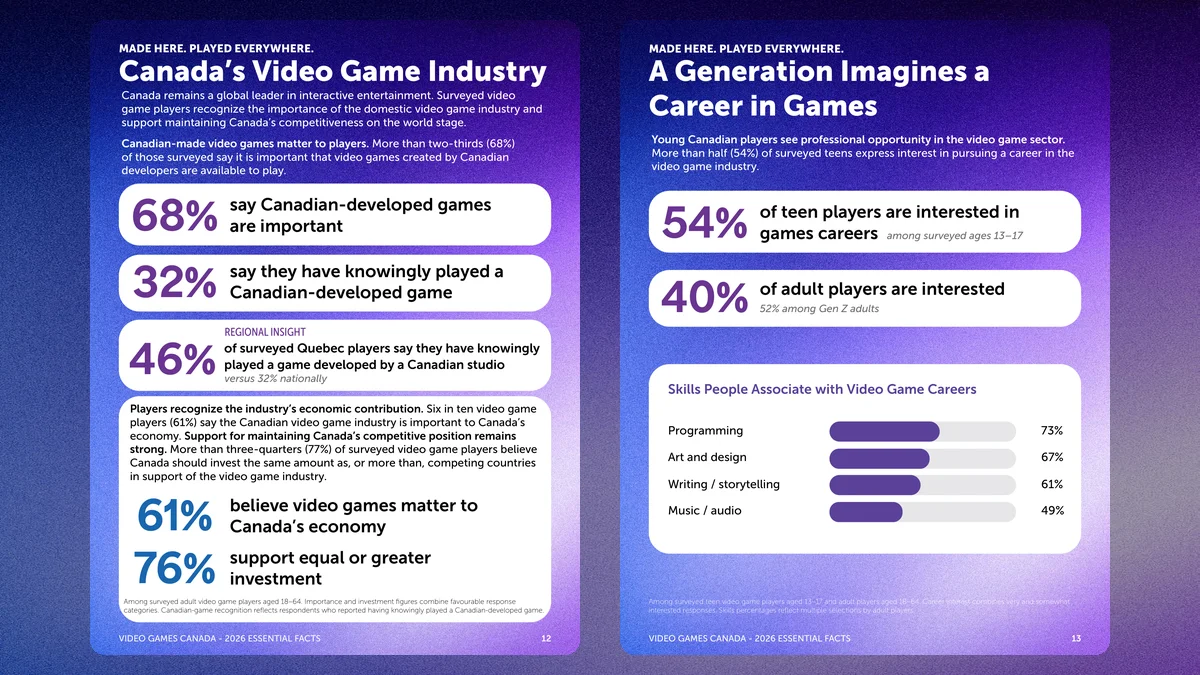
Even as North American studios navigate a turbulent three-year wave of corporate restructurings and layoffs, the next generation of Canadian talent shows no sign of walking away from interactive entertainment. Released on November 9, 2026 by Video Games Canada (the newly rebranded identity of the Entertainment Software Association of Canada, formerly ESAC), the annual 2026 Essential Facts report reveals that 54% of Canadian teen players aged 13 to 17 want to pursue a career in the video game industry.
Conducted by Burson via the Leger Opinion online panel between October 1 and October 16, 2026 among 2,150 Canadian video game players (1,650 adults aged 18 to 64, 250 teens aged 13 to 17, and 250 children aged 6 to 12), the nationwide study portrays a country where gaming is viewed both as an essential mental wellness outlet and a strategic economic pillar.
54% of Teens and 52% of Gen Z Adults Eye a Career in Game Development
The headline takeaway from the 2026 Essential Facts PDF report is the sheer resilience of the sector's appeal among younger demographics. Beyond the 54% of teen players (ages 13 to 17) who want to work in video games, career ambition remains remarkably high among young adults: 52% of Gen Z respondents and 44% of Millennials (representing 40% of all surveyed adult players aged 18 to 64) expressed interest in joining the industry.
Rather than viewing game development strictly through the lens of software engineering, respondents associate video game careers with four distinct creative and technical disciplines: programming (73%), art and design (67%), writing and storytelling (61%), and music and audio production (49%).
BioWare's Shadow, a $5.1 Billion GDP Engine, and the Push for a National Strategy
This generational enthusiasm stands in stark contrast to the recent corporate headwinds hitting several flagship Canadian studios. Over the past few weeks, Electronic Arts' decision to shutter its legendary Edmonton RPG studio,chronicled up to its final days in the upcoming Massive Effect documentary on BioWare's closure,sent shockwaves across the domestic development community.
With more than 800 studios across the country contributing $5.1 billion CAD to the national GDP through globally recognized franchises built in Canada such as Mass Effect, Assassin's Creed, EA Sports FC, Warframe, and Dead by Daylight, Canadian players are demanding stronger public backing. According to Video Games Canada's official release, 77% of surveyed players believe Canada should invest the same amount as, or more than, competing countries to keep domestic studios globally competitive.
Addressing BioWare's shutdown and the debates sparked by House of Commons petition e-7898 in Ottawa, Video Games Canada President and CEO Paul Fogolin acknowledged the post-pandemic macroeconomic squeeze while emphasizing that Canada's core pool of veteran talent remains intact:
"Anytime there is a studio closure in the industry or any job loss, it is incredibly difficult,that is their livelihood, and there are families behind it. It was hard to see a studio with such a rich history close, but the talent that grew up in Edmonton at BioWare remains right here in Canada. With capital tighter than ever and production budgets higher than ever, we need a coordinated national strategy that aligns capital availability, talent mobility, and provincial incentives."
Paul Fogolin, President and CEO of Video Games Canada (November 9, 2026)
Fogolin also pointed to a landmark policy signal in Ottawa's 2026 Federal Budget unveiled last week: alongside a historic $213.4 million federal injection into the Canada Media Fund, the Canadian government officially listed video games among the country's 10 to 15 "industries of the future",placing interactive entertainment at the same strategic growth table as artificial intelligence, robotics, automotive manufacturing, and cybersecurity.
Quebec Leads Domestic Studio Recognition (46%) as 91% Play for Mental Wellness
For the first time, the 2026 edition measured how strongly players connect with homegrown creations. While 68% of respondents say it is important that Canadian-developed games are available to play and 61% recognize the sector's importance to the national economy, Quebec leads the country in cultural awareness: 46% of surveyed Quebec players report having knowingly played a game created by a Canadian studio, compared to 32% nationally.
Finally, the survey underscores how deeply video games serve as a daily mental health buffer against stress and cost-of-living pressures. With 48% of Canadian adults playing regularly (at an average age of 39, and weekly participation reaching 93% among children and teens and 88% among adult gamers), 91% of adults and 90% of teens say they play to relax, manage stress, or lift their mood.
| Key Indicator (2026 Essential Facts Report) | National Result | Generational & Regional Breakdown |
|---|---|---|
| Interest in a Video Game Career | 54% of teens (ages 13-17) | 52% of Gen Z adults, 44% of Millennials (40% of all adult players) |
| Skills Associated with Game Jobs | 73% Programming | 67% Art & design, 61% Writing & storytelling, 49% Music & audio |
| Support for Public Investment | 77% back equal or greater funding | 68% value Canadian-made games; 61% cite economic impact ($5.1B GDP) |
| Awareness of Canadian-Made Games | 32% national average | Quebec leads at 46% of players knowingly playing domestic titles |
| Most Popular Gaming Platforms | 60% Mobile & 60% Console (tied) | Consoles lead among ages 6-17 (67%) and Millennials (71%); PC at 44% |
| Mental Wellness & Family Routine | 91% play to relax & unwind | 78% of adults cite positive mental health impact; 80% of parents play with their kids |
My Field Notes
Walking through the studio district here in Quebec City's Saint-Roch neighborhood or talking with friends in Montreal's Mile End, the contrast is impossible to miss. On one side, publicly traded publishers in California or Tokyo slash headcount on spreadsheets whenever a quarterly target slips; on the other, game development programs at UQAT, NAD, and Laval University are packed with teenagers who eat, sleep, and breathe level design and C++.
Seeing 46% of Quebec players proudly recognize local studio creations and 54% of Canadian teens aim for a career in games proves that creative drive never belonged to corporate boardrooms. Still, if Ottawa wants this next generation to turn that ambition into resilient, independent studios after the trauma of BioWare's closure, naming video games an "industry of the future" in Budget 2026 must quickly translate into direct seed funding for homegrown teams.
The 2026 report arrives just days ahead of a symbolic grassroots milestone in la Belle Province: the inaugural "Buy a Québec Video Game Day" officially kicks off this Saturday, November 14, to spotlight locally developed titles across digital storefronts.

Originally from Lyon, France, gaming journalist Bastien "Orion" relocated nearly a decade ago to Quebec City's Saint-Roch district, right in the heart of eastern Canada's development studio hub. Before crossing the Atlantic, he honed his versatile reporting style across classic French gaming web portals and specialist television outlets in the 2000s and 2010s, notably with JeuxVideo.fr and JeuxNews. Equally passionate about AAA blockbusters, North American studio culture, retro preservation, and community modding projects, he anchors Pro-Gamer's transatlantic desk and real-time coverage of US and Japanese industry announcements.