US Patent 2026/0346147 A1: How Sony's AI Tracks Controller Button Habits to Flag Smurf Accounts in Ranked Play
For years, console ecosystems have made it effortless for experienced players to spin up fresh profiles at zero cost, dropping back to the bottom of competitive ladders to stomp newcomers. With the publication of patent application US 2026/0346147 A1 by the United States Patent and Trademark Office (USPTO) on November 5, 2026, Sony Interactive Entertainment has detailed a platform-level solution aimed at the upcoming PlayStation 6 era and current PSN infrastructure: an AI-driven identification pipeline that spots secondary "smurf" accounts by fingerprinting how a player presses buttons on their controller.
Turning Controller Button Habits and System Menu Navigation Into a Behavioral Fingerprint
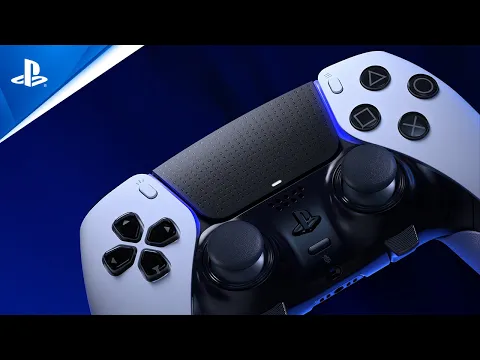
Filed on April 30, 2025 by five Sony Interactive Entertainment inventors,Christopher Fife, Dustin Clingman, Bob Jordan, Adrian Harris, and Chris Thielbar,under the title "Systems and methods for using gameplay characteristics to identify a user," the 20-claim filing requires no new hardware or government ID verification. Much like Sony's recent Generation Super Sampling patent that reads DualSense stick inputs to predict frames, this system relies entirely on raw controller telemetry already transmitted during normal console operation.
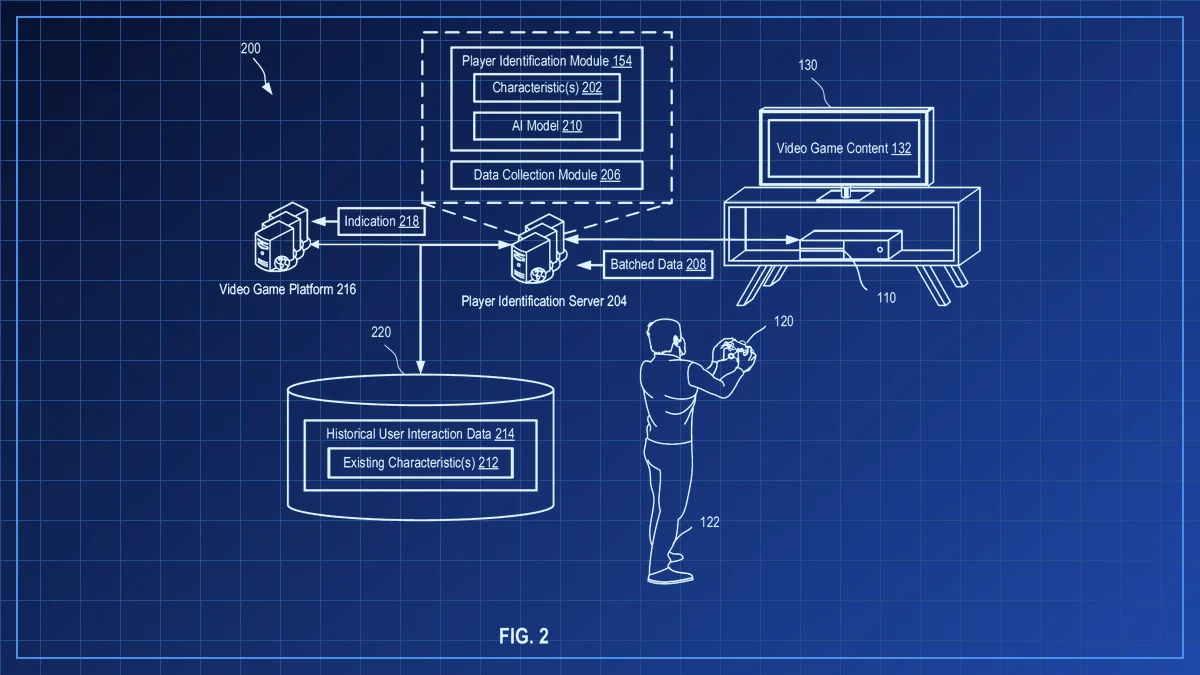
As illustrated in drawing sheet FIG. 2 of the USPTO filing, a Data Collection Module (206) continuously gathers User Interaction Data across days, weeks, or months for each account. Crucially, the neural network (AI Model 210) does not stop at in-match combat inputs: it also tracks how long a user holds specific buttons, the millisecond intervals between taps, the exact path taken from the console home screen into a game or settings menu, how they browse the PlayStation Store, and what time of day they typically log in.
| Patent Component (US 2026/0346147 A1) | Tracked Controller & System Signals | Platform / Developer Action |
|---|---|---|
| Data Collection Module (206) | Button hold durations, tap intervals, home screen and store navigation routes, typical login hours | Builds a behavioral profile specific to each player account (Characteristic(s) 202) |
| Pattern Recognition Module (310) | Cross-references input sequences against stored profiles (Historical User Interaction Data 214) | Computes a genre-aware similarity score across shooters, fighting games, and team arenas |
| Indication & Fraud Alert (218 / 508) | Similarity score between a primary account and a secondary account crosses a set threshold | Routes an alert to game developers or platform fraud teams to restrict ranked play or ban alternate accounts |
| Prediction Engine & Matchmaking (312 / 402) | Estimates true mechanical skill within 10 matches or fewer and filters out intentionally thrown games | Overrides skewed win-loss MMR and assigns a Recommended Skill Tier (412) for balanced lobbies |
10-Match Skill Calibration, Anti-Throwing Filters, and Developer Restriction Alerts
While publishers have increasingly turned to massive ban waves to protect competitive ladders,such as Riot Games penalizing nearly 300,000 accounts for rank manipulation and smurfing,Sony's architecture shifts detection directly to the console platform layer. When the similarity score between two PSN accounts crosses a defined threshold (step 506 in FIG. 5), the identification server dispatches an Indication (218) to either a platform fraud unit or the third-party developer, empowering studios to lock secondary accounts out of ranked playlists or issue account bans.
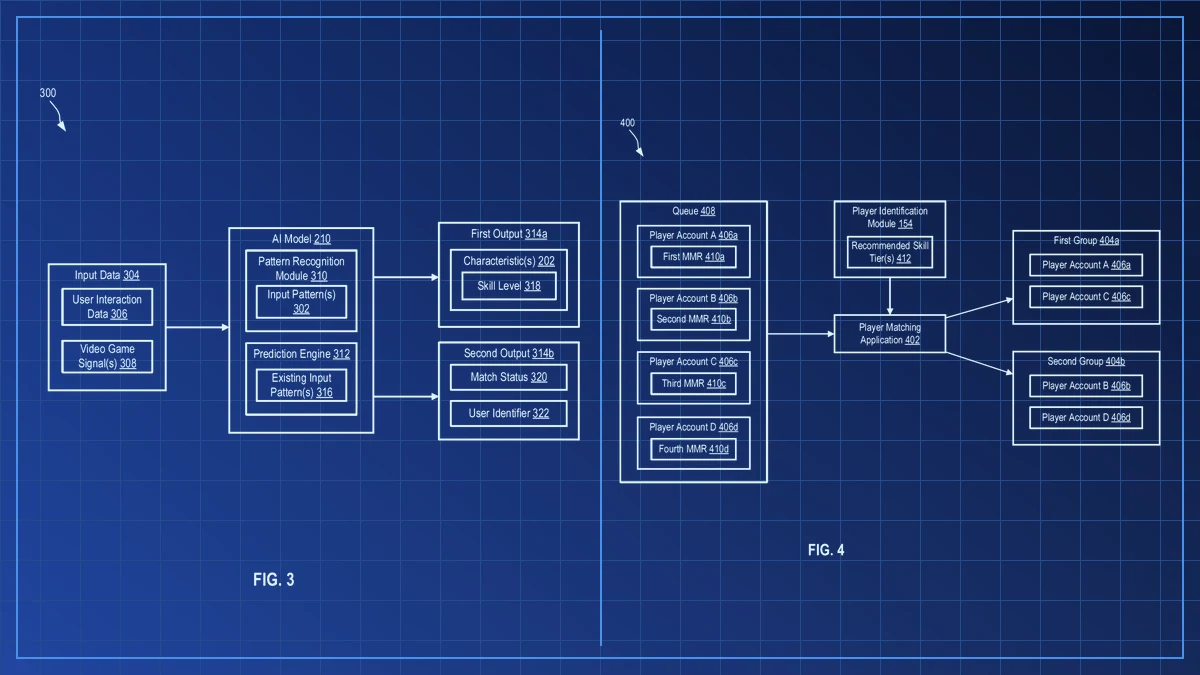
Because automated bans carry the risk of false positives in households where siblings or roommates share a console, drawing sheets FIG. 3 and FIG. 4 outline a non-punitive alternative: rapid skill-tier recalibration. By comparing a newcomer's controller input patterns against historical telemetry from known high-rank players, Sony's Prediction Engine (312) can determine a player's true mechanical skill in 10 matches or fewer. Furthermore, the patent explicitly notes that the AI can detect and discard anomalous telemetry from matches thrown on purpose to artificially tank an account's win-loss rating, passing a corrected Recommended Skill Tier (412) directly to the game's matchmaking server.
My Perspective
Console game sharing has always been a double-edged sword: letting every profile on a home console access online multiplayer under a single PlayStation Plus subscription is great for families, but it also made creating disposable smurf accounts completely frictionless. What makes this Sony patent genuinely compelling isn't the nuclear option of outright banning secondary accounts,which would inevitably trigger headaches for siblings sharing a living room,but the 10-match mechanical skill detector. Quietly moving a veteran smurf out of rookie lobbies within their first ten games, while ignoring intentionally thrown matches, solves the core competitive problem without punishing legitimate household sharing.

PC hardware enthusiast and competitive gamer, Arthur 'Heimdall' splits his time between France and the UK working in enterprise B2B software solutions. A business school graduate passionate about component benchmarking, he has been building, modding, and tuning PCs since childhood, optimizing every thermal degree and millisecond of display latency. An avid gamer across Assassin's Creed and sandbox titles, he forged his alliance with Grimtag and Chaya during late-night World of Warcraft raids before joining Pro-Gamer.