1,024 Cores on 2nm After 8 Years of Zero Silicon: Tachyum Files for Bankruptcy as Prodigy CPU Faces Uncertain Future
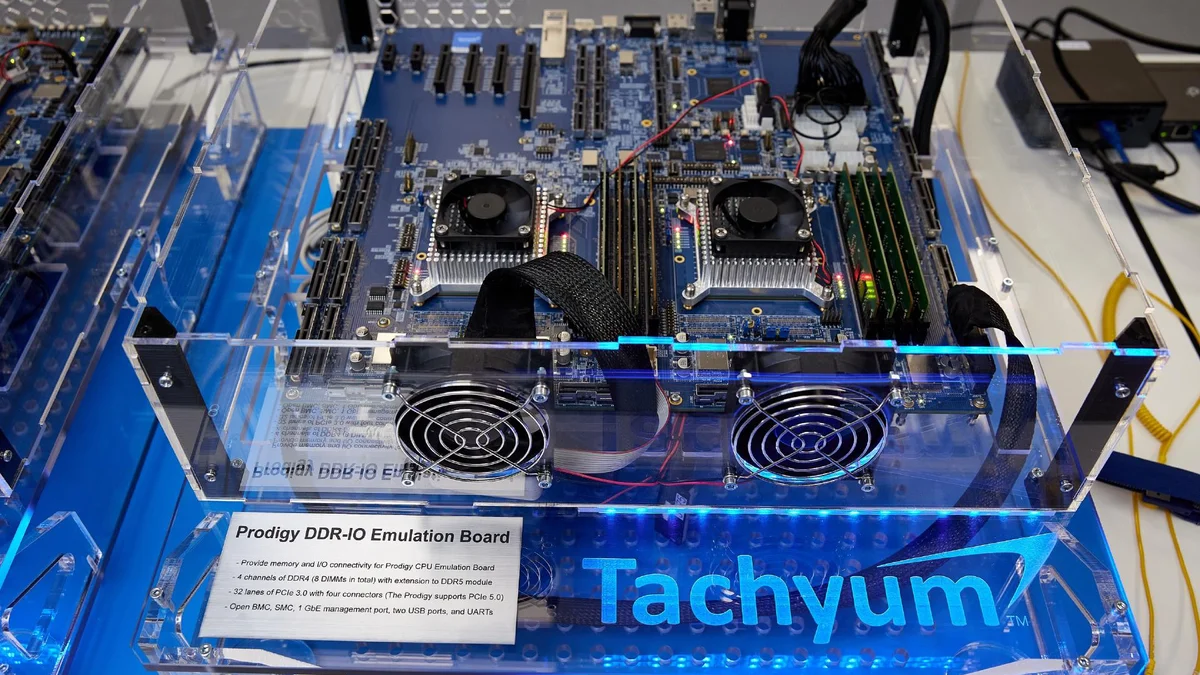
One of the longest-running silicon vaporware sagas of the past decade has reached a courtroom reckoning. According to filings at the Bratislava III Municipal Court (Mestský súd Bratislava III) reported by Forbes Slovakia and spotted by hardware analyst @System360Cheese, Tachyum s.r.o. voluntarily filed for bankruptcy on October 22, 2026. After eight years of bold claims that its universal Prodigy processor would simultaneously outperform Intel and AMD server CPUs alongside NVIDIA AI accelerators, the Slovak subsidiary has declared insolvency without ever delivering a single commercial silicon chip.
Voluntary Bankruptcy in Bratislava After Mounting Debts and a €15 Million State Loan
Rather than waiting for creditors to force a liquidation, Tachyum's Slovak operating entity submitted its own bankruptcy petition directly to the municipal court in Bratislava. Judges opened formal bankruptcy proceedings after confirming that the filing met statutory criteria. Under Slovak insolvency law, a company that voluntarily petitions for bankruptcy is legally presumed insolvent, meaning a court-appointed trustee will now step in to inventory the company's remaining assets and liquidate them to pay back creditors.
Financial trouble had been visibly escalating around the company founded by CEO Radoslav Danilák. Although Tachyum is structured under a U.S. parent corporation, the overwhelming majority of its engineering workforce and research activities were based in Bratislava. Early in 2026, Tachyum was evicted from its Bratislava R&D offices over unpaid rent, while accumulating substantial arrears with the state health insurance provider (VšZP), the social security agency (Sociálna poisťovňa), Slovak tax authorities, and its own employees. The collapse also leaves a major question mark over a €15 million public loan granted by the Slovak government in 2020 to help build national supercomputing hardware that never materialized.
From 64 Cores on 7nm to 1,024 Cores on 2nm: Eight Years of Moving Goalposts
When Tachyum first unveiled the Prodigy architecture across 2017 and 2018, Radoslav Danilák pitched a revolutionary "Universal Processor" combining general-purpose CPU cores, HPC vector engines, and AI/TPU matrix acceleration on a single monolithic die capable of running x86, ARM, and RISC-V binaries natively or through dynamic translation. Originally slated for a 7nm node with up to 64 cores and commercial availability in 2020, Prodigy missed every single tape-out window for eight consecutive years.
Each delay was accompanied by an even more extravagant specification bump on paper. The roadmap shifted from 64 cores on 7nm to 128 cores on TSMC's 5nm process, then to 192 cores with 16 DDR5 memory channels, and finally to a radical late-2025 chiplet redesign claiming up to 1,024 cores, 24 DDR5 memory channels, and a staggering 1,600W TDP on TSMC's 2nm node. That pivot effectively pushed commercial silicon toward 2030, even as TSMC's 2nm mass production lines and upcoming 1nm A10 mega-fab in Tainan are booked years in advance by cash-rich industry giants. Throughout its lifecycle, Tachyum only ever demonstrated FPGA emulation boards and touted questionable commercial milestones, including a supposed $500 million purchase order from an unnamed U.S. customer that never resulted in shipped hardware.
| Announcement Era | Process Node | Promised Specs | Target Launch | Hardware Reality |
|---|---|---|---|---|
| 2017 - 2018 | 7nm | Up to 64 universal cores | 2019 Tape-out / 2020 Launch | Software simulations only |
| 2020 - 2022 | 5nm (TSMC) | 128 cores at 5.7 GHz, VLIW dropped | Delayed from 2021 to 2023 | FPGA emulation boards only |
| 2023 - 2024 | 5nm then 3nm | 192 cores, 16-channel DDR5 | Pushed to 2024 then 2025 | Zero physical silicon, paper orders |
| Late 2025 | 2nm (Chiplets) | 1,024 cores, 24-channel DDR5, 1,600W | 2030+ theoretical horizon | Complete architectural redesign |
| October 22, 2026 | N/A | Prodigy IP ownership in limbo | Indefinitely halted | Voluntary bankruptcy in Bratislava |
What Happens to the Prodigy IP Between Slovakia and the U.S. Parent Company?
The biggest unresolved question surrounds who actually holds the intellectual property and patents behind Prodigy. As noted by Slovak publication Denník N, Tachyum s.r.o. in Bratislava operates as a subsidiary of U.S.-registered Tachyum Inc. (incorporated in Delaware with offices in Las Vegas). Depending on how the patents were assigned, the bankruptcy could play out in two very different ways.
If the U.S. parent corporation owns the core Prodigy IP while the Slovak subsidiary carried the engineering payroll and operational debt, liquidating the Bratislava entity could theoretically allow the group to shed its European liabilities while retaining or repurchasing the patents through another legal vehicle. However, Denník N reports that the American parent company is also facing intense legal pressure from its own creditors, several of whom have already petitioned for its liquidation in the United States. While proven chipmakers execute methodical multi-year transitions such as AMD's upcoming 1.4nm Ryzen Zen 7 "Grimlock" APUs and RDNA 5+ graphics architecture, Tachyum's dream of an all-in-one miracle chip has collided headfirst with financial reality.
Check Availability on Amazon (AMD Ryzen 7 9800X3D)→
My Take on the Spec Sheet
Let's be blunt: in all my years covering semiconductor architectures, I have rarely seen a spec sheet defy the laws of silicon economics for this long without producing a single working chip. Claiming back in 2018 that a lightly funded startup would build a single monolithic die faster than an Intel Xeon in general compute, faster than an NVIDIA GPU in AI training, and capable of running x86, ARM, and RISC-V binaries with zero performance penalty was architectural fantasy from day one. We have not yet had a physical unit on our desk—if the manufacturer's team would like to send over a review sample so we can put it through our full real-world testing protocol, our lab doors are wide open.
Every time a tape-out deadline approached, Tachyum simply moved to a smaller TSMC node on PowerPoint and doubled the core count to justify another two-year delay. When the company pivoted in late 2025 to a 1,024-core, 1,600W 2nm chiplet monster, the writing was on the wall: taping out a leading-edge 2nm design at TSMC requires hundreds of millions of dollars in mask sets, EDA licenses, and wafer commitments. A company that could not even pay the rent on its Bratislava engineering offices was never going to fund a 2nm tape-out. Slideware teraflops are free, but real silicon always sends the bill.

PC hardware enthusiast and competitive gamer, Arthur 'Heimdall' splits his time between France and the UK working in enterprise B2B software solutions. A business school graduate passionate about component benchmarking, he has been building, modding, and tuning PCs since childhood, optimizing every thermal degree and millisecond of display latency. An avid gamer across Assassin's Creed and sandbox titles, he forged his alliance with Grimtag and Chaya during late-night World of Warcraft raids before joining Pro-Gamer.