Over 100 Million Games Sold Annually: How Third-Party Publishers Now Drive Half of Nintendo Switch 2 and Switch Software Sales
Long viewed primarily as hardware built to showcase Mario, Link, or Pikachu, Kyoto's hybrid consoles now rest on a second pillar of equal scale. During Nintendo's Corporate Management Policy Briefing presented on Friday, November 6, 2026 alongside its first-half financial results for the fiscal year ending March 2027, Nintendo Co., Ltd. President Shuntaro Furukawa unveiled a ten-year breakdown of software sales across Nintendo Switch and Nintendo Switch 2: games from third-party software publishers consistently surpass 100 million units sold per year.
Third-Party Studios Drive Over Half of Annual Software Unit Volume
Backed by the official Software Unit Sales Trends chart spanning ten fiscal years (from FY17 through FY26), Shuntaro Furukawa delivered a clear assessment: "Titles from software publishers account for a significant share of software unit sales, making a substantial contribution to our business." While the first two years of the original Switch lifecycle (FY17 and FY18) were heavily weighted toward Nintendo's internal tentpoles, third-party publisher volume crossed the milestone of 100 million annual units in FY21 and has stayed at or near that benchmark ever since.
In FY26 (ended March 31, 2026), propelled by the arrival of the Nintendo Switch 2 and combined annual software sales of 185.62 million units (48.71 million on Switch 2 and 136.91 million on the original Switch), third-party releases once again exceeded 100 million units sold, representing more than half of total unit volume. That momentum carried directly into the first six months of FY27 (April through September 2026), with 90.22 million total games sold across both systems alongside the hits detailed in the Nintendo Switch 2 and Switch Million-Sellers rankings.
Even more telling, Kyoto's leadership notes that this unit chart only tracks titles sold in both physical retail boxes and digital editions. Download-only titles on the Nintendo eShop are excluded from the graph, a segment where Furukawa emphasizes that third-party publishers and indie studios hold a massive footprint. Across the first half of the current fiscal year, Nintendo's overall digital revenue surged 60.5% year-on-year to reach 249.6 billion yen, accounting for 60.7% of total platform software sales.
From Late Ports to Simultaneous Day-One Releases on Switch 2
To explain this structural shift between the original Switch launch in 2017 and today's ecosystem of nearly 130 million annual playing users, Nintendo's president points to two decisive factors: the leap in hardware performance delivered by the Nintendo Switch 2 and years of strengthened developer relations.
"Many third-party titles have been released since the launch of Nintendo Switch 2, and this year, we have increasingly seen multiplatform releases with more demanding hardware requirements being released on Nintendo Switch 2 at the same time as other platforms," Furukawa noted in the briefing. Where the first-generation hybrid frequently suffered from delayed ports or skipped releases altogether, the new hardware architecture allows global publishers to align day-one launch windows while propelling the console to the top of the 2026 Metacritic platform rankings thanks to third-party studios.
Capcom, FromSoftware, Square Enix, and Activision Featured in Nintendo's Showcase
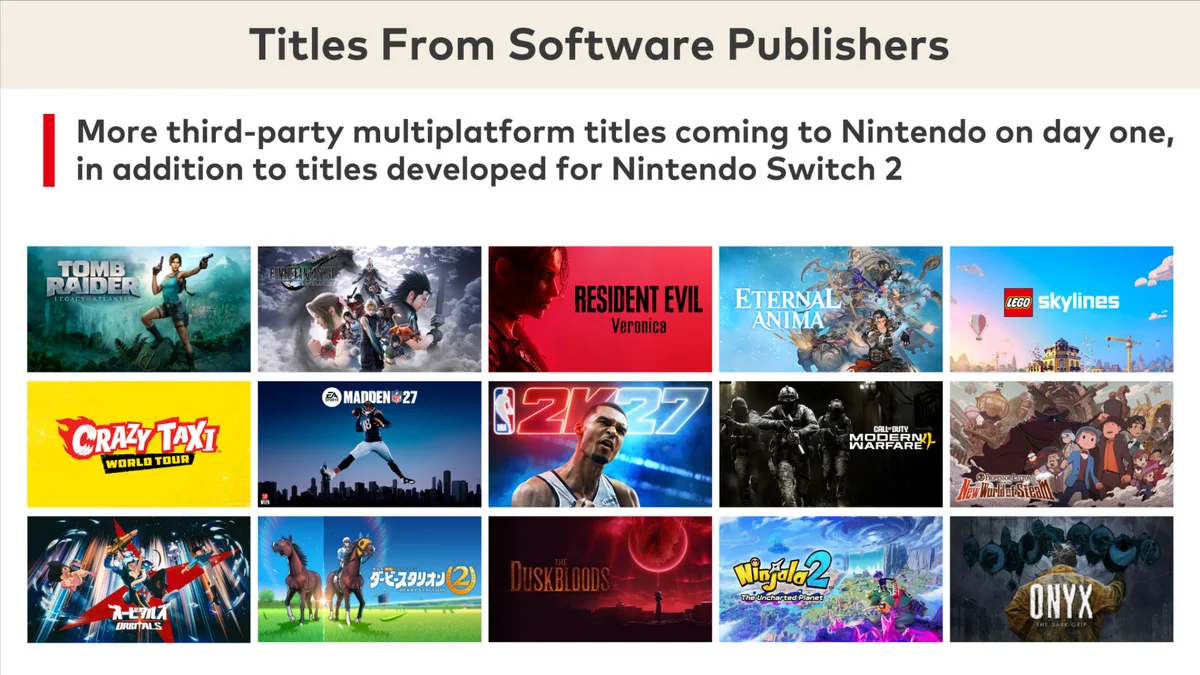
Across pages 31 and 32 of its investor presentation, Nintendo highlighted thirty partner titles illustrating both the breadth of genres and the technical scale now running on Switch 2:
- Demanding Multiplatform Blockbusters and Day-One Launches: Capcom's Monster Hunter Wilds (alongside Monster Hunter Wilds: Ascendance) and Resident Evil Veronica, Square Enix's Final Fantasy VII Revelation, Tomb Raider: Legacy of Atlantis, Call of Duty: Modern Warfare 4, EA Sports FC 27, Madden NFL 27, and NBA 2K27.
- Major Open-World RPGs Tailored for Hybrid Play: FromSoftware's Elden Ring: Tarnished Edition, CD Projekt Red's The Witcher 3: Wild Hunt Remastered, Dragon's Dogma II: Dark Arisen, and Trails in the Sky 2nd Chapter (Nintendo Switch 2 Edition).
- Titles Built Around Switch 2 Hardware Features: FromSoftware's exclusive The Duskbloods, Level-5's Professor Layton and the New World of Steam, Crazy Taxi: World Tour, Rayman Legends: Retold, Minecraft Dungeons II, Danganronpa 2x2, and Ninjala 2: The Uncharted Planet.
While Nintendo's own first-party releases still represent the majority of recognized software revenue (76.6% of total software net sales in the first half of FY27, since Nintendo books only its eShop distribution commission rather than gross retail revenue on third-party digital sales), external publishers now provide the steady cadence of releases required to keep hardware engagement high year-round.
My Perspective
Looking at this ten-year sales chart shared by Shuntaro Furukawa, I am struck by how completely Nintendo has reversed the third-party drought that haunted the Wii U era. For years, players bought a Nintendo system for its internal exclusives while knowing they needed a second console or PC to play demanding multiplatform blockbusters. Seeing external publishers move over 100 million games annually across six consecutive fiscal years proves that the Switch 2 hardware transition has fundamentally reshaped buyer habits. When heavyweights like Monster Hunter Wilds, Resident Evil Veronica, and The Duskbloods arrive day and date or take direct advantage of the hardware, Kyoto's hybrid stops being a secondary companion device and stands on its own as a primary gaming platform.
Based on the outskirts of New York City, Chaya 'Chayane' spent five years studying software engineering in Montreal before returning to her home state. A Full-Stack developer and Deep Learning AI architecture researcher, she explores neural networks and algorithmic optimization while engineering data pipelines for Retrocharting and Gamescharting alongside Grimtag. A gamer for over 20 years and an avid collector of Nintendo history and The Legend of Zelda, she explored World of Warcraft's Azeroth before bringing her deep technical background to video game analysis.