5,000-Nit In-Lens Screen and EMG Neural Wristband: How the $799 Meta Ray-Ban Display Glasses Work
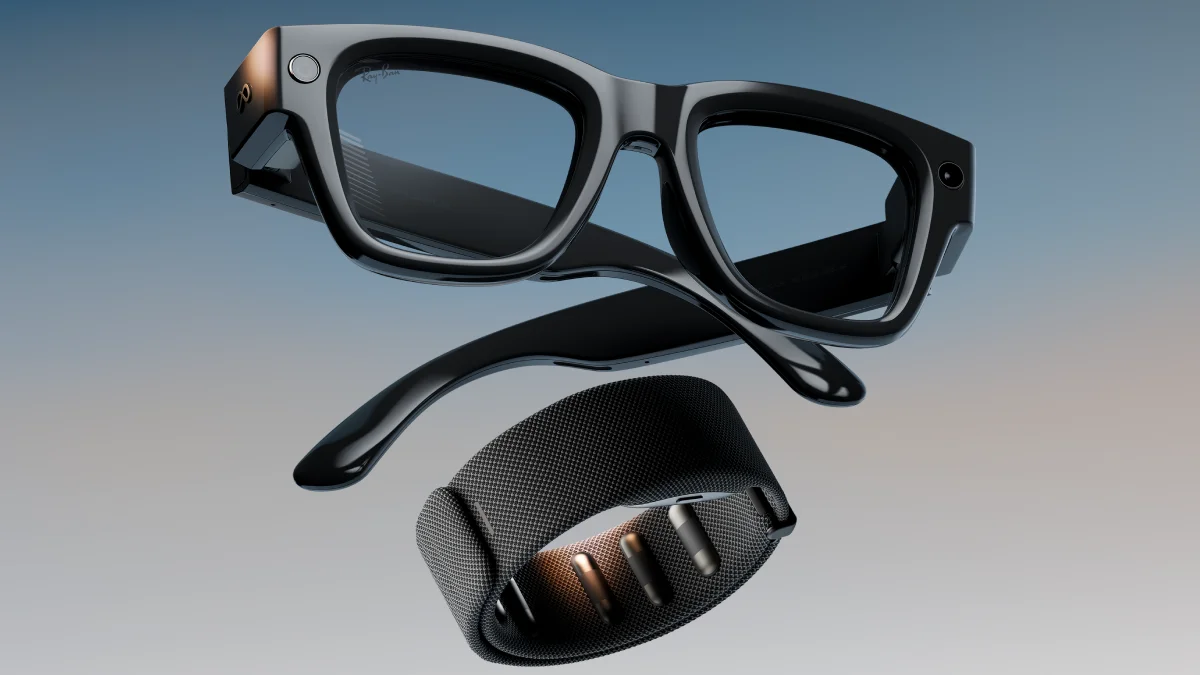
Following their initial stateside rollout and this month's international retail expansion across Canada, the UK, France, Germany, and Italy, the Meta Ray-Ban Display smart glasses represent the biggest hardware leap yet for everyday eyewear. Priced at $799 USD ($1,149 CAD / €899 EUR), the package pairs a high-brightness monocular color screen embedded inside the right lens with the Meta Neural Band wrist controller right out of the box.
This global push comes at a pivotal moment for the company's optical hardware roadmap, arriving just days after Sony transferred 419 XR patents to Meta in a move that reshaped the head-mounted display landscape.
A 5,000-Nit Color Display Hidden Inside the Right Lens
Built in partnership with EssilorLuxottica, the frame retains the familiar Wayfarer silhouette while keeping total weight down to 69 grams. Tucked inside the right lens is a full-color micro-display delivering a 600 x 600 pixel resolution across a 20-degree field of view, capable of reaching up to 5,000 nits of peak brightness.
That luminance ensures turn-by-turn walking directions, incoming messages, and live translation captions stay crisp even under direct midday sunlight, aided by standard light-adapting Transitions lenses (with prescription support ranging from -4.00 to +4.00). Crucially, optical light leakage is kept below 2%, meaning people standing directly across from you cannot see the heads-up interface floating in your vision.
Meta Neural Band: Surface EMG Wrist Control Replaces Voice Commands
While the in-lens HUD grabs headlines, the bundled Meta Neural Band solves the longest-standing usability flaw of smart glasses. Rated IPX7 water-resistant with up to 18 hours of battery life, the soft wrist strap uses surface electromyography (sEMG) sensors to read the subtle electrical nerve signals traveling from your brain to your fingers.
Instead of speaking voice prompts out loud on a quiet train or repeatedly tapping the temple frame, you can keep your arm relaxed at your side or inside a jacket pocket. A subtle thumb-to-index pinch clicks an icon, a light thumb swipe scrolls through notifications, and neural handwriting recognition lets you trace letters with your fingertip against your leg or desk to compose replies silently.
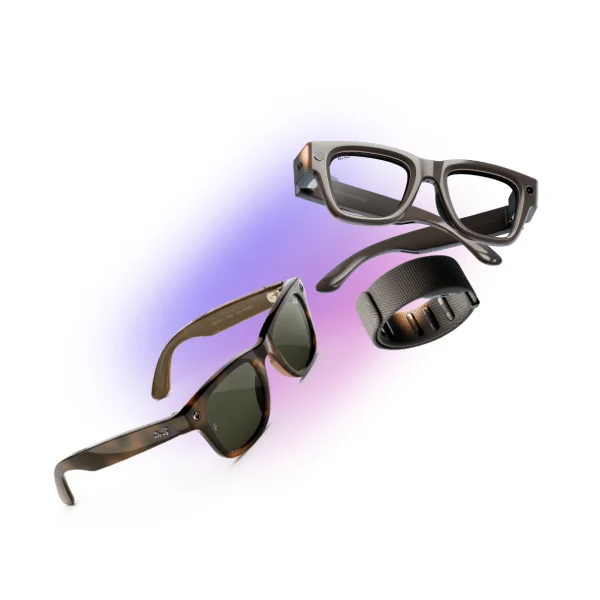
Meta Ray-Ban Display + Meta Neural Band
- 600x600 In-Lens Color Display (Up to 5,000 Nits)
- sEMG Meta Neural Wristband (IPX7, 18-Hour Battery)
- 12MP 3x Zoom Camera & Snapdragon AR1 Gen 1
12MP Live Viewfinder, Built-In Teleprompter, and Core Hardware Specs
For POV video creators and mobile journalists, the right-lens screen eliminates blind framing. The 12MP ultra-wide camera now projects a real-time viewfinder directly into your eye alongside a 3x digital zoom, allowing you to verify composition before snapping 4000 x 3000 photos or recording 1440 x 1920 vertical video at 30 fps.
Recent 2026 firmware updates also introduced a dedicated teleprompter mode capable of holding up to 16,000 characters (roughly 30 minutes of speaking notes), complete with a live timer and silent finger-controlled scrolling via the Neural Band. Under the hood, the glasses run on the Qualcomm Snapdragon AR1 Gen 1 processor paired with 32GB of internal storage:
- In-Lens Display: Monocular full-color right-eye micro-display (600 x 600 px, ~20° FOV, 30 to 5,000 nits, up to 90 Hz refresh rate, under 2% external light leakage).
- Wrist Controller: Meta Neural Band with sEMG neuromuscular sensors (18-hour battery life, IPX7 water resistance).
- Camera & Optics: 12MP sensor with live in-lens viewfinder and 3x zoom, standard Transitions lenses (-4.00 to +4.00 prescription range).
- Audio & Wireless: 6-microphone spatial array, open-ear temple speakers, Wi-Fi 6, and Bluetooth 5.3.
- Battery & Build: Up to 6 hours of continuous mixed use (69g frame, IPX4 splash resistance) plus up to 24 to 30 additional hours via the foldable charging case.
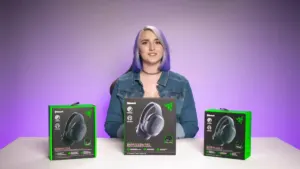
While the open-ear speakers built into the temples handle voice calls and multimodal Meta AI responses cleanly outdoors, competitive players seeking full acoustic isolation on the go will still want a dedicated over-ear solution like the Razer Barracuda V2 Pro wireless headset with active noise cancellation.
Similarly, if you only care about hands-free POV capture and audio without needing an in-lens HUD, the screen-free Ray-Ban Meta lineup (starting at $349 for the Audio edition and $449 for Gen 3) delivers the core camera and AI experience at roughly half the cost.
Check Ray-Ban Meta Availability on Amazon→
My hardware take: the EMG wristband finally saves smart glasses from looking awkward in public
What always held smart glasses back for me was never the camera resolution, but the social friction of using them around other people. Talking to a voice assistant in a crowded coffee shop or constantly tapping your temple frame immediately makes you look like a walking tech demo.
Pairing a zero-leakage 5,000-nit lens display with the Meta Neural Band changes that dynamic completely. Being able to scroll through a 30-minute teleprompter script or frame a 3x zoom shot with a barely perceptible finger pinch inside your pocket makes the hardware feel genuinely effortless.
At $799 (and €899 in Europe), having to charge both a 6-hour pair of glasses and an EMG wristband every night keeps this firmly in early-adopter territory. Still, as a first-generation blueprint for non-invasive neural input, the combination of sEMG wrist sensing and invisible heads-up optics sets the benchmark every rival wearable will be chasing through 2027.

PC hardware enthusiast and competitive gamer, Arthur 'Heimdall' splits his time between France and the UK working in enterprise B2B software solutions. A business school graduate passionate about component benchmarking, he has been building, modding, and tuning PCs since childhood, optimizing every thermal degree and millisecond of display latency. An avid gamer across Assassin's Creed and sandbox titles, he forged his alliance with Grimtag and Chaya during late-night World of Warcraft raids before joining Pro-Gamer.