71 Per Gamer and 80% Solo Play: Japan and South Korea Race to a 2 Billion Market
Japan and South Korea, respectively the world's third and fourth largest video game markets, are gearing up for a significant economic expansion. Following a brief contraction in 2025, the two East Asian powerhouses are on track to generate a combined $32 billion in gaming revenue by 2030.
According to the annual "East Asia Player Behavior & Market Insights" report published by industry intelligence firm Niko Partners, this rebound is fueled by landmark hardware releases, historic player spending, and stark cultural contrasts.
An Immediate Rebound in 2026 Following the 2025 Dip
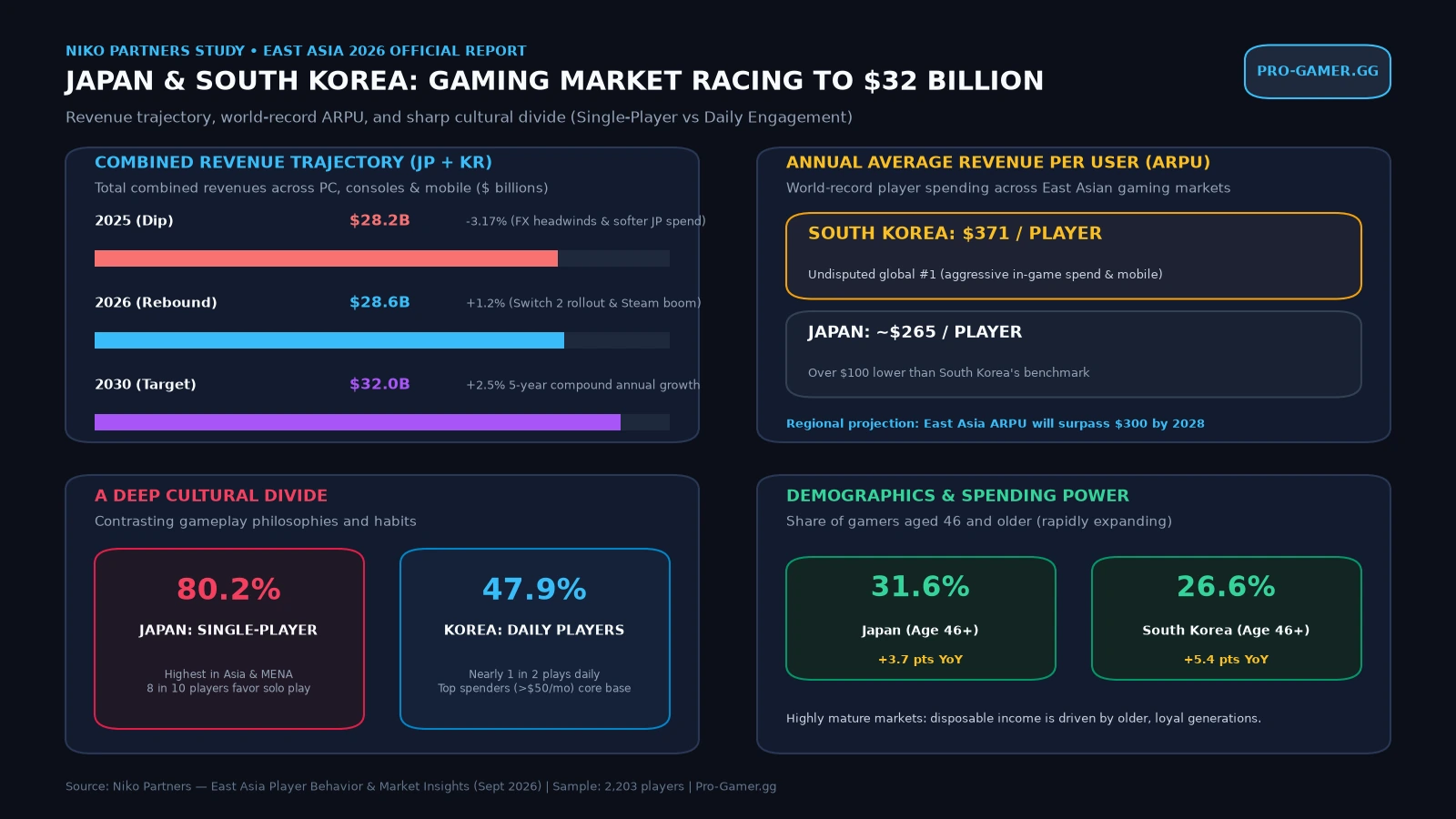
In 2025, combined gaming revenue across both nations reached $28.2 billion, representing a 3.17% year-over-year decline. The dip stemmed primarily from unfavorable foreign exchange rates alongside softer consumer spending in Japan.
The tide turns in 2026 with a projected 1.2% rebound to $28.6 billion. Over the next five years, Niko Partners forecasts a compound annual growth rate of 2.5%, driving the combined ecosystem to $32 billion by 2030.
Switch 2, Steam, and Home Consoles Drive Growth
In Japan, the recovery is spearheaded by the arrival of Nintendo Switch 2. Concurrently, PC gaming spending on Steam continues its historic surge, converting an audience that historically favored portable and mobile titles.
In South Korea, home consoles like the PlayStation 5 and Xbox Series are gaining unprecedented traction within a market historically dominated by PC bangs and mobile devices.
This monetization power aligns closely with the industry trends explored in our breakdown of the structural shift of free-to-play ecosystems on PC, where Asian revenue models continue setting the global benchmark.
World-Record ARPU: $371 Per Gamer in South Korea
East Asia remains the most lucrative gaming region globally in per-player spend. Average revenue per user across the region is projected to surpass $300 by 2028.
South Korea dominates global benchmarks with a staggering 2025 ARPU of $371 per player, outspending Japanese gamers by more than $100 (where ARPU hovers around $265).
This spending culture translates directly into engagement. Nearly half of all South Korean gamers (47.9%) play daily, with heavy spenders investing $50 or more each month forming the backbone of this daily audience.
80.2% Solo Play in Japan and an Aging Gamer Base
Japan presents a fundamentally different player profile. A massive 80.2% of Japanese gamers favor single-player experiences, marking the highest preference for solo gameplay across all Asian and Middle Eastern markets tracked by Niko Partners.
Demographics are also shifting rapidly toward older generations. Players aged 46 and older now represent 31.6% of the Japanese gamer population (+3.7 percentage points YoY) and 26.6% in South Korea (+5.4 points).
Distribution channels are evolving in tandem. In Japan, 51.1% of gamers purchase hardware on Amazon and 33.3% on Rakuten. In South Korea, 20.9% of mobile gamers now utilize third-party app stores outside Apple and Google platforms.
These findings showcase two mature gaming powerhouses where high disposable income among adult players guarantees resilient, long-term industry growth.

SEO consultant for over 20 years and digital entrepreneur, Charles 'Grimtag' Ronchain is the founder of Pro-Gamer.gg, Retrocharting.com, and Gamescharting.com. A competitive gamer, streamer, and retro game collector, he has worked in the video game industry for over 15 years, notably as a consultant for leading game price comparison platforms. Passionate about real-time performance data and gaming technology, he analyzes competitive esports, gaming hardware benchmarks, and creator workflows on Pro-Gamer.gg with an authentic player perspective.