Four LPDDR5X Pads on a Massive Package: First Intel Razor Lake-AX Sample Leaks Online
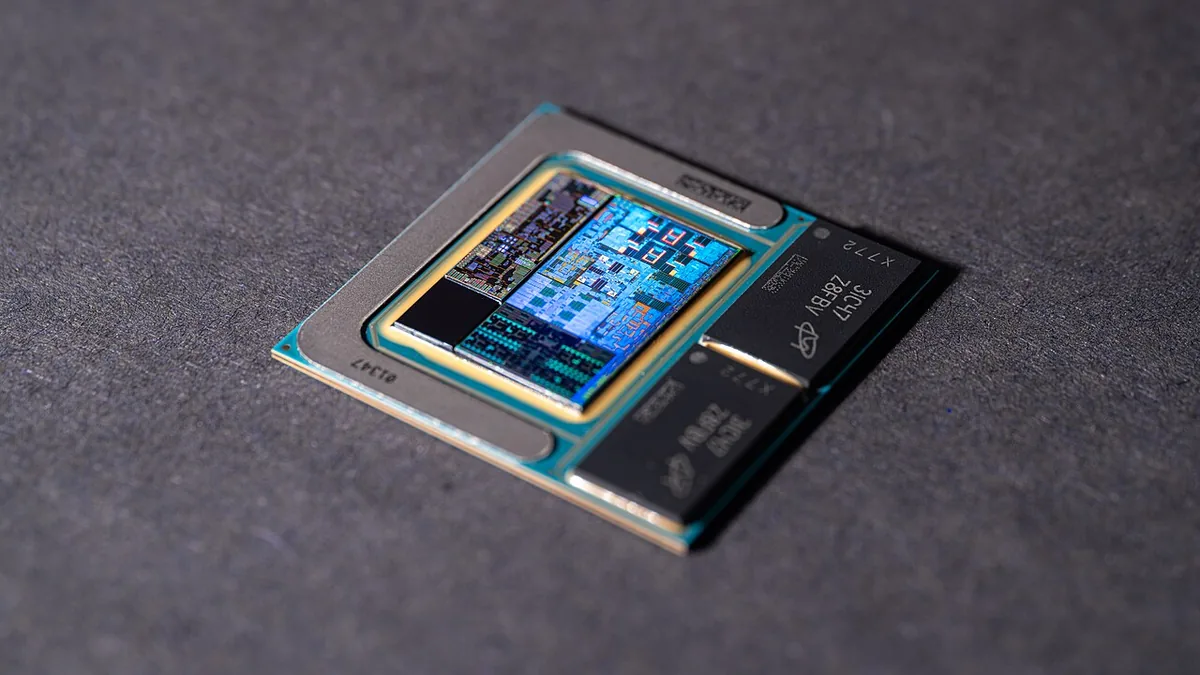
Intel has yet to ship its 2027 Nova Lake lineup, yet early hardware tied to the follow-up generation has already surfaced on China's secondary market. On November 26, 2026, photos of a pre-production package labeled for Intel's upcoming Razor Lake-AX platform (codenamed RZL-AX) appeared on the Chinese marketplace Xianyu before being amplified on X by hardware leaker HXL (@9550pro).
Beyond the sheer size of the package, the leak reveals a notable shift in Intel's long-term mobile and enthusiast roadmap. Razor Lake-AX looks set to bring back on-package memory for 2028, only on a much broader and more flexible scale than Lunar Lake.
A Massive Package Built Around a Dummy Validation Die
The first thing that stands out in the leaked photos is the footprint of the green-blue substrate, which dwarfs conventional laptop processors and Core Ultra 200V chips alike. Hardware observers analyzing the images estimate a package size of roughly 37.5 x 56.5 mm paired with a dense pin grid pointing to a BGA-4326 layout, a contact count typically associated with workstation or server-class silicon.
Inside the metallic stiffener sits a single, heavily scratched rectangular slab of silicon measuring roughly 14 x 45 mm. That length alone rules out a working monolithic processor, since 45 mm exceeds the standard optical lithography reticle limit of around 33 mm.
Everything points to a non-functional thermal or mechanical test sample using a dummy die. Chipmakers distribute these early test vehicles to OEM partners so they can validate cooling assemblies, socket clearances, and motherboard routing well ahead of functional multi-tile silicon. Even without live cores underneath, the sighting suggests early board-level work is already underway.
Four LPDDR5X Pad Arrays Signal a Flexible Return to On-Package Memory
The most telling detail sits right along one edge of the substrate. Four distinct rectangular pad arrays run side by side, showing faint solder residue where memory chips appear to have been mounted or removed, alongside strips of BGA memory packages taped down next to the sample.
After Lunar Lake shipped with two factory-soldered LPDDR5X packages on a 128-bit bus, Intel indicated it did not plan to repeat that fixed arrangement across mainstream lines due to supply-chain rigidity. According to Taiwanese supply-chain reports tied to the leak, Razor Lake-AX takes a more pragmatic route by letting OEM partners populate four LPDDR5X packages themselves on the substrate.
Giving partners control over memory population would unlock multiple unified memory capacities rather than locking laptops and mini-PCs into fixed SKUs. Just as importantly, four memory packages point toward a wider 256-bit memory bus, the kind of bandwidth required to keep a large integrated GPU and local AI workloads properly fed.
700 TOPS Confirmed by Intel, With Halo-Class Rivals in Sight
While the sample's internal silicon remains under wraps, Razor Lake-AX itself is already on the record. In October 2026, during the Semiconductors Powering Humanoids seminar in Seoul, Intel executive Cho Min-sung confirmed the platform for 2028 with a target of roughly 700 TOPS of AI compute, nearly 3.88 times Panther Lake's 180 TOPS rating. During that presentation, Intel highlighted physical AI and advanced robotics as key targets.
On the enthusiast PC side, industry leaks frame Razor Lake-AX as Intel's answer to AMD's Halo-class APUs (Strix Halo and its Medusa Halo successor) as well as Apple's higher-tier Silicon chips for compact workstations, mini-PCs, and high-end laptops. Before any of that arrives, Intel still has to roll out its 2027 wave, led on desktop by the Intel Core Ultra 4000 Nova Lake-S processors.
Unconfirmed architectural rumors suggest Razor Lake-AX could pair Nova Lake-era CPU cores (Coyote Cove P-cores and Arctic Wolf E-cores) with a massive integrated graphics engine scaling up to 16 or 32 Xe3 or Xe3P GPU cores. Meanwhile, Intel's socketed 2028 desktop plans appear to follow a separate track with the Intel Razor Lake-S LGA 1954 roadmap.
| Aspect | Status | Current Details |
|---|---|---|
| Launch window | Confirmed by Intel | 2028 (following Nova Lake in 2027) |
| AI compute target | Confirmed by Intel | Around 700 TOPS (Seoul seminar, October 2026) |
| Package footprint | Leaked (RZL-AX sample) | Estimated 37.5 x 56.5 mm substrate, suspected BGA-4326 layout |
| On-package memory | Leaked (RZL-AX sample) | Four OEM-configurable LPDDR5X pads, pointing to a 256-bit bus |
| CPU / iGPU specs | Rumored (unconfirmed) | Coyote Cove and Arctic Wolf cores, up to 16 or 32 Xe3 / Xe3P GPU cores |
No reliable figures have surfaced yet for CPU core counts, clock speeds, or TDP targets, and a 2028 launch leaves plenty of time for specifications to shift. For now, this early mechanical sample serves as the clearest physical proof yet that Intel is building a massive Halo-class APU platform behind the scenes.

Originally from Lyon, France, gaming journalist Bastien "Orion" relocated nearly a decade ago to Quebec City's Saint-Roch district, right in the heart of eastern Canada's development studio hub. Before crossing the Atlantic, he honed his versatile reporting style across classic French gaming web portals and specialist television outlets in the 2000s and 2010s, notably with JeuxVideo.fr and JeuxNews. Equally passionate about AAA blockbusters, North American studio culture, retro preservation, and community modding projects, he anchors Pro-Gamer's transatlantic desk and real-time coverage of US and Japanese industry announcements.