Sciatica, Nerve Damage, and Arteries: What 10 Years of Sitting Does to a Gamer's Body
We often talk about reaction times, warm-up routines, mouse sensitivity, or high refresh rates to level up competitive play. But there is a taboo subject that most players and streamers ignore until their body sounds the alarm: the cumulative physical damage caused by years spent glued to a gaming chair.
After 5, 8, or 10 years of grinding 6 to 12 hours a day, the human body, evolved biologically for movement, undergoes a slow, silent breakdown. From crushed cervical vertebrae and compressed femoral arteries to lost nerve sensation in the pelvic floor, medical research is finally unveiling alarming data on veteran gamers.
While this crisis hits esports athletes hardest, it threatens anyone logging long desk hours (developers, digital artists, remote workers) who share the same static posture. Here is a complete clinical breakdown of the damage caused by extreme sedentary routines.
Cervical and Lumbar Spine: The Aging Biomechanics of a Gamer's Back
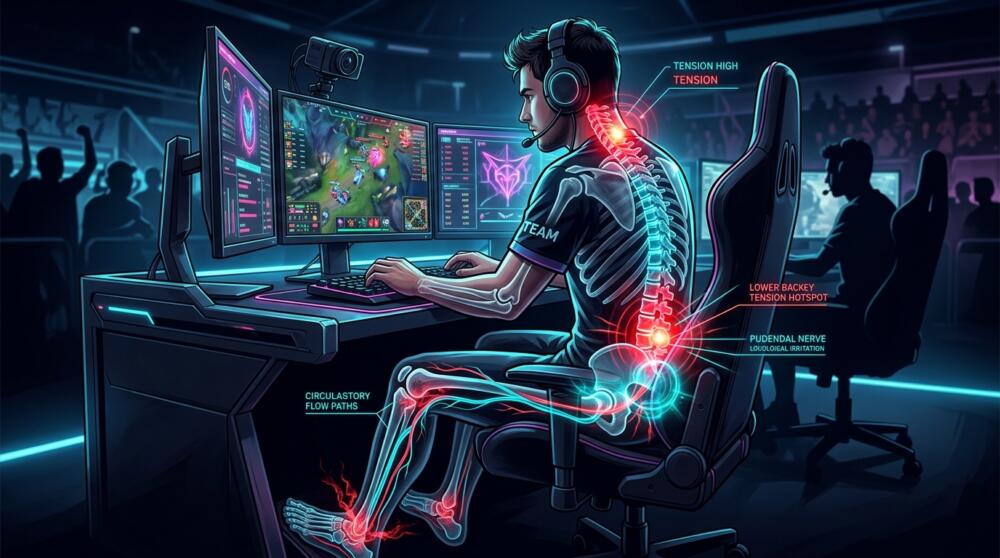
The first structure to buckle under thousands of gaming hours is the spine. When a competitive player or coder sets up at their battle station, they almost invariably slump into a forward lean: chin jutting out and shoulders rolled inward.
In orthopedics, this postural collapse is known as Tech Neck (or text-neck syndrome). According to clinical research published in the Journal of Biomechanics (NCBI), the human head weighs approximately 11 pounds (5 kg) in a neutral upright position.
When tilted forward at 45 degrees to lock onto a crosshair or inspect lines of code, the sustained load on the cervical vertebrae (C5-C7) surges to nearly 50 pounds (22 kg) of constant mechanical tension.
In the lower back, prolonged sitting flattens your natural lumbar lordosis (the inward curve of the lower spine). The pelvis rolls backward, dumping the entire weight of your upper torso directly onto the L4-L5 and L5-S1 intervertebral discs.
Intradiscal pressure spikes by 40% to 90% in a slouched seated posture compared to standing. After years of marathon gaming without posterior chain conditioning, discs dehydrate, compress, and herniate: opening the floodgates to premature disc bulges and debilitating chronic sciatica that can numb your leg mid-match.
🚨 Anatomy of Damage: 4 Critical Zones in Gamers & Desk Workers
1. Cervical Spine & Neck
"Tech Neck" Syndrome
Up to 50 lbs (22 kg) of mechanical tension on C5-C7 vertebrae, triggering tension headaches and occipital neuralgia.
2. Lumbar Region
L4-L5 Disc Degeneration
Intradiscal pressure jumps by 90%, triggering herniated discs, nerve pinches, and severe sciatica.
3. Perineal Zone
Pudendal Nerve Entrapment
Compression of the internal pudendal artery and nerve, causing pelvic numbness and reduced genital sensation.
4. Circulation & Legs
Venous Stasis & eThrombosis
Venous blood return drops by 70%, heightening the risk of deep vein thrombosis and pulmonary embolism.
Source: pro-gamer.gg, Esports Medicine & Virtual Athlete Health
The Taboo Subject: Pudendal Nerve Entrapment and Genital Numbness in Men
This is the most overlooked and alarming complication documented in men logging years of desk-bound gaming: pudendal neuralgia and impaired pelvic blood flow. When sitting for hours on poor cushioning or unsupportive bucket seats, body weight crushes Alcock's canal, a narrow anatomical corridor shielding the pudendal nerve and internal pudendal artery.
Recent clinical literature indexed across urology journals at the National Library of Medicine demonstrates that sustained pressure exceeding four continuous hours restricts arterial perfusion to erectile tissues and compresses the perineal nerve branch. Symptoms begin with minor tingling, often dismissed as "dead butt syndrome," but can progress to persistent genital numbness and chronic pelvic pain.
For veteran gamers or 30-something desk workers who have logged 10 to 15 years without ergonomic intervention, nerve entrapment syndromes often require months of targeted pelvic floor physical therapy to reverse.
Blood Circulation in the Legs: The Hidden Threat of eThrombosis and Venous Stasis
The lower limbs face their own silent assault. In a standard seated position, knees bent at 90 degrees and the underside of the thighs compressed against the edge of the seat pan create a literal bottleneck for venous blood return.
The calf muscle pump, which normally propels deoxygenated blood back toward the heart, is completely inactive.
In modern cardiovascular medicine, the term eThrombosis (deep vein thrombosis linked to prolonged desk or screen work) is a recognized clinical hazard. A landmark study published in The Lancet revealed that remaining immobile at a desk for more than three consecutive hours increases the risk of a venous blood clot (thrombus) by nine-fold.
If a clot dislodges and migrates toward the lungs, it can trigger a life-threatening pulmonary embolism. On a daily level, poor venous return causes chronic heavy legs, localized swelling, and systemic muscular fatigue.
How to Shield Your Body: The Mandatory Prevention Protocol
Does this mean you need to give up gaming or quit your computer job? Absolutely not.
Just as elite athletes manage recovery protocols, competitive gamers and desk professionals must implement strict routines to neutralize these biomechanical risks:
- The 60-Minute Rule: Stand up every hour without fail for 3 to 5 minutes. Active walking immediately restarts the calf muscle pump and restores arterial blood flow through the pudendal pathway.
- Ergonomic Chair Adjustments: Tilt your seat pan slightly forward to encourage natural lumbar lordosis. The front edge of the seat pan must NEVER press hard against the underside of your knees (maintain a two-finger gap between the seat cushion and the back of your knees).
- Hydration Discipline: Drink at least 2 liters of water daily to maintain blood volume and reduce the plasma viscosity that encourages clot formation. (And no, two liters of cold brew or energy drinks do not count: their diuretic action flushes electrolytes rather than hydrating deep tissue). For deeper protocols, consult our guide on pro gamer nutrition and hydration.
- Joint & Nerve Preservation: In the same way you protect your hands against carpal tunnel syndrome and tendonitis, safeguarding your back and cardiovascular system is the ultimate longevity investment for competitive gaming.
Take care of your anatomy: being cracked at 20 is great, but staying at the top of your game for decades is true mastery.

SEO consultant for over 20 years and digital entrepreneur, Charles 'Grimtag' Ronchain is the founder of Pro-Gamer.gg, Retrocharting.com, and Gamescharting.com. A competitive gamer, streamer, and retro game collector, he has worked in the video game industry for over 15 years, notably as a consultant for leading game price comparison platforms. Passionate about real-time performance data and gaming technology, he analyzes competitive esports, gaming hardware benchmarks, and creator workflows on Pro-Gamer.gg with an authentic player perspective.